




Statement 4: Assessing the Sustainability
of the Budget
Strengthening the financial system
Given that the underlying cause of the global recession is a global financial crisis, it has been necessary in the current environment to support the financial system. While the financial crisis is centred in credit markets in the United States, the United Kingdom and Europe, there have been significant spill‑over effects to the rest of the world.
While Australia is not immune from these impacts, its financial system remains sound. Australian banks have some of the highest credit ratings in the world — 4 of the world's 10 highest‑rated large banks are Australian (Chart 3) — and Australia has not had to 'bail out' any financial institutions.
The Government, in conjunction with the regulators, has taken pre‑emptive action to strengthen the resilience of Australia's financial sector. This has included moving quickly to protect the financial system from the wholesale funding disadvantage that may have resulted from the policy interventions of other countries. These actions also support the effectiveness of fiscal stimulus measures in the current environment.
Chart 3: World's largest banks by credit rating
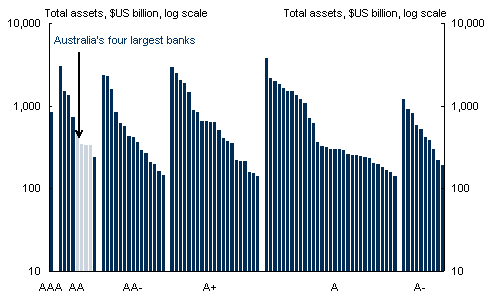
Note: Data refer to bank ratings as at 20 April 2009 and assets as at late 2007 (latest available data).
Source: Bloomberg and The Banker.
The Government and regulators have enhanced liquidity arrangements, increased prudential oversight, introduced bank guarantees for large deposits and wholesale funding, and introduced the financial claims scheme to give effect to the Government's guarantee of deposits under $1 million. Other actions include the Government's investment in residential mortgage‑backed securities and the provision of particular financing vehicles for viable businesses where financiers have withdrawn from debt financing arrangements as a result of the global financial crisis. The Government is also supporting state government access to funding through a guarantee of state and territory government borrowing.
In addition, Australia is actively engaged in international efforts to address the global financial crisis. The global integration of financial markets makes it important for Australia to work with the G‑20, IMF and Financial Stability Board to address the systemic problems currently confronting the global financial system.
Not all of the measures implemented to support the financial system have a direct negative impact on the budget balance. In particular, the guarantees for large deposits and wholesale funding and the guarantee of state and territory government borrowing are contingent liabilities. Contingent liabilities are liabilities that depend on the occurrence of some uncertain future event.
The Government is taking on these contingent liabilities because of extraordinary circumstances and is charging a fee for the guarantees. The fee is designed such that it will no longer be in the interests of financial institutions and state and territory governments to use the guarantees when financial market conditions return to normal.
Under these contingent liabilities, Government expenditure would only arise if an institution fails to meet its obligations with respect to a guaranteed commitment. Given that Australia's banks, and the Australian financial system, are among the strongest in the world, the risk of these contingent liabilities being realised is remote.
If www.budget.gov.au responds slowly or you are having trouble downloading a document, try one of the Budget Website Mirrors
Note: Where possible, Budget documents are available in HTML and for downloading in Portable Document Format(PDF). If you require further information on any of the tables or charts on this website, please contact The Treasury.