




Statement 5: Revenue
Variations in the revenue estimates since the 2008‑09 Budget
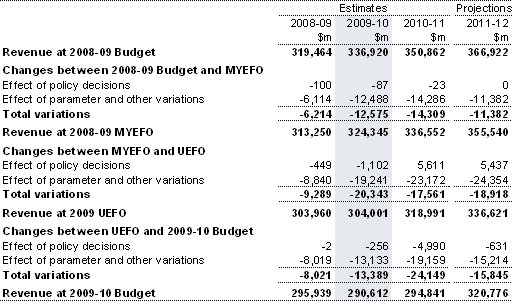
Table 2 reconciles this budget's revenue estimates with those at the 2008‑09 Budget, 2008‑09 MYEFO and the UEFO.
Table 2: Reconciliation of Australian Government general government revenue
estimates from the 2008‑09 Budget
Variations to total revenue in the estimates years
Since UEFO, estimated total revenue for 2008‑09 has been revised down by $8.0 billion, almost entirely because of parameter and other variations to taxation revenue.
Individuals' and companies income taxes and GST account for most of the revisions, reflecting lower than anticipated growth in wages in the March and June quarters and the current weakness in the economy flowing through to lower company profits and consumption.
Non‑taxation revenue has been revised up by $1.0 billion in 2008‑09.
Total revenue for 2009‑10 has been revised down by $13.4 billion since the UEFO.
Policy decisions taken since the UEFO contribute $256 million to the overall revision in 2009‑10.
Revenue parameter and other variations have contributed $13.1 billion to the revision. Most taxes are expected to fall sharply in 2009‑10 with the economic contraction. Growth in individuals' incomes is expected to be weaker given the more moderate wage growth and expected falls in employment and unincorporated business and property income. Company profits are forecast to fall dramatically, reflecting the continuing weakness in the domestic economy. Lower forecasts for consumption and dwelling investment have significantly reduced the forecast for GST and other consumption tax revenues.
Non‑taxation revenue has been revised up by around $1.4 billion in 2009‑10 mainly reflecting fee revenue from the Guarantee Scheme for Large Deposits and Wholesale Funding.
Total revenue for 2010‑11 has been revised down by $24.1 billion since the UEFO, with policy decisions contributing $5.0 billion and parameter and other variations contributing $19.2 billion. The sharp falls in taxation revenue expected for 2010‑11 are broad‑based and follow on from the effect of the contraction in the economy in 2009‑10.
Effect of policy decisions
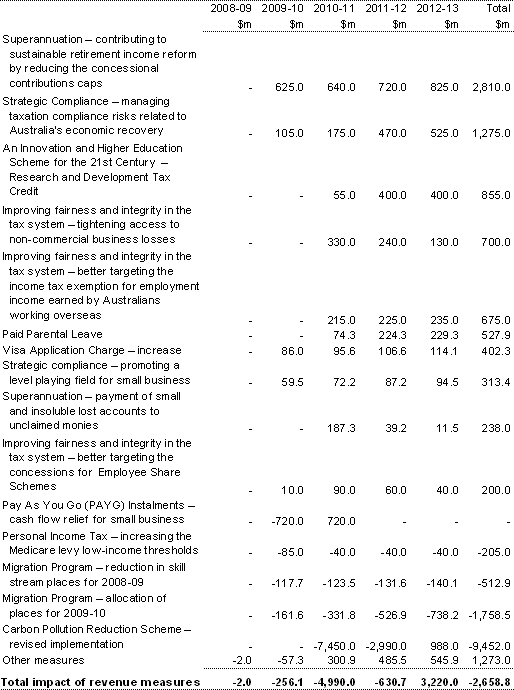
Policy decisions since the 2009 UEFO are expected to decrease revenue by $256 million in 2009‑10. In 2010‑11 and 2011‑12, policy decisions detract a further $5.6 billion from revenues, before increasing revenues by $3.2 billion in 2012‑13. These fluctuations in the impact of policy decisions are mainly due to the change in the timing of the introduction of the Carbon Pollution Reduction Scheme (CPRS). Abstracting from the impact of the change in timing of the CPRS introduction, policy decisions increase revenue in each year from 2010‑11.
The major policy decisions in the budget are targeted at improving the efficiency, fairness and integrity of the taxation system. The Government has reviewed the operation of programs delivered through the tax system to ensure that tax expenditures are cost effective, and has looked at areas where tax system integrity can be enhanced to ensure taxpayers pay the appropriate level of tax. The revenue from these changes makes a significant contribution to budget sustainability in the medium term.
Major policy decisions in the Budget include:
- Reducing the concessional contributions caps for superannuation. This will generate additional revenue of $2.8 billion over the forward estimates.
- Providing additional funding to the Australian Taxation Office to address known risks in the taxation system that could further erode Australia's revenue base and to address risks that will emerge as Australia's economy recovers from the economic downturn and returns to growth. This will generate additional revenue of $1.3 billion over the forward estimates.
- The replacement of the existing research and development (R&D) tax concessions with a new R&D tax credit. This will generate additional revenue of $855 million over the forward estimates, as part of a package that is broadly budget neutral in the medium term.
- Tightening the non‑commercial losses rules to prevent high‑income individuals (those who earn $250,000 or more) from deducting losses from activities that are unlikely to make a profit, and which are often more like hobbies or lifestyle choices, against their salary, wage and other income. This will generate additional revenue of $700 million over the forward estimates.
- Limiting the scope of the tax exemption for the foreign employment income of Australians who work overseas for periods of 91 days or more so that this exemption only applies to aid workers (both government and non‑government organisations), charitable workers, certain government employees (such as defence and police force personnel deployed overseas), and those employed on overseas projects approved by the Minister for Trade as being in the national interest. This will generate additional revenue of $675 million over the forward estimates.
- Better targeting the concessions for employee share schemes. This will generate additional revenue of $200 million over the forward estimates.
- Reducing the GDP adjustment for Pay As You Go (PAYG) instalments for the 2009‑10 year will reduce revenue in 2009‑10 by $720 million, with this reduction recouped mainly through reduced tax refunds in 2010‑11. This has no net impact on revenue over the forward estimates period.
- Increasing the Medicare levy low income thresholds to take account of changes in the consumer price index. This will reduce revenue by $205 million over the forward estimates period.
Table 3: Revenue policy decisions since the 2009 UEFO
Effect of parameter and other variations
In addition to new policy decisions, revisions to expected revenue are driven by recent economic outcomes and tax collections, and the updated economic outlook. The revenue variations discussed in this section stem from those parameter and other variations. That is, they explicitly exclude the impact of new policy decisions on revenue.
The revenue forecasts are based on the economic outlook presented in Statement 2, with changes in nominal incomes and spending having consequent impacts on expected taxation revenue. The key economic parameters that influence revenue are shown in Table 4.
Two substantive changes have been made to the forward estimates methodology in this Budget. The forecast period has been extended by one year to 2010‑11, and GDP is expected to grow above (rather than at) trend in the projection years. This changed methodology is explained in Statement 2.
Analysis of the sensitivity of the taxation revenue estimates to changes in the economic outlook is provided in Statement 3.
Table 4: Key revenue parameters(a)
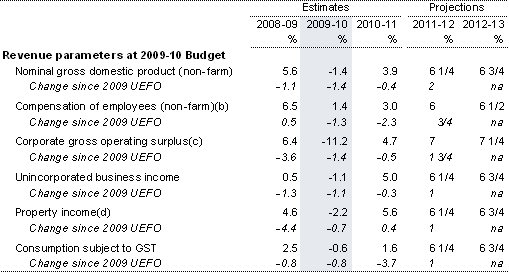
- Current prices, per cent change on previous year.
- Compensation of employees measures total remuneration earned by employees.
- Corporate GOS is an Australian National Accounts measure of company profits.
- Property income measures income derived from rent, dividends and interest.
na Data not available.
As a result of the deterioration in the Australian economic outlook, parameter and other variations have reduced revenue by $8.0 billion in 2008‑09 and $13.1 billion in 2009‑10 since UEFO.
Gross income tax withholding revenue is expected to be $2.9 billion lower than the estimate at UEFO in 2008‑09 and $6.0 billion lower in 2009‑10, primarily due to slower than expected wage growth in the March and June quarters of 2009 and stronger forecast contraction in employment in 2009‑10.
Property income and unincorporated business income, the principal components of individuals' earnings outside of wages and salaries, and CGT have been revised down since UEFO for 2009‑10. This contributes to a $0.5 billion decrease in forecast gross other individuals' income tax in 2009‑10.
Superannuation funds tax revenue is expected to be $270 million lower than forecast at UEFO in 2008‑09 owing to refunds being claimed for losses on foreign exchange hedge transactions. With some superannuation funds appearing to have not yet claimed refunds related to lower expected 2008‑09 income, 2009‑10 revenue is expected to be $610 million weaker relative to UEFO.
Hedge transactions are only half of an overall transaction involving foreign currency denominated assets. The other half of the transaction will have offsetting gains that will eventually add to superannuation fund tax revenues, but the timing of these is highly uncertain.
Company tax revenue in 2008‑09 is forecast to be $3.3 billion lower than the UEFO estimate, reflecting a weaker forecast of corporate profits and weaker than expected tax collections in the first part of 2009. Company tax revenue in 2009‑10 has been revised down by $2.8 billion since UEFO, with the forecast weaker economy leading to a sharper contraction in corporate profits.
CGT, which is a component of individuals, companies and superannuation funds income taxes, is relatively unchanged from UEFO in 2008‑09. In 2009‑10, CGT is forecast to increase by $540 million compared with the UEFO estimate, on the back of a recent improvement in the share market.
GST revenue has been revised down by $1.2 billion in 2008‑09 and $2.2 billion in 2009‑10, primarily reflecting lower forecast growth in consumption subject to GST, dwelling investment and ownership transfer costs. The weakness in taxable consumption also reflects a shift in consumer spending away from discretionary purchases, which are generally taxable, towards more essential goods that have large non‑taxable components (for example rent and fresh food) (Box 3).
Luxury car tax revenue has been revised down by $60 million in 2008‑09 and $80 million in 2009‑10, reflecting the impact of the downturn on demand for new motor vehicles.
Excise duty revenue has been revised up in 2008‑09 by $160 million, following stronger than expected growth in the production of unleaded petrol, blended fuels, crude oil and tobacco. These increases are partly offset by lower demand for diesel flowing from weakness in the mining and manufacturing sectors, which are significant consumers of diesel fuel.
Aggregate production of fuels (especially diesel) is now expected to fall in 2009‑10 as the economic downturn produces a greater reduction in demand, leading to a downward revision to excises of $1.1 billion in that year.
Customs duty revenue estimates have remained largely unchanged in 2008‑09, with lower demand for imported passenger motor vehicles and general imports, offset by higher demand in the textiles, clothing and footwear, and spirits categories. However, for 2009‑10, customs duty revenue has been revised down by about $230 million, reflecting expected lower demand for cars and imports generally due to the contraction in aggregate demand.
Forecast non‑tax revenue has been revised up since UEFO by $1.0 billion in 2008‑09 and $1.4 billion in 2009‑10. In 2009‑10, the increase mainly reflects fee revenue from the Guarantee Scheme for Large Deposits and Wholesale Funding being revised upwards by $0.9 billion as a result of higher than anticipated growth in guaranteed liabilities over recent months.
If www.budget.gov.au responds slowly or you are having trouble downloading a document, try one of the Budget Website Mirrors
Note: Where possible, Budget documents are available in HTML and for downloading in Portable Document Format(PDF). If you require further information on any of the tables or charts on this website, please contact The Treasury.