Most challenging global economic conditions since the Great Depression



Distressed financial markets
Global financial market stress intensified rapidly in September 2008 to levels unseen since the early 1930s.
Global equity prices are still a fraction of their pre-crisis levels, while indicators of stress in money and credit markets remain elevated.
Credit-related losses since the start of 2007 already total more than US$1.3 trillion and, according to IMF estimates, could ultimately reach around US$4.1 trillion.
This will place further pressure on bank balance sheets and suggests that a return to normal conditions may still be some time away.
Synchronised fall in activity
As the crisis took hold, industrial production plummeted globally, and exports collapsed.
Household spending also fell as confidence slumped to record lows in many countries.
In the major economies, GDP outcomes were worse than already pessimistic expectations.
With an estimated annualised contraction of 6¼ per cent, the global economy experienced the sharpest and most synchronised downturn on record in the December quarter of 2008.
Virtually every advanced economy is expected to be in recession in 2009.
World trade is set to record the sharpest fall since World War II.
Labour markets are deteriorating rapidly, with millions joining the jobless queues globally.
The speed and severity of the unfolding events has resulted in steep downward revisions to 2009 global growth forecasts.
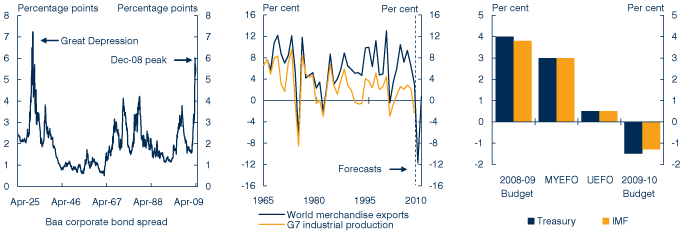
Acute financial market strains
Collapsing trade and industrial production
Sharp revisions of global GDP forecasts