




Statement 1:
Budget Overview
(Continued)
Economic outlook
2009 was a year of unprecedented turbulence in the global economy. Global GDP contracted, driven by the largest contractions in the US, Japan and many other advanced economies since the Second World War. Unemployment rose sharply across the advanced economies, peaking in the double digits in the US and Europe.
While the global economy is growing faster than anticipated, the recovery is patchy and a number of risks remain. A resurgence in the developing Asian economies is leading the way, with a more modest recovery underway in the advanced economies.
China and India continued to grow robustly through 2009. China's significant policy stimulus provided strong momentum to the economy in the face of collapsing demand from the advanced economies. Strength in demand from China and India has supported a recovery in other Asian economies.
A prolonged period of financial sector balance sheet repair and fiscal consolidation will place a drag on recovery in the other advanced economies. Some smaller advanced economies in the euro area have encountered serious problems in managing large fiscal deficits, with the problems in Greece particularly acute. Concerns about fiscal sustainability have the potential to spill over from the EU periphery to other highly indebted countries and to financial markets more broadly. While these developments are a risk to the outlook for the global economy, overall financial conditions have improved, and with the signs of economic recovery broadening, solid world GDP growth of 4¼ per cent is expected in 2010.
The strong pull of global forces caused the Australian economy to slow over the past year and saw a modest rise in the unemployment rate. It also caused incomes growth to fall as lower commodity prices and generally weaker profitability flowed through the economy. Still, the Australian downturn was remarkably shallow, both by international standards and relative to the expectations of most economic commentators a year ago, and a solid recovery is underway.
Australia's relatively mild downturn and rapid recovery reflect a range of factors, including the success of both fiscal and monetary policy stimulus which was delivered rapidly and had immediate effect. In the absence of fiscal stimulus, it is estimated that the Australian economy would have contracted by 0.7 per cent in 2009, rather than growing by 1.4 per cent. As stimulus is being phased out as planned through 2010, a recovery in private sector activity is taking hold. The withdrawal of stimulus is estimated to subtract around 1 percentage point from GDP growth over 2010.
Real GDP is expected to grow strongly over the next two years, by 3¼ per cent in 2010‑11 and 4 per cent in 2011‑12. The unemployment rate is expected to fall from its current level of 5.3 per cent, down to 5 per cent in late 2010‑11, and 4¾ per cent in late 2011‑12, around levels consistent with full employment.
The global recovery is putting upward pressure on prices for Australia's key commodity exports, which is expected to cause a substantial rise in the terms of trade in 2010. This in turn will support a recovery in incomes across the economy. The terms of trade are expected to rebound by around 25 per cent by mid‑2010 — injecting $30 billion into the economy. This injection of incomes will help reinvigorate the mining sector and economic activity more generally.
Engineering construction investment is expected to increase by around 50 per cent over the forecast period as large resource projects come on line. The recovery in other industries, such as non‑residential building, is expected to be more subdued.
The economy's solid performance through the global financial crisis has meant that we have avoided the erosion of the skills base and the loss of business capital that have occurred in other countries and in previous downturns. As a result, Australian firms and workers are in good shape to meet a recovery in demand. Inflation has also moderated and is expected to remain moderate over the forecast horizon.
The 2010‑11 Budget continues to build the economy's capacity to take advantage of the opportunities of a resurgent Asia. Expanding capacity to ensure sustainable growth and the maintenance of moderate inflation outcomes will be a key challenge as the Australian economy enters this next phase.
The major economic parameters used in preparing the Budget are contained in Table 1.
Table 1: Major economic parameters(a)
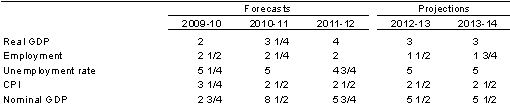
- Real and nominal GDP parameters are year average. CPI and employment are through‑the‑year growth to the June quarter. The unemployment rate is the rate in the June quarter.
If www.budget.gov.au responds slowly or you are having trouble downloading a document, try one of the Budget Website Mirrors
Note: Where possible, Budget documents are available in HTML and for downloading in Portable Document Format(PDF). If you require further information on any of the tables or charts on this website, please contact The Treasury.