




Statement 1:
Budget Overview
(Continued)
Delivering on the fiscal strategy
The budget is projected to return to a small surplus in 2012‑13, before any major advanced economy and three years ahead of schedule (Chart 1).
This represents the fastest fiscal consolidation in Australia since at least the 1960s, and has been achieved without increasing tax as a share of GDP above 2007‑08 levels.
Chart 1: Budget balances of Australia and the G7, 2009‑2015
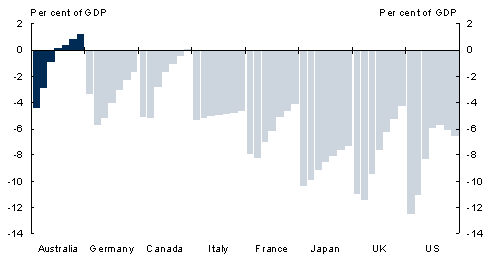
Note: Australian data are for the Australian Government general government sector underlying cash balance and refer to financial years beginning 2009‑10. Data for all other economies are total Government net lending and refer to calendar years.
Source: IMF World Economic Outlook April 2010 and Treasury.
A key to delivering disciplined fiscal policy has been the Government's adherence to a strict medium‑term fiscal strategy, with the following components:
- achieve budget surpluses, on average, over the medium term;
- keep taxation as a share of GDP, on average, below the level for 2007‑08; and
- improve the Government's net financial worth over the medium term.
In the February 2009 Updated Economic and Fiscal Outlook, the Government presented a strategy to support the economy during the economic downturn and to return the budget to surplus as the economy recovers, which this Budget delivers.
Supporting the economy during the global recession
The first stage of this strategy required the Government to support the economy during the economic downturn by:
- allowing the variations in revenue and expenditure, which are naturally associated with slower economic growth, to drive a temporary underlying cash budget deficit; and
- using additional spending to deliver timely, targeted and temporary stimulus, with the clear objective of other budget priorities and new policy proposals being met through a reprioritisation of existing expenditure.
The 2009‑10 Budget delivered on this strategy in full.
The budget moved into deficit as the impact of slower economic growth was felt on revenue. This provided a natural cushion to the economy against the effects of slower economic growth.
The Government delivered timely, targeted and temporary stimulus to the economy. Along with monetary stimulus from the Reserve Bank of Australia, this provided key support to economic growth at a critical time. Non‑stimulus policy measures were funded by reprioritising existing policies.
These measures supported growth in the Australian economy while other advanced economies contracted.
Deficit exit strategy
Now that the Australian economy is well on the path to recovery, the Government's focus is on returning the budget to surplus by:
- allowing the level of tax receipts to recover naturally as the economy improves, while maintaining the Government's commitment to keep taxation as a share of GDP below the 2007‑08 level on average; and
- holding real growth in spending to 2 per cent a year once the economy is growing above trend until the budget returns to surplus.
The 2010‑11 Budget continues to deliver on this strategy.
Real growth in payments has been kept below 2 per cent in years when the economy is expected to grow above trend. All new spending measures have been fully offset across the forward estimates. And the additional tax receipts associated with a strengthening economy have improved the budget position, while maintaining a tax‑to‑GDP ratio below 2007‑08 levels.
Once the budget returns to surplus, and while the economy is growing at or above trend, the Government will maintain expenditure restraint by retaining a 2 per cent annual cap on real spending growth, on average, until the budget surplus is at least 1 per cent of GDP.
If www.budget.gov.au responds slowly or you are having trouble downloading a document, try one of the Budget Website Mirrors
Note: Where possible, Budget documents are available in HTML and for downloading in Portable Document Format(PDF). If you require further information on any of the tables or charts on this website, please contact The Treasury.