




Statement 4:
Benefiting from our Mineral Resources:
Opportunities, Challenges and Policy Settings
(Continued)
Sound policy settings
Australia's institutional settings — which include a market‑determined exchange rate, medium‑term monetary and fiscal policy frameworks as well as a flexible labour market — have given the economy the flexibility needed to deal with different economic shocks and helped to largely avoid problems that arose in previous terms of trade booms (Gruen 2006). As commodity prices rose during the 2000s, these settings acted as a shock absorber, muting the expansionary effects of the terms of trade on the aggregate economy, allowing resources to reallocate, and moderating inflation pressures.
To take full advantage of the opportunities and meet the challenges of the improved terms of trade, we need to build on these strong policy foundations. Doing so will involve:
- undertaking tax reform to support productivity and allow other sectors of the economy to grow;
- applying an appropriate fiscal policy response to terms of trade shocks;
- better distributing the benefits of Australia's increased resource wealth over time by improving superannuation arrangements for individuals; and
- pursuing reforms more broadly and making productive investments, to encourage a diverse and skilled economy and expand economic capacity.
A tax system that encourages growth across the economy
As owners of natural resources on behalf of the community, Australian governments have a responsibility to ensure that the community shares in the benefits from the sale of Australia's non‑renewable resources. In Australia, governments have generally allowed private firms to extract non‑renewable resources in return for a charge that has not kept pace with the increased value of Australia's resource deposits. This has resulted in Australia forgoing some of its potential national income gain from the stronger terms of trade.
The current charging arrangements also distort investment and production decisions, further lowering the community's return from its resources. Analysis commissioned by the Australia's Future Tax System review found the most inefficient taxes levied in Australia include mining royalties and crude oil excise; a number of state taxes including insurance taxes, payroll tax and stamp duties; and company income tax (Chart 14).
Chart 14: Marginal welfare loss from a small increase in selected taxes(a)
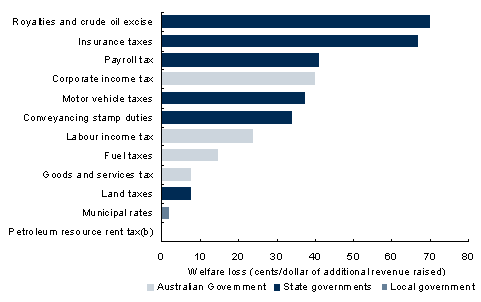
- The welfare loss from varying each tax has been assessed using the KPMG Econtech MM900 general equilibrium model of the Australian economy. The welfare loss is the loss in consumer welfare per dollar of revenue raised for a small (5 per cent) increase in each tax, simulated individually. It is measured as the amount of lump sum compensation required to restore the representative consumer's level of satisfaction (utility) to its original level, after returning the revenue raised by the tax to the consumer as a lump sum transfer. The extent of such compensation reflects the distorting effect of the tax on the economy.
- The petroleum resource rent tax is modelled as a pure rent tax giving rise to a zero welfare loss. In practice, a small increase in this tax could be expected to induce some welfare loss because it is not a pure resource rent tax with full loss offset. However, it would be expected to rank as one of the most efficient taxes in the chart.
Source: KPMG Econtech, produced for the Review of Australia's Future Tax System.
An inefficient tax results in lower GDP because it induces people to change their work, investment or saving decisions. For example, every additional dollar of revenue raised from royalties is estimated to cost the community around 70 cents because miners reduce their investment and output.
Encouraging investment and jobs in the mining sector
The Government will reform the taxation of Australia's non‑renewable resources, with a uniform resource rent tax — the Resource Super Profits Tax (RSPT) — to apply to Australia's non‑renewable resources from 1 July 2012 (Commonwealth of Australia 2010b). The RSPT will be payable at a rate of 40 per cent on the realised value of all resource deposits, with the exception of projects within the scope of the Petroleum Resource Rent Tax, for which opt‑in arrangements will be developed in consultation with industry.
Under the RSPT, the States will be able to continue to levy royalties. However, the Australian Government will provide a refundable credit for state royalties paid. The credit will be available at least up to the amount of royalties imposed at the time of announcement, including scheduled increases. Refunding royalties will allow the States to continue to collect a stable stream of revenue from royalties, while removing the distorting effects they have on investment and production.
The RSPT only taxes economic rents, or 'super profits'. Super profits reflect the rents attributable to the mineral resource and other location‑specific rents, and also firm‑specific rents arising from firm attributes such as know‑how.
This is in stark contrast to the current royalty arrangements which deter investment and reduce jobs, as royalties apply no matter how profitable a project might be. Only projects generating high returns will pay more tax compared to current arrangements. However, new highly profitable projects will remain attractive to investors: the RSPT only takes 40 per cent of the super profits that would otherwise go to shareholders.
More marginal mines that currently pay royalties may not earn sufficient profits to be net payers of the resource rent tax, so they will have an incentive to expand. Marginal prospective mines will pay less under the RSPT than under royalties, and so a disincentive to invest in some new projects will also be removed.
As the RSPT is more responsive than royalties to changes in profitability it will also act in a counter‑cyclical fashion, collecting more revenue during booms and less when prices are subdued.
Exploration incentives, as influenced by company income tax arrangements, will also be improved through a new Resource Exploration Rebate. The rebate will provide significant cash flow benefits to small, pre‑profit exploration companies. Currently, these smaller companies face a competitive disadvantage because they have little taxable income against which to deduct their exploration expenditure.
Notwithstanding the greater expected net revenues, Australia will remain an attractive place for mining projects, given the economically efficient design of the RSPT, the exploration rebate, Australia's stock of mineral resources and Australia's stable business environment for long‑term investment.
In the long term, the reforms to resource taxation will lead to more investment and jobs in the resource sector. According to independent modelling by KPMG Econtech, commissioned by the Australian Treasury, the reforms to the taxation of Australia's non‑renewable resources are estimated to result in around a 4.5 per cent increase in investment, a 7 per cent increase in employment and a 5.5 per cent increase in output in the resource sector in the long run. Overall, KPMG Econtech projected that resource taxation reforms could lead to an increase in GDP of around 0.3 per cent in the long run.3
It should be noted that the modelled analysis is sensitive to the assumptions used, particularly the degree of capital mobility. However, differing assumptions would only affect the size of the efficiency gains and not their direction. In the long run, the assumption of perfect capital mobility is likely to hold as used in the KPMG Econtech modelling.
Allowing other sectors to grow — a lower company income tax rate
The Australia's Future Tax System review outlined how the structure of the tax system can affect economic growth (Australia's Future Tax System 2009). Recent work undertaken for the OECD shows that in terms of the major tax bases, company income tax has the largest adverse effect on economic growth, followed by personal income taxes, consumption taxes and land tax (Johanssen et al. 2009). Taxes which are less efficient at raising revenue are levied on bases which can move or change to escape the tax.
Consequently, the Australia's Future Tax System review recommended having a lighter tax burden on more mobile bases, such as investment — particularly in the context of continued globalisation — and taxing less mobile bases (such as resource rents) more heavily.
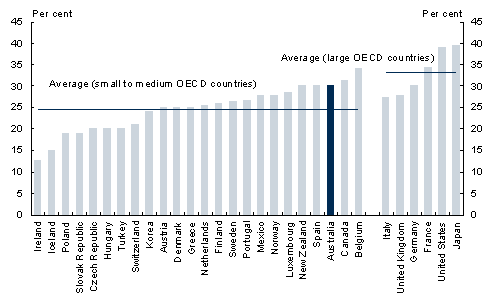
Australia's company income tax rate is high compared to other OECD countries of similar size. In 2009, Australia's 30 per cent company income tax rate was around 5 percentage points higher than the average for small‑ to medium‑size OECD economies (Chart 15). In our region, economies such as Hong Kong, Singapore, Taiwan and Vietnam have much lower rates of company income tax.
The Government will use part of the revenue from the RSPT to fund a cut in the company income tax rate to 28 per cent. A lower company income tax rate will improve incentives to invest in Australia, boosting the capital stock available for Australians to work with. Greater capital intensity will lead to higher labour productivity and therefore higher real wages for Australian workers, ensuring the benefits of a strong economy are widespread.
Cutting the company income tax rate will also help sectors other than mining to attract investment and grow.
Chart 15: Statutory corporate tax rates, OECD countries 2009
Source: OECD Tax Database.
In the KPMG Econtech modelling, the potential long‑run gain to total output from reforms to resource taxation and reducing the company income tax rate to 28 per cent is projected to be around 0.7 per cent. Real household consumption is projected to be 0.4 per cent higher. The modelling also estimates that real wages would be around 1.1 per cent higher than otherwise in the long run.
The most important driver of the long‑run increase in GDP and real wages is the increase in the capital stock, as a result of increased investment, improved resource allocation and the associated increase in labour productivity and labour demand. For example, total investment is projected to be around 2.1 per cent higher in the long run.
Fiscal policy responses to terms of trade shocks
The appropriate fiscal policy response to a rise in the terms of trade depends on its expected duration. Although it is difficult to distinguish between commodity price cycles that are permanent (or relatively long‑lasting) and those which are temporary, there are a number of principles which can help shape fiscal policy under both circumstances.
Should a rise in the terms of trade be temporary, those parts of revenue and government expenditures that move with the economic cycle (the automatic stabilisers) should be allowed to operate freely — generating a budget surplus (IMF 2006b). Increased expenditures should be avoided, as these may risk a structural deterioration in the fiscal position.
The short‑ to medium‑term accumulation of surpluses will help provide the necessary fiscal space to run deficits during periods of below‑trend growth, and is consistent with the principles of fiscal sustainability. This would also see fiscal policy exerting a restraining influence on economic activity, thereby supporting monetary policy.
While there is unavoidable uncertainty about how mineral prices will evolve, it is likely that a substantial part of this increase in income flowing from the terms of trade will be sustained for a relatively long time. The accumulation of surpluses under this scenario is likely to be more prolonged — implying a structural improvement in the fiscal position over the medium to longer term.
In addition to managing the challenges presented by our strong terms of trade, enhancing economic growth is a longer term objective of fiscal policy. In the medium to longer term, the Government's fiscal policy will help ensure that resources are allocated to their most productive uses, and will provide the ability to invest in welfare‑enhancing drivers of productivity and growth.
Saving the benefits of improved resource revenues for the future
A structurally higher fiscal position can present its own challenges. Persistent budget surpluses can make the task of maintaining fiscal discipline and directing revenue to uses that are of lasting benefit more difficult (OECD 2008). Debates for managing natural resource wealth often suggest that commodity tax revenues be invested in a sovereign wealth fund which, among other things, aims to distribute the benefits of resource endowments over a long period of time.
The Government's decision to fund changes to superannuation out of RSPT receipts shares similar goals with many sovereign wealth funds around the world — namely to invest the benefits of our resources over a long period. These changes provide an additional superannuation contribution of up to $500 per year for low‑income earners, provide higher superannuation contribution caps for those nearing retirement, and raise the superannuation guarantee age limit. These measures have been complemented by the increase in the superannuation guarantee to 12 per cent by 2019‑20.
These reforms will increase private and national saving and help to ensure that the wealth from the community's resources is invested over a long period of time — rather than being consumed immediately — providing an enduring benefit from better charging for mineral resource access.
Improving skills and infrastructure
Flexible labour markets and investing in skills
With growth in labour demand likely to be much stronger in some industry sectors and regions than in others, a flexible labour market is critical to ensuring broad wages growth reflects productivity improvements, thereby containing inflationary pressures during periods of high capacity utilisation. Current enterprise‑focused wage setting arrangements limit the scope for higher wages in one sector to spill over into other sectors when not supported by labour market conditions.
Reducing impediments to labour mobility, such as inconsistent skills recognition arrangements, will also limit any geographically driven wage and inflationary pressures.
To ensure that the benefits of a flexible labour market are realised, it is also important that education, training and immigration systems can respond to relative wage signals and the needs of employers. Flexible and responsive education and training systems allow educational institutions to alter the quantity and mix of education and training services provided, as both individual preferences and the needs of the economy change.
Due to the lead times associated with education and training, temporary migration also provides a means of responding to short‑term demands for skills in particular areas. In addition, to meet future skill needs as the economy strengthens the Government will recalibrate the general migration program by increasing skilled migration by an additional 5,750 program places in 2010‑11, to a total of 113,850 program places, with an offsetting reduction in family migration. Increasing skilled migration will enhance productivity, by providing additional skilled workers to the labour force, and increase participation, since skilled migrants typically have positive employment outcomes.
Higher level qualifications
One of the keys to raising Australia's future growth rate is increasing the education and skill level of the workforce. A more highly educated workforce is likely to be more productive and better able to adapt to changing circumstances. This requires not only increasing the number of people with higher level qualifications, but also ensuring that all Australians have strong foundation skills.
Two key measures supporting these objectives in the 2009‑10 Budget were the uncapping of the number of Commonwealth supported places and the increase to the Higher Education Indexation Factor.
These measures are complemented in the 2010‑11 Budget through the $661.2 million Skills for Sustainable Growth strategy. The strategy aims to boost the skills base of Australia's workforce and ensure that Australia's education and training systems are responsive to the skills needs of the economy.
Spending on education, which includes early childhood education, schools, vocational education and training, and higher education, is projected to be higher over the forward estimates — averaging around $26 billion per year (Chart 16). This is a substantial increase when compared with the average level of spending during the period of strong growth in Australia's terms of trade between 2002‑03 to 2007‑08.
Chart 16: Commonwealth spending on education
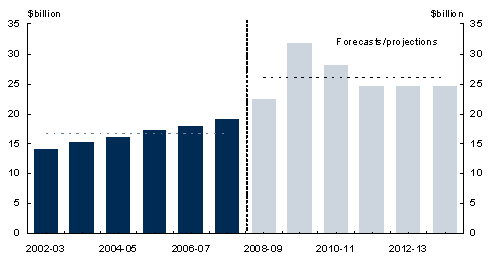
Note: 2009‑10 dollars. Education sub‑function totals, excluding income support payments. 2002‑03 to 2008‑09 actuals, 2009‑10 to 2011‑12 forecasts and 2012‑13 to 2013‑14 projections.
Source: Final Budget Outcome (various years), Statement 6 and Treasury.
Investing in infrastructure — a national approach
Investment in well‑planned infrastructure can provide for future generations. Investment in infrastructure projects and associated reforms in the operation of these capital assets are designed to enhance supply capacity — helping to manage medium‑term pressures arising from the growing economy.
The Australian Government will direct some of the proceeds from the RSPT to investment in nation building infrastructure. The Government will establish an infrastructure fund that will start at $700 million in 2012‑13 and grow to over $5.6 billion over the next decade. The 2010‑11 Budget invests a further $1 billion in the nation's transport infrastructure, building on the significant investment that the Government has already committed to roads, rail and ports.
Commonwealth spending on transport infrastructure (road and rail) is projected to be substantially higher over the forward estimates (Chart 17), averaging around $5 billion per year. In real terms, this represents expenditure on major transport infrastructure in the six years to 2013‑14, that is more than double the expenditure during the period of strong growth in Australia's terms of trade between 2002‑03 to 2007‑08.
Chart 17: Commonwealth spending on major transport infrastructure(a)
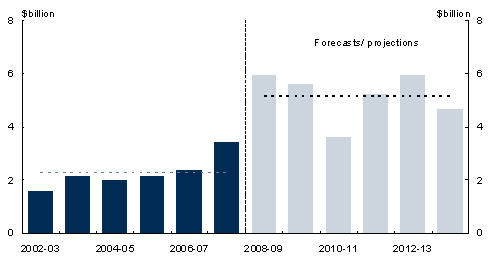
- Road and rail infrastructure.
Note: 2009‑10 dollars. 2002‑03 to 2008‑09 actuals, 2009‑10 to 2011‑12 forecasts and 2012‑13 to 2013‑14 projections.
Source: Statement 6 and Treasury.
The Government has previously established Infrastructure Australia to provide advice to governments, investors and owners of infrastructure, and to assist their decision‑making for Australia's current and future needs and priorities relating to nationally significant infrastructure. In doing so, the Government has sought to institute a national approach to assessing and meeting Australia's infrastructure needs and to ensure Australia gets the most out of its infrastructure.
This includes promoting the effective regulation and more efficient use of existing infrastructure, and more robust and transparent frameworks for new investment decisions. Infrastructure Australia has undertaken a national infrastructure audit, identified national infrastructure priorities and developed a priority list and pipeline of infrastructure projects.
Pursuing broader microeconomic reforms to improve productivity
History suggests that long‑term prosperity is driven by improvements in the efficiency with which the inputs to production are used, which is in turn facilitated by the drive for competitiveness. An increase in the terms of trade through higher commodity prices will boost national income, but this alone cannot be relied on to sustain prosperity into the future.
Productivity growth depends in part on maintaining the momentum of reform (OECD 2009). It is noteworthy that Australia's productivity performance slowed in the 2000s, with annual labour productivity growth on average only 1.4 per cent compared with 2.1 per cent during the 1990s. There were also signs that the pace of reform in Australia had fallen behind that of other countries (Box 4: Lost impetus in product market regulation reform, highlights one example).
A challenge for Australia is to create and maintain momentum for reform that generates stronger productivity growth, benefiting both those employed and the broader community by allowing demographic and associated challenges to be addressed in a fiscally responsible way.
Tax reform is an important part of the microeconomic reform agenda. The introduction of the RSPT, the reduction in the company income tax rate, and associated reforms will improve productivity — leading to a projected increase in real GDP of 0.7 per cent and in real wages of 1.1 per cent in the long run.
Another way this challenge is being addressed is through the Seamless National Economy reform agenda being implemented by the Council of Australian Governments (COAG). The reforms are intended to reduce inconsistent and unnecessary regulation and restrictions on competition across Commonwealth, State and Territory governments.
The Productivity Commission (2008) estimates that consumer policy reforms alone, could result in a net gain to the Australian community of between $1.5 billion and $4.5 billion a year. The reforms will also ensure that new regulations minimise compliance costs to business, which ultimately improves productivity and Australia's international competitiveness.
Box 4: Lost impetus in product market regulation reform
As a result of earlier reforms, by the end of the 1990s and into the early 2000s OECD indicators of product market regulation ranked Australia amongst the most open in the OECD. The OECD has found that opening Australia's product markets to increased international competition helped to drive productivity improvements that enabled Australia's living standards to catch up to the wealthiest OECD countries, with GDP per capita rising from 16th place in 1992 to 8th place in 2007 (OECD 2010b).
However, in the most recent OECD review, the Australian regulatory environment was found to have become less conducive to competition between 2003 and 2008, resulting in Australia moving from being ranked as a 'front runner' in the OECD to close to average in the latest rankings (Chart 18).
Chart 18: OECD integrated product market regulation indicator ranking
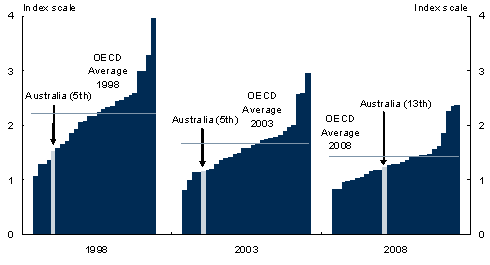
Note: indicator uses an index scale 0‑6 from least to most restrictive.
Source: OECD regulation database and Treasury.
According to the OECD, Australia has fallen back in the rankings due to the rate of reform, relative to comparator countries, having slowed in recent years. For Australia to return to higher productivity growth, the OECD (2010b) recommended that efforts be refocused on longstanding commitments to reform challenging aspects of the transport, energy, water and infrastructure sectors. Work for the OECD also suggests that countries such as Australia that have undertaken major reforms are increasingly left with areas of regulation that could be politically difficult to reform (Wolfl et al. 2009). The OECD (2010b) has acknowledged the actions the Australian Government is taking in response to the past rate of decline in the reform process, by commending the Government's commitment to a new reform agenda focused on productivity and regulatory reform. Much of this agenda is to be carried out within the context of COAG.
3 The Australian Treasury provided the Government's policy parameters for tax reform to KPMG Econtech which then independently modelled their economic effects. KPMG Econtech was not involved in policy development.
If www.budget.gov.au responds slowly or you are having trouble downloading a document, try one of the Budget Website Mirrors
Note: Where possible, Budget documents are available in HTML and for downloading in Portable Document Format(PDF). If you require further information on any of the tables or charts on this website, please contact The Treasury.