




Statement 5:
Revenue
(Continued)
Government revenue during the recovery
The unfolding global financial crisis and subsequent onset of global recession in the latter half of 2008 and into 2009 led to a sharp fall in Government receipts. Initially felt in Australia through sharp falls in both equity and commodity prices, its adverse impact on Australia's economy quickly affected a broad range of expenditure and income taxes.
As a consequence, by the time of the 2009‑10 Budget, total receipts for the five years from 2008‑09 to 2012‑13 had been revised down by around $210 billion since the 2008‑09 Budget. While all revenue heads were affected, around two‑thirds of the total downward revisions were in company and capital gains taxes (Box 1).
'Automatic stabiliser' features of the tax system were reflected in receipts being revised down by a larger proportion than GDP during the downturn. These features include the progressive nature of personal income tax, as well as company and capital gains tax whose bases — profits and asset prices respectively — fluctuate more than GDP over the economic cycle. At the 2009‑10 Budget, total nominal GDP in 2008‑09 and 2009‑10 was expected to decline from the 2008‑09 Budget forecasts by around 6 per cent, while tax receipts were expected to decline by around 12 per cent. This was a sharper and earlier fall in tax receipts than in earlier cycles — and reflected the view that changes to the tax system had, in effect, allowed for a closer alignment of the automatic stabilisers with the change in economic circumstances (see page 5‑13 of 2009‑10 Budget Paper Number 1).
Since the 2009‑10 Budget, the economic outlook has improved significantly. Assisted by the Government's fiscal stimulus measures, the Australian economy has emerged from the global recession‑induced downturn both faster and stronger than was originally expected. Company profitability has risen and labour market outcomes have been better than expected. Share prices have increased steadily since hitting lows in the March quarter of 2009. A sharp resurgence in commodity prices has seen short‑term prospects for stronger terms of trade and nominal GDP further enhanced.
Against such a marked improvement in the economic outlook, attention has focused on the extent and timing of the related recovery in taxation receipts and expectations of an early and strong surge in receipts. Such a recovery in taxation receipts is clearly in prospect, but has not been seen in revenue collections (excepting GST) in 2009‑10 to date.
This is not unexpected. It reflects the operation of several different factors, many of which were foreshadowed in the 2009‑10 Budget and the 2009‑10 MYEFO.
The most important of these are features of the company tax system that have the effect of lowering company tax payments in the early stages of any recovery. In the first instance, there will be delays between when the income is earned and tax paid. This effect can last for several years. In addition, the inherent lags in the company tax instalment system can generate lower collections for up to two years following a downturn (see Box 1 on page 51 of the 2009‑10 MYEFO). Finally, companies accumulate losses during downturns that can then be used to offset future tax liabilities when the economy recovers.
A further factor is capital gains tax collections. Despite recent rises, share prices remain well below levels seen prior to the global recession — as at the end of April, the ASX200 index was around 4,750, compared to its peak of around 6,800 during 2007. This is keeping capital gains tax collections relatively low.
Less predictable were developments in the labour market. While unemployment did not rise by as much as feared in 2009‑10, this was tempered by individuals' hours worked, on average, being less than anticipated (and hence, too, their average tax rates). As a result, tax withheld from wages did not improve as much as might have been expected from the lower unemployment outcomes.
Box 1: Evolution of revenue through the economic cycle
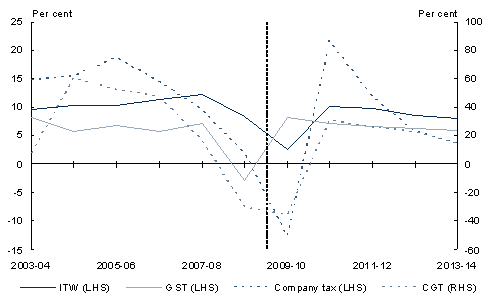
The recent economic downturn and recovery graphically illustrate how the tax system responds to economic fluctuations (Chart A).
Share price falls in late 2007 were reflected in revenues through tax returns lodged during 2008‑09. However, revenue from companies operating on a calendar year basis was affected by June 2008, decreasing growth in capital gains tax (CGT) in 2007‑08. The weakness in financial markets translated into a weaker economy, including weaker consumption, in 2008‑09 generating an unprecedented fall in GST — the second sign of the downturn through the tax system.
Businesses initially absorbed decreased turnover into their own profits, generating large falls in company tax, mainly in 2009‑10, owing to lags in the tax collection system. Finally, businesses began to shed labour through a combination of retrenchments and reductions in hours during 2009. The impacts were immediately seen in a slowdown in growth in payments of income tax withholding (ITW).
Chart A: Growth in receipts from selected heads of revenue and CGT
Source: Treasury estimates.
As the economy recovers, growth rates in these heads of revenue have also recovered or are expected to recover in the near future. Supported by stimulus measures, household consumption rebounded, hence GST growth has recovered. As the labour market continues to improve and the hours worked by individuals rise, ITW growth is expected to strengthen. Rising household wealth and improving business profitability will translate through to higher CGT and company taxes. However, lags in the tax system mean rebounds in these taxes are not expected until 2010‑11.
GST receipts fell sharply in the first half of the year (Box 2). However, with consumption initially buoyed by stimulus packages and the substantial monetary policy relaxation, GST receipts are now growing strongly, and current estimates have them growing at 7.9 per cent in 2009‑10.
As a result, our most recent estimates for total revenues in 2009‑10 remain broadly in line with expectations over most of the past year.
If www.budget.gov.au responds slowly or you are having trouble downloading a document, try one of the Budget Website Mirrors
Note: Where possible, Budget documents are available in HTML and for downloading in Portable Document Format(PDF). If you require further information on any of the tables or charts on this website, please contact The Treasury.