




Appendix
AusAID Country and Global Programs
Table 15: AusAID country programs
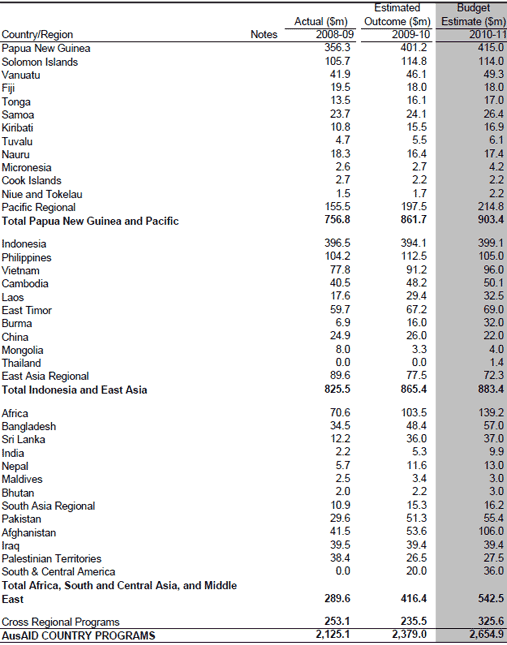
Notes: see page 73.
Table 16: AusAID global programs
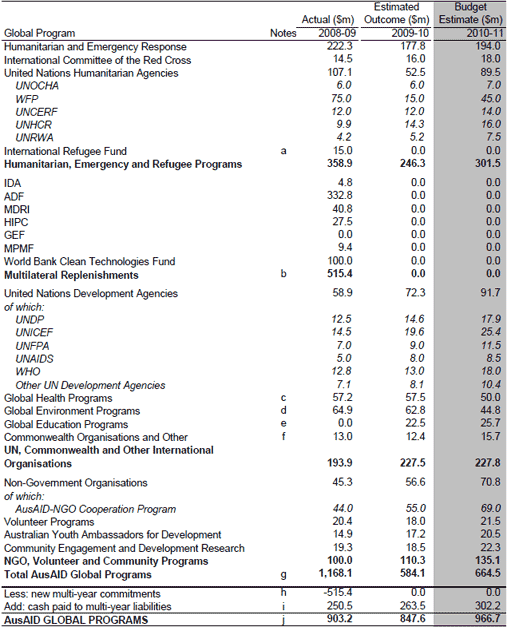
Notes: see page 74.
Total Australian Official Development Assistance
Table 17: Australia's ODA 1971-72 to 2010‑11
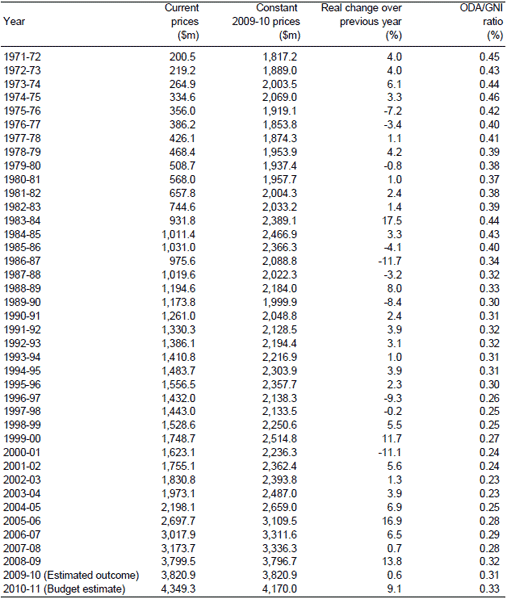
Notes: see page 74.
Notes
Figures in tables and generally in the text have been rounded. Totals and percentages are calculated on un-rounded totals. Any discrepancies between totals and sums of components in tables and generally in the text are due to rounding.
In this statement, 'real' means adjusted for the effect of inflation. Real changes are calculated using the non-farm Gross Domestic Product deflator.
All amounts are in Australian dollars (AUD) unless otherwise indicated. All estimates are exclusive of recoverable Goods and Services Tax (GST).
One billion is equal to one thousand million.
The source of data is AusAID unless otherwise stated.
Intensifying progress towards the MDGs (from page 1)
1. World Bank (2010) Global Economic Prospects 2010: Crisis, Finance, and Growth, World Bank February 2010
contentMDK:22438006~menuPK:6665268~pagePK:64167689~piPK:64167673~theSitePK:6665253,00.html
2. Ibid.
3. Ibid.
4. Information adapted from: http://www.un-ngls.org/spip.php?page=article_s&id_article=1963
Table 1: Composition of Australian ODA (page 4)
The column 'Budget Estimate 2009‑10' shows estimates provided in the 2009‑10 Budget at May 2009. The column 'Estimated Outcome 2009‑10' shows outcomes for 2009‑10 as estimated at May 2010.
- 'AusAID Country Programs' is detailed in Table 15 on page 66, and includes country and regional programs, as well as AIRPD grants and loans.
- 'AusAID Global Programs' is detailed in Table 16 on page 67, and is adjusted to include cash but exclude expenses associated with multi year liabilities (such as to the ADF and IDA). See notes (h) and (i) to Table 14 for details and explanation of these adjustments.
- 'AusAID Departmental' shows AusAID's Departmental expenses.
- Australian Centre for International Agricultural Research (ACIAR) financial statements are included in the Foreign Affairs and Trade Portfolio Budget Statement.
- 'Other Government Departments' includes ODA eligible expenditure by Australian Government and State Government agencies other than AusAID and ACIAR.
- 'Adjustments' includes adjustments to reconcile expenses to ODA, which is reported on a cash basis. These adjustments include accrual adjustments to adjust expenses to cash, and adjustments to exclude non ODA eligible departmental and administered expenditure. The adjustments exclude non ODA eligible departmental expenditure such as receipts under Section 31 of the Financial Management and Accountability Act 1997, GST payments, and Fringe Benefits Tax. The adjustments also exclude non ODA eligible administered expenditure such as miscellaneous receipts and GST payments.
- ODA is reported on a cash basis.
- 'Real change from previous year outcome' shows the real increase in total ODA from the outcome figure for the previous year to the figure for the reference year.
Table 2: Australian ODA by partner countries and regions (page 5)
The column 'Budget Estimate 2009‑10' shows estimates provided in the 2009‑10 Budget at May 2009. The column 'Estimated Outcome 2009‑10' shows outcomes for 2009‑10 as estimated at May 2010.
- 'Solomon Islands' includes ODA eligible Australian Government expenditure under the Regional Assistance Mission to Solomon Islands.
- In this table, 'Nauru' includes cash paid in each year in line with the Nauru Settlement Treaty, in addition to amounts through the AusAID Country Program for Nauru (identified in Table 15 on page 66).
- For the purposes of this table, 'Micronesia' includes the Federated States of Micronesia, Palau, and the Republic of the Marshall Islands.
- 'Regional and Other Pacific' includes amounts attributable to the Pacific region (but not to a specific country) from the Pacific Regional program (see Table 16 for amounts and Table 3 for program details) as well as AusAID global programs and other government departments.
- 'Indonesia' estimated expenditure includes AIPRD.
- 'East Asia Regional' shows amounts attributable to the East Asia region (but not to a specific country) from the East Asia Regional program (see Table 15 for amounts and Table 4 for program details), AusAID global programs (see Table 16 for a breakdown), and other government departments.
- 'South Asia Regional' shows amounts attributable to the South Asia region (but not a specific country) from the South Asia Regional program (see Table 15 for amounts and Table 6 for program details), AusAID global program (see Table 16 for a breakdown), and other government departments.
- 'Core contributions to multilateral organisations and other ODA not attributed to particular countries or regions' includes payments to some UN and Commonwealth organisations, and ODA eligible departmental expenditure. The ODA eligible components of cash payments to IDA, ADF, GEF, CTF, HIPC and the MPMF are also included in this line item (see page 60 for 2010‑11 funding levels).
- 'Adjustments' — see notes to Table 1 (f) above.
- ODA is reported on a cash basis.
Diagrams 2,3,4,5 and 6 (from page 6)
AusAID budget allocations are made to country, regional and global programs, rather than to specific sectors. The projections of expenditure in each sector for 2010‑11 shown in Diagram 2 are generated using an analysis of the nature of actual and planned expenditure in the current (2009‑10) year combined with the expected sectoral allocation of new resources through this 2010‑11 Budget. Further, while AusAID tracks ODA expenditure according to sector and sub-sector classifications endorsed by the OECD DAC, information on projected sectoral allocations in this document is presented in line with the strategic direction and priorities of the development assistance program and in some cases will not directly align with DAC Sector definitions.
Priorities for Australia's International Development Assistance (from page 7)
Education
5. United Nations Educational, Scientific and Cultural Organisation (UNESCO) (2010), Education for All Global Monitoring Report 2010; Highlights of the Education for All Report 2010, UNESCO Publishing and Oxford University Press, p 1 and Progress Towards the Education for All Goals, p 56. http://www.unesco.org/en/efareport/reports/2010-marginalization
6. Ibid p 6.
7. Ibid p 119.
8. Ibid p 119.
9. Australian Agency for International Development (AusAID) (2008‑09): Education Annual Thematic Performance Review 2008‑09, p 8.
10. UNESCO (2010), Education for All Global Monitoring Report 2010, Selected Education Indicators, p 15 and 17.
11. AusAID: Development for All — towards a disability inclusive aid program 2009-2014.
http://www.ausaid.gov.au/publications/pubout.cfm?ID=801_2718_8655_7741_2575&Type adopted from Draft Annual Education Thematic Performance Report, p 8 (based on findings from UNESCAP profile of 28 countries and areas in the Asia and the Pacific in 2006).
12. The six goals for Education for All are:
- Expanding and improving comprehensive early childhood care and education, especially for the most vulnerable and disadvantaged children;
- Ensuring that by 2015 all children, particularly girls, children in difficult circumstances and those belonging to ethnic minorities, have access to, and complete, free and compulsory primary education of good quality;
- Ensuring that the learning needs of all young people and adults are met through equitable access to appropriate learning and life-skills programs;
- Achieving a 50 per cent improvement in levels of adult literacy by 2015, especially for women, and equitable access to basic and continuing education for all adults;
- Eliminating gender disparities in primary and secondary education by 2005, and achieving gender equality, in all levels of education by 2015, with a focus on ensuring girls' full and equal access to and achievement in basic education of good quality; and
- Improving all aspects of the quality of education and ensuring excellence of all so that recognised and measurable learning outcomes are achieved by all, especially in literacy, numeracy and essential life-skills.
Source: UNESCO, The Dakar Framework for Action, Education for All: Meeting our Collective Commitments, Text adopted by the World Education Forum, Dakar, Senegal, 26-28 April 2000.
13. UNESCO (2010), Education for All Global Monitoring Report 2010; Highlights of the Education for All Report 2010, UNESCO Publishing and Oxford University Press, p 1.
Health and HIV
14. United Nations Population Fund (UNFPA) (2008) State of the World Population Report 2008: Reaching Common Ground: Culture, Gender and Human Rights, New York http://www.unfpa.org/swp/2008/presskit/docs/en-swop08-report.pdf
15. Ibid.
16. National Statistical Office Port Moresby (2009) Papua New Guinea Demographic and Health Survey 2006 National Report 2006, p 102.
17. World Health Organisation (WHO) (2009), World Health Statistics Report, Geneva, p 36-43.
http://www.who.int/whosis/whostat/2009/en/index.html
18. WHO (2009), World Health Statistics Report, Geneva, p 13 and 49.
http://www.who.int/whosis/whostat/2009/en/index.html
19. United Nations Joint Programme on HIV/AIDS and World Health Organisation (2009) AIDS Epidemic Update, Geneva Switzerland, p 82. http://data.unaids.org/pub/REport/2009/JC1700_Epi_Update_2009_en.pdf
20. Commission on AIDS in the Pacific (2009) Report of the Commission on AIDS in the Pacific: Turning the Tide: An OPEN response to AIDS in the Pacific, Suva Fiji, p 2.
http://data.unaids.org/pub/Report/2009/20091202_pacificcommission_en.pdf
http://www.aidscommissionpacific.com/index.html
21. Sen. A (2009) Non Communicable Diseases and Achieving the MDG's, Health and Development Section United Nations Economic and Social Commission for Asia and the Pacific, p 1.
22. World Health Organisation (2008) Health in Asia and the Pacific, p 287.
Environmental Sustainability
23. As noted by the Conference of the Parties to the United Nations Framework Convention on Climate Change (Decision 1/CP.15). See further http://unfccc.int/resource/docs/2009/cop15/eng/11a01.pdf#page=3
Economic Growth
24. Organisation for Economic Co-operation and Development (OECD) and the Food and Agriculture Organisation of the United Nations (FAO) (OECD FAO) (2009), Agricultural Outlook 2009-2018.
25. FAO 2009, The State of Food Insecurity in the World: Economic Crisis- Impacts and Lessons Learned, United Nations Rome 2009. http://www.fao.org/docrep/012/i0876e/i0876e00.htm
26. FAO Declaration of the World Food Summit on Food Security 16-18 November 2009 in Rome. At this summit, sixty heads of state and government and 192 ministers unanimously adopt a declaration pledging renewed commitment to eradicate hunger from the Earth at the earliest date. http://www.fao.org/wsfs/world-summit/en/
27. Consultative Group to Assist the Poor (CGAP) (2009), Financial Access Measuring Access to Financial Services Around the World, the World Bank, Washington.
Infrastructure
28. Asian Development Bank, the International Bank for Reconstruction and Development The World Bank and Japan Bank for International Cooperation (2005) Connecting East Asia: A New Framework for Infrastructure, p 9.
http://www.adb.org/Documents/Studies/Connecting-EastAsia/connecting-east-asia-study-final.pdf
29. Australian Agency for International Development (AusAID) (2009), Pacific Economic Survey- Engaging with the World, Canberra, p 104. http://www.ausaid.gov.au/publications/pdf/Pacific_Economic_Survey09.pdf
30. World Health Organisation (WHO) and United Nations Children's Fund (UNICEF) Joint Monitoring Programme for Water Supply and Sanitation (2008) Progress on Drinking Water and Sanitation: Special Focus on Sanitation, p 53.
Equitable Development
Gender
31. United Nations (2009) The Millennium Development Goals Progress Report 2009. New York: United Nations, p 23.
http://www.un.org/millenniumgoals/pdf/MDG_Report_2009_ENG.pdf
32. United Nations Development Fund for Women (UNIFEM) (2008) Progress of the World's Women 2008/2009, Who Answers to Women? Gender and Accountability, Figure 3 'Women are Paid 17% less than men', p 55.
http://www.unifem.org/progress/2008/media/POWW08_Report_Full_Text.pdf
33. Buvinic M. World Bank (2009) The Global Financial Crisis: Assessing Vulnerability for Women and Children, Identifying Policy Responses, February 2009, p 3. http://pslforum.worldbankgroup.org/docs/WBFinancialCrisis.doc
34. United Nations Children Fund (UNICEF) (2008) Progress for Children: A Report Card on Maternal Mortality (No.7). New York: UNICEF, September 2008, p 4.
http://www.unicef.org/publications/files/Progress_for_Children-No._7_Lo-Res_082008.pdf
35. UNESCO (2009) Education for All: Global Monitoring Report, UNESCO Publishing and Oxford University Press, p 11. http://www.unesco.org/en/efareport/reports/2010-marginalization
36. World Bank (2009), Girls' Education, see
http://web.worldbank.org/WBSITE/EXTERNAL/TOPICS/EXTEDUCATION/0,,contentMDK:20298916~menu
PK:617572~pagePK:148956~piPK:216618~theSitePK:282386,00.html
37. The World Economic Forum The Girl Effect on Development, see
http://www.weforum.org/pdf/AnnualReport/2009/social_backlash.htm
38. A World Bank report found lost wages due to family violence cost Chile 2% of its GDP, and Nicaragua 1.6% of its GDP: cited in AusAID Office of Development Effectiveness Report (2008), Violence against Women in Melanesia and East Timor, Canberra, p vii.
Disability
39. Mont, D (2007) Measuring Disability Prevalence, Social Protection, the World Bank.
http://siteresources.worldbank.org/DISABILITY/Resources/Data/MontPrevalence.doc
40. United Nations Educational, Scientific and Cultural Organisation (UNESCO) (2009)�Policy Guidelines on Inclusion in Education, p 5. http://unesdoc.unesco.org/images/0017/001778/177849e.pdf
41. Metts, R (2004) Disability and Development: Background Paper for the World Bank, p 9.
http://siteresources.worldbank.org/DISABILITY/Resources/280658-1172606907476/mettsBGpaper.pdf
42. AusAID (2008) Development for All -Towards a disability inclusive Australian aid program 2009-2014, Canberra.
http://www.ausaid.gov.au/publications/developmentforall.cfm
Strengthening Effectiveness of Development Assistance
43. Australian National Audit Office (2009), AusAID's Management of the Expanding Australian Aid Program, Audit Report Number 15 of 2009‑10, Canberra.
http://www.anao.gov.au/uploads/documents/2009-10_Audit_Report_15.pdf
Multilateral Engagement (page 59)
The 41 borrowing country members of the Asian Development Bank are: Afghanistan, Armenia, Azerbaijan, Bangladesh, Bhutan, Burma, Cambodia, China, Cook Islands, East Timor, Federated States of Micronesia, Fiji, Georgia, India, Indonesia, Kazakhstan, Kiribati, Kyrgyz Republic, Laos, Maldives, Malaysia, Marshall Islands, Mongolia, Nauru, Nepal, Papua New Guinea, Philippines, Samoa, Singapore, Solomon Islands, Sri Lanka, Pakistan, Palau, Tajikistan, Thailand, Tonga, Turkmenistan, Tuvalu, Uzbekistan, Vanuatu, Vietnam.
Non-Government Organisations and Community Engagement (page 62)
44. Department of the Prime Minister and Cabinet (PM&C) (2009) A Stronger, Fairer Australia. National Statement on Social Inclusion, Commonwealth of Australia
http://www.socialinclusion.gov.au/Resources/Documents/ReportAStrongerFairerAustralia.pdf
Table 15: AusAID country programs (page 66)
This table includes AusAID country and regional program expenses for all partner countries and regions, and also includes AIPRD grants and loans. The column 'Estimated Outcome 2009‑10' shows estimates for 2009‑10 as at May 2010.
- 'Solomon Islands' includes an ODA eligible AusAID estimate of $63 million for the Regional Assistance Mission to Solomon Islands.
- 'Nauru' country program estimate shown here does not include cash paid in line with the Nauru Settlement Treaty (as the expense was recorded in 1993‑94).
- For the purposes of this table, 'Micronesia' includes the Federated States of Micronesia, Palau, and the Republic of the Marshall Islands.
- 'Indonesia' includes AIPRD grants and loans.
- 'AusAID Country Programs' includes country and regional programs, as well as AIRPD grants and loans. It is also shown as a line item in Table 1 on page 6.
Table 16: AusAID global programs (page 67)
The column labelled 'Estimated Outcome 2009‑10' shows estimates for 2009‑10 as at May 2010.
- From 2008‑09, funding for the International Refugee Fund has been redistributed within 'Humanitarian, Emergency, and Refugee Programs'. Redistributed funding will continue to support responses to refugee and displacement issues, predominately through United Nations and other international organisations.
- Multilateral Replenishments' includes expenses for new commitments to multilateral development banks and other multilateral funds. There are no new commitments budgeted for in 2010‑11 as at May 2010. See Table 12 on page 59 for multilateral program details, including a breakdown of the $298.4 million estimated cash by multilateral institution in 2010‑11 (items for IDA, ADF, HIPC, GEF, CTF and MPMF in Table 12).
- 'Global Environment Programs' includes the Global Crop Diversity Trust, the International Tropical Timber Organisation, the International Forest Carbon Initiative and other climate change initiatives.
- 'Global Education Programs' includes the Education for All Fast Track Initiative and UNICEF's Back on Track Initiative.
- 'Commonwealth organisations and Other' includes the Commonwealth Fund for Technical Cooperation, Commonwealth Foundation, Commonwealth Youth Program, the Consultative Group to Assist the Poor and some other minor Commonwealth organisations.
- 'AusAID Global Programs' includes expense items only. This is converted to an expenditure figure by adjustments detailed at (h) and (i) below.
- 'Less: new multi-year commitments' removes the total expense commitment for new multi year liabilities. There are no new commitments budgeted for in 2010‑11 as at May 2010.
- 'Add: cash paid to multi-year liabilities' adds back $302.2 million in cash expected to be paid to multilateral commitments in 2010‑11, of which $298.4 million relates to cash funding for multilateral organisations — see Table 12 on page 65 for program details and amounts in 2010‑11 for each multilateral organisation. The $3.8 million in cash for this item ('Add: cash paid to multi-year liabilities') also includes other cash paid against multi year liabilities such as the Nauru Settlement Treaty (also discussed in note (b) to Table 2 on page 70).
- 'AusAID Global Programs' includes AusAID global program expenses, adjusted for multi year liabilities. It is also shown as a line item in Table 1 on page 4.
Table 17: Australia's ODA 1971-72 to 2010‑11 (page 68)
This table has been amended to reflect new GNI.
If www.budget.gov.au responds slowly or you are having trouble downloading a document, try one of the Budget Website Mirrors
Note: Where possible, Budget documents are available in HTML and for downloading in Portable Document Format(PDF). If you require further information on any of the tables or charts on this website, please contact The Treasury.