




Economic outlook
The Australian economy is in a strong position. Timely and targeted stimulus helped Australia to avoid recession during the global financial crisis and real GDP is now growing at around its trend rate. Over 360,000 jobs have been created in the past year and the unemployment rate has fallen to around 5 per cent. Underlying inflation has moderated to around a five year low, and is within the target band. The outlook is for the Australian economy to strengthen further in 2010‑11 and 2011‑12, although an uncertain international environment and volatile international commodity prices present risks.
The global economy has recovered from recession faster than expected, but at different speeds across regions. Economic growth has been strongest in emerging markets, particularly Asia, with more moderate growth in the major advanced economies. This divergence is expected to persist over the forecast horizon. While emerging market economies are returning to high levels of economic activity, the major advanced economies are expected to continue operating at well below their productive capacity, weighed down by impaired credit markets, weak household sector balance sheets and high unemployment.
Financial market conditions have improved since the sharp increase in market volatility and stress experienced in mid‑2010 when the European sovereign debt crisis reached its peak. However, euro area periphery bond spreads remain elevated, despite the presence of the European Financial Stability Facility. More generally, the global economic outlook is clouded by uncertainty, with concerns centring on the durability of the recovery in major advanced economies. These economies are yet to transition to a clear self-sustaining recovery and their capacity to respond to a renewed substantial slowing in growth is constrained by weak fiscal positions and monetary policy interest rates that are already effectively zero.
Notwithstanding these uncertainties, the world economy is forecast to grow at a solid annual rate of 4-4¾ per cent over the forecast horizon. The remarkable economic performance of our major trading partners in emerging Asia is set to continue, with China and India forecast to achieve a smooth transition to growth rates that are more sustainable in the medium term. However, the pace of expansion in the major advanced economies is expected to slow in late 2010 and into 2011 as the short-term impulses from policy stimulus and inventory rebuilding fade.
Against this international backdrop, the Australian economy is expected to grow at an above-trend rate over the next two years, with real GDP forecast to grow by 3¼ per cent in 2010‑11 and 3¾ per cent in 2011‑12. As fiscal stimulus is withdrawn, private-sector led growth is taking hold, with business investment and commodity exports emerging as the key drivers of growth.
Table 1.2 presents the major economic parameters used in preparing the Mid-Year Economic and Fiscal Outlook 2010‑11.
Table 1.2: Major economic parameters(a)(b)
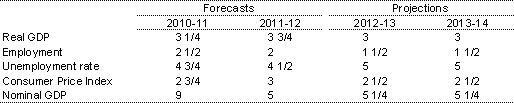
- Real and nominal GDP are year-average growth. Employment and CPI are through-the-year growth to the June quarter. The unemployment rate is the rate in the June quarter.
- The parameters for 2010‑11 and 2011‑12 are forecasts, while those for 2012‑13 and 2013‑14 are projections. The projections of economic growth are based on analysis of underlying trends in employment and productivity. Similar to Budget, the projection years include the assumption that the prices of key non-rural commodities will fall gradually from their 2011‑12 forecast levels. The projections of inflation are consistent with the medium-term target band.
Source: ABS cat. nos. 5206.0, 6202.0 and 6401.0 and Treasury.
The unemployment rate is forecast to fall to 4¾ per cent by the June quarter 2011 and 4½ per cent by the June quarter 2012, returning to levels last reached prior to the global financial crisis. Inflation is expected to remain contained, although the risks are on the upside as the unemployment rate falls. Headline inflation is forecast to be 2¾ per cent through the year to the June quarter 2011 and 3 per cent through the year to the June quarter 2012.
Strong demand from emerging Asia is supporting high prices for Australia's key commodity exports, driving the terms of trade towards historical highs. As the global supply of iron ore and coal increases, the medium-term outlook is for Australia's terms of trade to decline. However, the rapid pace of economic development in emerging Asia — and the prospect that strong resource-intensive growth in China and India will continue for many years to come — underpins expectations that the medium-term decline will be gradual, notwithstanding the potential for significant volatility over shorter time horizons. That said, the structural terms of trade are likely to remain above their historical average levels over the medium term. The terms of trade are expected to increase by 15½ per cent in 2010‑11, before falling by 4½ per cent in 2011‑12.
High prices for Australia's non-rural commodity exports are driving a mining-led investment boom. With previous investment in mining capacity and transport infrastructure already underpinning strong growth in commodity exports, the mining industry is planning an additional $55 billion of investment in 2010‑11 — five times the level in the years leading up to the boom — primarily in the LNG and iron ore sectors. Investment intentions in the manufacturing and construction sectors have also improved as the outlook for the Australian economy has strengthened. Total new business investment is now expected to increase by 8 per cent in 2010‑11 and 13 per cent in 2011‑12, moving back towards 40-year highs as a percentage of GDP.
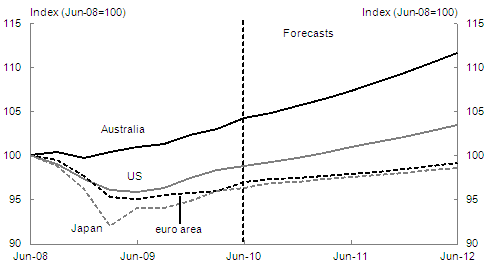
While most advanced economies will take many years to recover from the loss in output and increase in unemployment experienced during the global recession, the Australian economy is expected to return to full capacity over the next year or so (Chart 1.1). Australia's current high exchange rate and the withdrawal of fiscal and monetary stimulus will be important moderating influences on both demand pressures and inflation during this period.
Chart 1.1: GDP levels in advanced economies
Source: ABS cat. no. 5206.0, national statistical publications, Thomson Reuters and Treasury.
Note: US forecasts begin in December 2010.
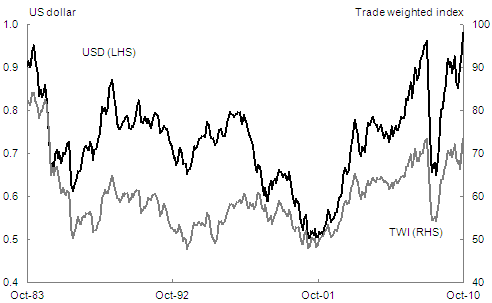
The relative strength of Australia's economic outlook and our high terms of trade have contributed to a significant appreciation of the exchange rate. In US dollar terms, the Australian dollar is at the highest level since the currency was floated in the early 1980s, while the trade weighted index has returned to levels reached prior to the global financial crisis (Chart 1.2).
Chart 1.2: Exchange rate
Source: Ecowin.
Australia's flexible exchange rate acts as a form of shock absorber for the economy, helping to moderate the effect of external shocks, and is an important channel for the transmission of monetary policy. The exchange rate fell sharply in 2008 when deteriorating global economic conditions precipitated a significant fall in commodity prices and heightened financial market volatility prompted international investors to seek the perceived security of US dollar assets. The depreciation supported the economy at a time when Australia's growth was slowing, just as the recent appreciation will be a moderating influence on economic growth and inflation as the Australian economy approaches full capacity, albeit with different impacts on different sectors of the economy.
Fiscal and monetary policy stimulus is also being withdrawn. As robust growth in private sector activity is taking hold, the fiscal stimulus is being phased out as planned and monetary policy stimulus has been withdrawn. The withdrawal of the fiscal stimulus started to detract from economic growth in the March quarter 2010, and is expected to reduce real GDP growth by 1 percentage point in 2010‑11 and ½ of a percentage point in 2011‑12.
If www.budget.gov.au responds slowly or you are having trouble downloading a document, try one of the Budget Website Mirrors
Note: Where possible, Budget documents are available in HTML and for downloading in Portable Document Format(PDF). If you require further information on any of the tables or charts on this website, please contact The Treasury.