




Fiscal outlook
The budget remains on track to return to surplus in 2012‑13, with a growing economy and restrained spending growth delivering the fastest fiscal consolidation in modern budget history.
The revenue outlook has softened somewhat in the period since the release of the Pre-Election Economic and Fiscal Outlook 2010. This mainly reflects the impact of the appreciation of the Australian dollar on receipts, weaker capital gains tax collections and earlier than anticipated utilisation of losses. Notwithstanding this downward revision, tax receipts are still projected to grow faster than the economy over the forward estimates period.
The budget is still expected to return to surplus in 2012‑13 and net debt is expected to peak at 6.4 per cent of GDP in 2011‑12. This will leave Australia in a substantially stronger fiscal position than any of the major advanced economies.
In 2012‑13, when the Australian budget is expected to return to surplus, the major advanced economies are forecast to still be in deficit by an average of 6 per cent of GDP (Chart 1.3).
Chart 1.3: Budget balance positions for selected countries, 2010-15
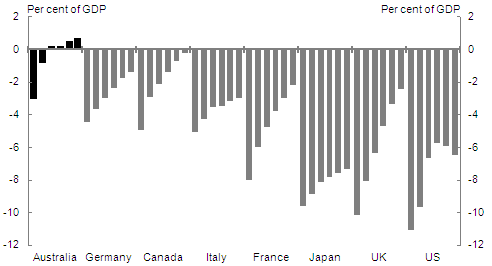
Note: Australian data are for the Australian Government general government sector underlying cash balance and refer to financial years beginning 2010‑11. Data for all other economies are total government net lending and refer to calendar years.
Source: IMF Fiscal Monitor November 2010 and Treasury.
Net debt in the major advanced economies is expected to reach an average 90 per cent of GDP in 2015, 14 times higher than the expected peak in Australia's net debt (Chart 1.4).
Chart 1.4: Government net debt positions for selected countries, 2010-15
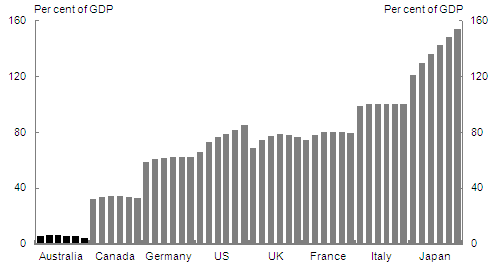
Note: Australian data are for the Australian Government general government sector and refer to financial years beginning 2010‑11. Data for all other economies are total government and refer to calendar years.
Source: IMF Fiscal Monitor November 2010 and Treasury.
An underlying cash deficit of 3.0 per cent of GDP is forecast for 2010‑11, a 1.3 per cent of GDP improvement on the 2009‑10 outcome. The underlying cash balance is expected to reach a surplus of 0.2 per cent of GDP in 2012‑13. This represents a fiscal consolidation of 4½ per cent of GDP over three years.
In this Mid-Year Economic and Fiscal Outlook, the Government has begun the task of delivering its election commitments, focusing on those with a financial impact in 2010‑11.
The Government has continued to offset all new spending, including in relation to spending on election commitments. This ensures that the expected timing of the budget's return to surplus is not affected by new spending measures.
If www.budget.gov.au responds slowly or you are having trouble downloading a document, try one of the Budget Website Mirrors
Note: Where possible, Budget documents are available in HTML and for downloading in Portable Document Format(PDF). If you require further information on any of the tables or charts on this website, please contact The Treasury.