




Domestic economic outlook
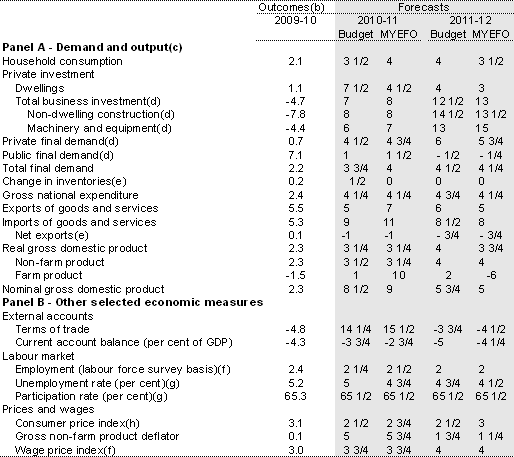
Australia's GDP is forecast to grow by 3¼ per cent in 2010‑11 and 3¾ per cent in 2011‑12, reflecting strong business investment, rising commodity exports and robust income growth supporting household consumption.
The solid growth in the economy has been reflected in strong employment growth and this is expected to continue. Around 360,000 jobs were created in the past year and employment is forecast to grow by 2½ per cent in 2010‑11 and a further 2 per cent in 2011‑12. The unemployment rate, already low, is expected to fall further, to 4¾ per cent in the June quarter 2011 and 4½ per cent in the June quarter 2012.
The high terms of trade are supporting stronger growth in real activity, driving up business investment and exports in both 2010‑11 and 2011‑12, particularly in the mining sector (Chart 2.1). The mining industry alone is planning $55 billion of investment in 2010‑11, pushing business investment to near 40-year highs as a percentage of GDP. New engineering construction is expected to grow by over 16 per cent in 2010‑11 and 21 per cent in 2011‑12, underpinned by Liquefied Natural Gas projects. The strength in the mining sector is also expected to drive higher levels of investment in new machinery and equipment. The expected surge in investment will expand the economy's capacity over time and underpin a projected increase of around $80 billion in the value of non-rural commodity exports over the next five years to more than $200 billion per annum.
Chart 2.1: Mining investment (current price, original)
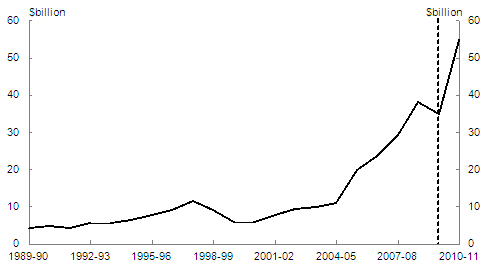
Note: 2010‑11 is Estimate 3 for 2010‑11 from the June quarter 2010 Capex Survey (ABS cat. no. 5625.0).
Source: ABS cat. no. 5625.0.
The tight labour market and the pick-up in aggregate demand associated with the higher terms of trade will also have implications for inflation, with Treasury's most recent estimates of the non-accelerating inflation rate of unemployment (NAIRU) — the rate of unemployment at which inflation pressures start to emerge — ranging between 4½ and 5 per cent.
Headline and underlying inflation are expected to rise over the forecast horizon, reaching 3 per cent in through-the-year terms in the June quarter of 2012. With the economy expected to be operating at around capacity, inflation risks remain on the upside.
Demand and inflationary pressures, while building, will be moderated through tighter macroeconomic policy settings and the stabilising effects of the exchange rate (Box 2.1). The Reserve Bank of Australia has withdrawn monetary stimulus and the Australian Government's withdrawal of the fiscal stimulus is expected to reduce GDP growth by 1 percentage point in 2010‑11 and ½ of a percentage point in 2011‑12. The significant appreciation of the Australian dollar is expected to be a contractionary influence on the economy, further dampening price pressures.
Notwithstanding this positive domestic outlook, risks surrounding the global economy have heightened in recent months. Were the global economy to falter, it is likely that Australia would be affected through both financial and trade channels, including through lower prices for our key commodity exports. Australia's terms of trade and income growth are heavily influenced by the prices of several key non-rural commodities that are currently trading around record levels and which are highly sensitive to demand from the Asian region. While demand is expected to remain strong, a sudden decline in these commodity prices would have major negative implications for national income and activity.
Table 2.1: Domestic economy forecasts(a)
- Percentage change on preceding year unless otherwise indicated.
- Calculated using original data unless otherwise indicated.
- Chain volume measures except for nominal gross domestic product which is in current prices.
- Excluding second-hand asset sales from the public sector to the private sector.
- Percentage point contribution to growth in GDP.
- Seasonally adjusted, through-the-year growth rate to the June quarter.
- Seasonally adjusted, rate for the June quarter.
- Through-the-year growth rate to the June quarter.
Note: The forecasts for the domestic economy are underpinned by several technical assumptions. The exchange rate is assumed to remain around levels seen at the time the forecasts were prepared (a trade weighted index of around 74 and a US$ exchange rate of around 98½c). The policy interest rate is assumed to rise in line with market expectations. World oil prices (Tapis) are assumed to remain at around US$88 per barrel. Farm sector forecasts assume average seasonal conditions over the remainder of the forecasting period.
Source: ABS cat. no. 5204.0, 5206.0, 5302.0, 6202.0, 6345.0, 6401.0, unpublished ABS data and Treasury.
Box 2.1: The role of the exchange rate in helping to balance the macroeconomy
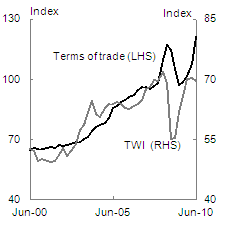
Since late August, the Australian dollar has risen around 8 per cent against the trade weighted index (TWI), and nearly 13 per cent against the US dollar, reaching parity for the first time since 1982.
The appreciation of the Australian dollar reflects the relatively strong outlook for the Australian economy and our high terms of trade (Chart A).
Chart A: Terms of Trade and the TWI
Source: ABS cat. no. 5302.0.
The dollar's appreciation is also symptomatic of US dollar weakness, reflecting market perceptions that the US economic outlook has softened and the recently-announced second round of quantitative easing by the US Federal Reserve.
In the context where the terms of trade are boosting demand in an economy approaching full capacity, the appreciation of the exchange rate helps to moderate inflationary pressures.
The higher dollar directly reduces import prices and also dampens the income effects from higher commodity prices, which are contracted in US dollars (with flow-through consequences for budget revenues).
A higher dollar also eases demand pressures by shifting some spending from domestic to foreign goods and services, moderating the extent to which spending butts up against domestic supply constraints.
It is also a key channel by which the benefits of high resource prices are spread more widely through increased consumer purchasing power. Without this appreciation more of the gains would accrue to the resources sector and less to the general community.
However, the higher dollar can also have significant impacts on trade exposed sectors of the economy, which become less competitive and which are not benefiting from higher prices for their exports.
The budget forecasts have been prepared on the technical assumption that the exchange rate remains constant.
As near-term factors fade and if the projected decline in commodity prices and the terms of trade were realised, it is likely that the exchange rate would also fall over time. This would work to moderate the forecast decline in Australian dollar prices and earnings, and its flow-through implications to the Budget.
If www.budget.gov.au responds slowly or you are having trouble downloading a document, try one of the Budget Website Mirrors
Note: Where possible, Budget documents are available in HTML and for downloading in Portable Document Format(PDF). If you require further information on any of the tables or charts on this website, please contact The Treasury.