




International economic outlook
World outlook
World growth is expected to remain at or above 4 per cent over the next two years, although the outlook has become more uncertain and downside risks remain elevated. While the emerging economies of Asia remain strong, the outlook for the euro area is weak, prospects for Japan are worsening, and there are increasing concerns that the economic recovery in the United States may be faltering.
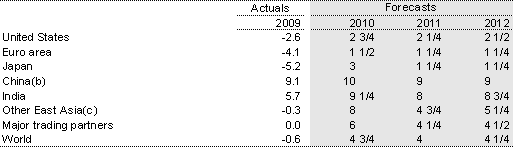
Table 2.2: International GDP growth forecasts
- World and euro area growth rates are calculated using GDP weights based on purchasing power parity (PPP), while growth rates for major trading partners and Other East Asia are calculated using export trade weights.
- Production-based measure of GDP.
- Other East Asia comprises the NIEs of Hong Kong, South Korea, Singapore and Taiwan and the Association of Southeast Asian Nations group of five (ASEAN-5), which comprises Indonesia, Malaysia, the Philippines, Thailand and Vietnam.
Source: National statistical publications, IMF and Treasury.
While the outlook for global growth has become more uncertain, the central forecast is for world GDP to grow by a solid 4¾ per cent in 2010. Outcomes in East Asia and the euro area (led by Germany) in the first half of 2010 were generally stronger than expected, offsetting weaker-than-expected outcomes in the US and Japan. Global growth is forecast to be 4 per cent in 2011. The easing reflects an expected moderation in US and Chinese growth, due in part to the fading of temporary factors (fiscal stimulus and the inventory cycle), which helped boost growth in 2010. Global growth is expected to rise to 4¼ per cent in 2012 as most economies outside the euro area return to around trend growth rates. Nevertheless, many advanced economies are likely to continue to operate well below capacity for some time (Box 2.2).
Australia's major trading partners are forecast to grow 6 per cent in 2010 and over 4 per cent in each of the next two years, underpinned by robust growth in China, India and other key Asian economies. This strong regional growth should provide strong support for the Australian economy even as the rest of the global economy struggles.
Notwithstanding this, downside risks surrounding the outlook remain prominent, particularly due to increased concerns over the durability of the US recovery, a weakening in prospects for Japan and the potential for renewed stress in the euro area. Among some major advanced economies there is a risk that planned fiscal consolidations in 2011 could threaten recovery given that growth in these countries has largely been driven by policy stimulus, an inventory rebound, and exports. Further, the capacity of advanced economies to respond to any substantial slowing in growth is constrained by weak fiscal positions and monetary policy interest rates that are already effectively zero.
China continues to grow strongly, albeit at a moderating pace, as authorities attempt to engineer a 'soft landing' in response to fears of overheating in some sectors of the economy. Large and volatile capital inflows also pose some risk.
The ongoing uncertainty surrounding the global outlook is also reflected in financial markets. Global stock markets rose strongly in the September quarter, but also experienced periods of heightened volatility. Government bond yields in a number of advanced economies, most notably the US, remain around historically low levels, due to a significant degree of pessimism regarding their medium-term growth prospects, and the impact of quantitative easing. Meanwhile, in the euro area periphery (Greece, Portugal, Ireland and Spain), government bond yield spreads over the German bond benchmark remain elevated, suggesting continued concerns about sovereign credit worthiness in these countries.
Country summaries
In the United States growth is expected to moderate as the effects of fiscal stimulus and the inventory cycle fade, notwithstanding some support from the recent depreciation in the US dollar. Modest consumer spending, weak jobs growth, a slowing industrial cycle and continued housing market strains raise the risk that the slowing in growth may be more pronounced than anticipated. GDP is forecast to grow by 2¾ per cent in 2010 and 2¼ per cent in 2011, before rising slightly to 2½ per cent for 2012. The slowing in activity, concerns about deflation, and near record high unemployment has prompted the US Federal Reserve to undertake further 'quantitative easing' in an effort to push down long-term interest rates, and lower the cost of borrowing across private markets to support demand.
In the euro area, the outlook remains weak, although recent outcomes have been better than expected. Growth is expected to moderate as an easing in world growth slows foreign trade. Fiscal consolidation across the region from 2011 is likely to weigh on the labour market and household consumption, and tight credit conditions are likely to continue to restrain investment. The recovery is expected to remain sluggish, with GDP forecast to grow 1½ per cent in 2010 before slowing slightly to 1¼ per cent in both 2011 and 2012.
Box 2.2: International comparisons
Australia's economy outperformed other advanced economies during the global financial crisis and continues to do so.
Although growth has resumed in the major advanced economies, it is starting from low levels of output and the pace of recovery is tepid.
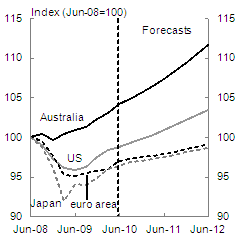
Australia's economy held up well during the global recession — underpinned by policy support and other factors — and so did not suffer the same loss of output that other advanced economies experienced. As a result it also did not suffer the more permanent loss of productive capacity that occurred in other countries as a result of large scale business closures and rising levels of long-term unemployment.
Chart A: GDP level — advanced
economies
Source: ABS cat. no. 5206.0, national statistical agencies, Thomson Reuters and Treasury.
Note: US forecasts begin in December 2010.
Australia's GDP is significantly higher than before the global financial crisis, while many other advanced economies suffered deep contractions with the level of output in the US, euro area and Japan still below pre‑crisis levels. Based on the latest growth forecasts, the Australian economy is also likely to grow more quickly than the major advanced economies over the next couple of years, further widening the GDP gap (Chart A).
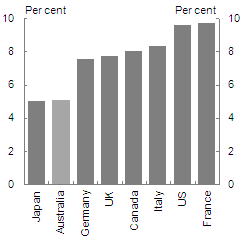
The relative strength of economic activity in Australia is also reflected in its lower unemployment rate (Chart B). Australia's unemployment rate is around 5 per cent. Around 360,000 jobs have been created over the past year. In contrast, unemployment in the US and the euro area is around 10 per cent. In the US around 7¾ million jobs have been lost since December 2007.
Chart B: Unemployment rates:
Australia and G7
Source: ABS cat. no. 6202.0 and national statistical agencies.
China's economy is expected to grow strongly over the forecast horizon. GDP is forecast to grow by 10 per cent in 2010 before easing to 9 per cent in both 2011 and 2012 as the authorities withdraw fiscal and monetary stimulus and continued advanced economy weakness weighs on export growth. This largely government-engineered moderation is expected to provide more stable and sustainable growth for the Chinese economy, although China is facing increasingly complex reform challenges in areas including energy, the financial sector and state-owned enterprises.
The Japanese economic outlook is weak. While the recovery was initially export-driven, a weaker-than-expected June quarter 2010 GDP outcome has confirmed that the export rebound is easing, domestic demand remains weak and deflationary pressures are entrenched — with prices falling almost continuously since the late 1990s. While Japanese economic growth is expected to be 3 per cent in 2010, reflecting a bounce back from a record fall in 2009, it is forecast to ease significantly to 1¼ per cent in both 2011 and 2012.
The economic outlook for India has improved in recent months. Private consumption has strengthened, mirroring a run-up in manufacturing output. Consumer price pressures are receding, owing to a favourable monsoon season. Indian economic growth is expected to be 9¼ per cent in 2010, before slowing to 8 per cent in 2011 and 8¾ per cent in 2012.
For the rest of Asia, economic growth is strong but expected to moderate. After recovering strongly from the global recession, the Newly Industrialised Economies (South Korea, Singapore, Hong Kong and Taiwan) are expected to slow on the back of softening export demand and tightening fiscal positions. In Southeast Asia, while growth is expected to slow for similar reasons, solid economic growth is expected to continue to be supported by the underlying strength in domestic demand.
If www.budget.gov.au responds slowly or you are having trouble downloading a document, try one of the Budget Website Mirrors
Note: Where possible, Budget documents are available in HTML and for downloading in Portable Document Format(PDF). If you require further information on any of the tables or charts on this website, please contact The Treasury.