




Statement 1: Budget Overview (Continued)
Economic outlook
The severe weather events that hit Australia over the recent summer exacted a terrible toll on many communities, causing loss of life and damage to livelihoods. The macroeconomic impacts were also substantial, causing considerable destruction to private and public assets and directly resulting in around $9 billion of real production losses, predominantly in the resources and agriculture sectors. Indirect impacts continue to add to these losses.
The floods and cyclones in Australia were followed by the devastating New Zealand and Japanese earthquakes. Japan is Australia's second largest trading partner, taking around a quarter of our bulk commodity exports. Lower production and the destruction of productive capacity in Japan will see a decline in our exports to Japan in the near term.
Combined, the disasters in Australia and overseas are expected to detract around ¾ of a percentage point from Australia's real GDP growth in 2010‑11. While it will take many years for the affected communities to recover fully from the devastation caused by these disasters, the negative impacts on Australia's economic growth are expected to be temporary, with the resumption of activity and commencement of reconstruction expected to add to real GDP growth from 2011‑12.
The Australian economy has confronted these natural disasters from a position of strength. Over 300,000 jobs have been created over the past year, the unemployment rate has fallen to around 5 per cent and underlying inflation has moderated to around 10‑year lows.
Australia's medium‑term prospects are strong, with the economy forecast to grow at an above‑trend rate over the next two years, driven by an investment surge in the resources sector. Following 2¼ per cent growth in 2010‑11, real GDP growth is forecast to increase to 4 per cent in 2011‑12 and 3¾ per cent in 2012‑13 (Table 2).
Table 2: Major economic parameters(a)
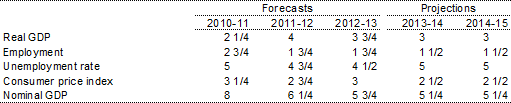
- Real and nominal GDP are year‑average growth. Employment and CPI are through‑the‑year growth to the June quarter. The unemployment rate is the rate in the June quarter.
Source: Treasury.
Sustained high prices for Australia's key commodity exports underpin record investment intentions in the mining sector and strong forecast growth in commodity exports. The mining industry is planning to invest $76 billion in 2011‑12 — around eight times the annual level preceding the boom — led by the LNG sector. The volume of non‑rural commodity exports is expected to rise by over 20 per cent over the next two years.
High prices for Australia's commodity exports have pushed the terms of trade towards historical highs. While the medium‑term outlook is for Australia's terms of trade to decline as the global supply of iron ore and coal increases, the prospect that strong resource‑intensive investment in China and India in particular will continue for many years underpins expectations that this fall will be gradual.
Australia's high terms of trade and strong growth in the resources sector are supporting incomes and activity in the broader economy. But while the resources sector is driving strong aggregate real GDP growth, conditions in other sectors are made more difficult by the related strength of the Australian dollar, tightened macroeconomic policy settings and increasing competition for labour and other inputs.
For some industries, these challenges are compounded by more cautious household spending behaviour and the increased difficulty that some businesses still confront in accessing credit following the global financial crisis. Accordingly, while the Australian economy in aggregate is expected to grow at an above‑trend rate, conditions are likely to remain uneven across the economy.
The unemployment rate is forecast to fall from around 5 per cent currently to 4¾ per cent in late 2011‑12 and 4½ per cent in late 2012‑13. Underlying inflationary pressures are expected to remain contained, but increase gradually as the labour market tightens and the economy approaches capacity. Headline inflation will be higher in the short term because of the increase in world oil prices and the temporary impact of the floods and Cyclone Yasi on fruit and vegetable prices.
The favourable outlook for the Australian economy is supported by a strengthening global economy, although the recovery from the global financial crisis remains uneven and subject to significant risks. The strong growth in emerging market economies that drove the initial phase of the global recovery is expected to moderate to more sustainable rates, while the recovery in major advanced economies is expected to become more self‑sustaining. Following 5 per cent growth in 2010, the global economy is forecast to grow 4¼ per cent in 2011 and 4½ per cent in 2012.
Still, substantial risks remain, with rising world oil prices and greater economic uncertainty in Japan following the recent earthquake compounding existing fragilities. Sovereign debt concerns remain a key source of weakness in a number of advanced economies, particularly in the euro area periphery. Failure to develop a credible medium‑term response to the unsustainable US fiscal position would also pose a threat to the sustainability of the global recovery. Inflationary pressures continue to build in emerging market economies, driven by reduced spare capacity and compounded by rising food and oil prices. Further sustained increases in world oil prices would pose significant risks to global growth.
Whereas a number of advanced economies are yet to return to the levels of output reached prior to the global financial crisis (Chart 1) and continue to experience high unemployment rates, the Australian economy is approaching full capacity.
Chart 1: Level of real GDP in selected advanced economies
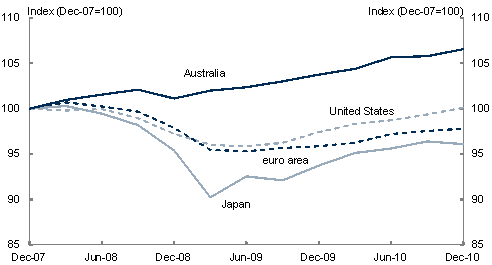
Source: ABS cat. no. 5206.0, national statistical agencies, Thomas Reuters and Treasury.
If www.budget.gov.au responds slowly or you are having trouble downloading a document, try one of the Budget Website Mirrors
Note: Where possible, Budget documents are available in HTML and for downloading in Portable Document Format(PDF). If you require further information on any of the tables or charts on this website, please contact The Treasury.