




Statement 1: Budget Overview (Continued)
Fiscal strategy and outlook
The Government will deliver a surplus in 2012‑13, despite the recent natural disasters and the weaker near‑term outlook for tax receipts making the return to surplus more difficult.
Returning the budget to surplus will ensure the Government does not draw on resources needed to support the unprecedented mining investment boom. It will also contribute to the sustainability of public finances and support Australia's capacity to respond to unanticipated shocks, including those related to the uncertain global economic outlook.
The Government is achieving the return to surplus by:
- paying for new spending, including the cost of the recent natural disasters, by making $22 billion in savings;
- restraining real growth in spending to an average of around 1 per cent per year over the forward estimates, the lowest five year period of growth since the 1980s; and
- allowing the natural increase in tax receipts associated with a strengthening economy in future years to flow through to the budget.
This tough stance on spending goes beyond the requirements of the fiscal strategy and reflects the Government's commitment to returning the budget to surplus as prudently and as quickly as possible.
Fiscal strategy
The Government's fiscal strategy is designed to ensure fiscal sustainability, while providing the necessary flexibility for the budget position to vary in line with economic conditions.
The medium‑term fiscal strategy, which has remained unchanged since the Government's first budget in 2008‑09, is to:
- achieve budget surpluses, on average, over the medium term;
- keep taxation as a share of GDP, on average, below the level for 2007‑08 (23.5 per cent); and
- improve the Government's net financial worth over the medium term.
To ensure a timely return to surplus, the Government further committed, in the Updated Economic and Fiscal Outlook released in February 2009, to:
- allow the level of tax receipts to recover naturally as the economy improves, while maintaining the Government's commitment to keep taxation as a share of GDP below the 2007‑08 level on average; and
- hold real growth in spending to 2 per cent a year once the economy is growing above trend until the budget returns to surplus.
The Government will build growing surpluses by retaining the 2 per cent limit on annual real spending growth, on average, until the budget surplus is at least 1 per cent of GDP, and while the economy is growing at or above trend.
Fiscal outlook
The recent natural disasters in Australia are expected to result in around $6.6 billion in payments over six years to assist affected communities with the costs of rebuilding, over one‑half of which will occur in 2010‑11.
In addition, tax receipts have been revised down since the Mid‑Year Economic and Fiscal Outlook 2010‑11 by a total of $16.3 billion in 2010‑11 and 2011‑12. The downward revisions to tax receipts reflect the influence of a number of important factors including:
- more subdued short term economic conditions with growth in 2010‑11 impacted by natural disasters, more cautious behaviour on the part of consumers, and a strong dollar; and
- larger than anticipated losses accumulated during the global financial crisis.
The impacts of natural disaster spending and the weaker near‑term outlook for tax receipts have contributed to an underlying cash deficit of $49.4 billion or 3.6 per cent of GDP in the current year and $22.6 billion or 1.5 per cent of GDP in 2011‑12.
Return to surplus
Disciplined spending and responsible savings have ensured that the budget remains on track to return to surplus in 2012‑13, notwithstanding the near‑term challenges from the natural disasters and reduced tax receipts.
An underlying cash surplus of $3.5 billion (0.2 per cent of GDP) is expected for 2012‑13, with this surplus expected to grow to $5.8 billion (0.3 per cent of GDP) in 2014‑15.
A surplus will be achieved through the implementation of a very rapid fiscal consolidation — 3.8 per cent of GDP (or $52.9 billion) over the two years from 2010‑11.
The budget is projected to return to surplus only three years after the deficit peaked during the global financial crisis, despite the challenges faced this year and next. This would be the fastest return to surplus in the 44 years for which comparable data is available, and before any major advanced economy (Chart 2).
The Government is delivering the return to surplus by making difficult but responsible decisions, paying for new spending, including the cost of the recent natural disasters, by making $22 billion in savings. Many of the savings deliver continuing benefits to the bottom‑line beyond the forward estimates, improving the long‑term sustainability of public finances.
As part of the savings task, the Government has identified significant reductions in expenditure to help fund new priorities and strengthen the budget position, with savings broadly drawn from the following areas:
- limiting growth in payments to families higher up the income scale, by maintaining the upper income thresholds for certain family payments at their current levels, improving the long‑term sustainability of the family payment system;
- reforming income support payments, including Parenting Payment Single, Newstart and Youth Allowance (along with phasing out the Dependent Spouse Tax Offset), to encourage participation and enhance social and economic outcomes for individuals and the economy more broadly;
- further improving the sustainability of the health budget by capping pathology services expenditure under the Medicare Benefits Schedule;
- making the higher education loan program fairer, by reducing the upfront discount;
- requiring greater efficiency from the public sector, by temporarily increasing the efficiency dividend;
- delivering new efficiencies in defence, through ongoing reforms; and
- reducing industry assistance and spending across the budget, and better targeting the timing of programs, including infrastructure deferrals to prioritise re‑building in flood and natural disaster affected areas.
The savings build on previously announced changes to the private health insurance arrangements, better targeting of family payments, and changes to pension eligibility, all designed to improve the long term structural position of the budget.
This disciplined approach to spending has contributed to average real growth in spending of around 1 per cent over the forward estimates period. By the end of the forward estimates, government spending as a share of GDP is projected to fall to 23.5 per cent. This is less than the average of the ten years preceding the financial crisis (24.0 per cent).
The Budget also contains a number of tax measures that improve the fairness and integrity of the tax system and cut tax expenditures, and so provide structural improvements in revenue.
A strong balance sheet
Net debt is expected to peak at 7.2 per cent of GDP in 2011‑12 and decline over the remainder of the forward estimates. The peak is higher than previously expected, reflecting the immediate pressures on the budget from the natural disasters and reduced tax receipts. Still, the Australian Government's net debt position remains extremely low by international standards (Chart 3).
Chart 2: Budget balance for Australia and the G7 economies, 2010‑2016
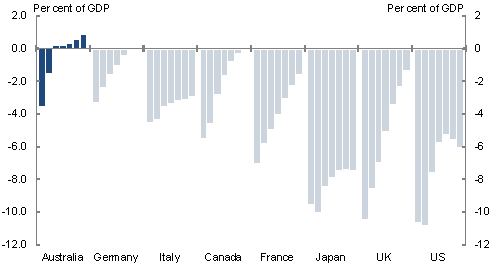
Note: Australian data are for the Australian Government general government sector underlying cash balance and refer to financial years beginning 2010‑11. Data for all other economies are total government budget balance and refer to calendar years beginning 2010.
Source: IMF Fiscal Monitor April 2011 and Treasury.
Chart 3: Net debt for Australia and the G7 economies, 2010‑2016
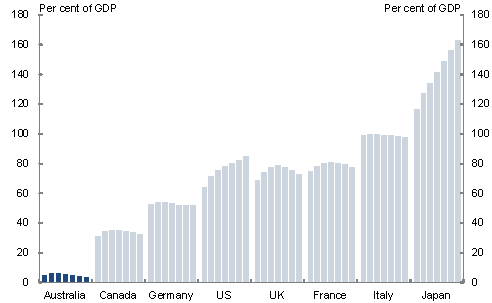
Note: Australian data are for the Australian Government general government sector and refer to financial years beginning 2010‑11. Data for all other economies are total government and refer to calendar years beginning 2010.
Source: IMF Fiscal Monitor April 2011 and Treasury.
If www.budget.gov.au responds slowly or you are having trouble downloading a document, try one of the Budget Website Mirrors
Note: Where possible, Budget documents are available in HTML and for downloading in Portable Document Format(PDF). If you require further information on any of the tables or charts on this website, please contact The Treasury.