




Appendix A: An Overview of Australia's Federal Relations
Overview
On 29 November 2008, the Council of Australian Governments (COAG) reached an historic Intergovernmental Agreement on Federal Financial Relations (Intergovernmental Agreement) which establishes the overarching framework for the Commonwealth's financial relations with the States and Territories. The framework represents the most significant reform to Australia's federal financial relations in decades.
The framework commenced on 1 January 2009 and provides a strong foundation for COAG to pursue economic and social reforms to underpin growth, prosperity and wellbeing into the future. It also provides clearer specification of the roles and responsibilities of each level of government so that the appropriate government is accountable to the community.
The structure of Australia's federal relations
Australia has a federal system of government, consisting of three different levels of government: the Commonwealth Government; State and Territory governments; and local councils.
Australia's federal relations are characterised by three broad features:
- financial arrangements that are influenced by the large expenditure responsibilities of the States relative to their revenue capacities, so that they rely on transfers from the Commonwealth to finance their activities — referred to as vertical fiscal imbalance;
- States having different capacities to raise revenue and deliver services — referred to as horizontal fiscal imbalance; and
- overlapping roles and responsibilities in areas of government activity which can lead to sectors where regulation or services remain fragmented, with duplication of activities, lack of coordination and blurred accountabilities.
Vertical fiscal imbalance
Vertical fiscal imbalance is common to most, if not all, federal systems. It results when a level of government has expenditure functions that are not wholly financed through its own assigned tax bases.
Commonwealth financial assistance to the States comprises all GST revenue, plus an amount of other general revenue assistance, and payments for specific purposes.
The level of vertical fiscal imbalance can be measured as the revenue transferred from the Commonwealth to the States as a proportion of the State's total revenue. In 2009‑10, the Commonwealth transferred approximately $97.2 billion to the States in the form of general revenue assistance and payments for specific purposes, accounting for around 50.0 per cent of total state revenue.
Horizontal fiscal equalisation
It is usual for individual States within a federation to have different capacities to raise revenue or deliver services. The practice of equalising revenue capacities and/or expenditure capacities between the States in a federation is common. Australia has had various forms of fiscal equalisation since 1901.
Australia's current system of fiscal equalisation is based upon GST revenue sharing relativities assessed by the Commonwealth Grants Commission. The relativities determine how much GST revenue each State receives compared with an equal per capita share. The relativities are assessed in respect of each State's ability to raise revenue from its own sources and also the costs each State would incur in providing the same standard of government services and the associated infrastructure.
Horizontal fiscal equalisation does not guarantee that the States will provide a uniform standard of service: its aim is to equalise the capacity of each State to do so, while leaving each State free to determine the standard of service provision.
Box A.1: The effect of horizontal fiscal equalisation
One way to view the effect of horizontal fiscal equalisation is to compare each State's share of the GST payments using the GST relativities, with a notional distribution on an equal per capita basis. In 2011‑12, around $3.9 billion (or 8.0 per cent) of the GST payments will be redistributed among the States, compared with an equal per capita distribution (Table A).
Table A.1: Difference from equal per capita distribution, 2011‑12
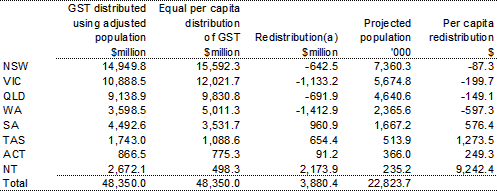
- The total redistribution of $3,880.4 million is the sum of positive items in that column.
The proportion of the GST payments being redistributed in 2011‑12 is broadly consistent with the average redistribution since the commencement of the GST.
Chart A.1: GST redistributed as a proportion of the GST payments
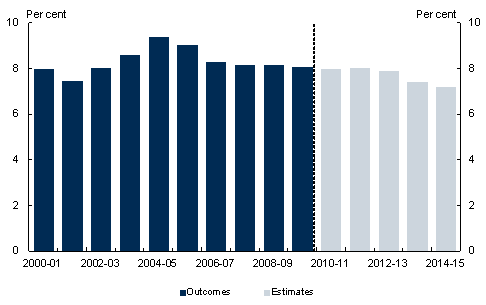
Note: From 2000‑01 to 2008‑09 the Commission was asked to recommend relativities to distribute a pool of GST payments plus health care grants. This methodology is conceptually equivalent, when expressed in proportions of GST payments, with the current relativities recommended by the Commission. As such, Chart A.1 is a comparison of the proportion of GST payments rather than the proportion of the GST pool estimated to be redistributed for this period.
Roles and responsibilities
Federal systems work best when the roles and responsibilities of each jurisdiction are clear and good public accountability mechanisms allow the community to hold the appropriate level of government to account for the quality and efficiency of the services delivered and outcomes achieved.
The framework for federal financial relations
The objective of the federal financial relations framework is to improve the quality and effectiveness of government services. It seeks to do so by providing clarity about who is responsible for the delivery of those services, flexibility in the delivery of services and increased accountability to the public, as well as by providing incentives for reform.
Intergovernmental Agreement on Federal Financial Relations
The Intergovernmental Agreement provides the overarching framework for the Commonwealth's financial relations with the States. It establishes a foundation for the Commonwealth and the States to collaborate on policy development and service delivery, and facilitate the implementation of economic and social reforms in areas of national importance.
All financial relations between the Commonwealth and the States are governed by the provisions of the Intergovernmental Agreement. The Commonwealth's financial relations with the States come under the umbrella of one piece of legislation, the Federal Financial Relations Act 2009.
Federal Financial Relations Act 2009
The Federal Financial Relations Act 2009 implements the payment arrangements of the framework. The Act provides a standing appropriation for the Commonwealth to make ongoing financial contributions to the States through five National SPPs, and for the Treasurer to determine GST payments to the States. The Act also provides for the Treasurer, through a written determination, to credit amounts to the COAG Reform Fund for the purpose of making grants of National Partnership payments and general revenue assistance to the States. For the first time in decades, the complexity of all the Commonwealth's financial relations with the States is contained in one piece of legislation. This improves the public transparency of these payments and the ability of the Parliament to scrutinise the payment arrangements.
Key features of the framework
Funding
The Commonwealth currently provides financial support for the States' service delivery efforts through:
- National Specific Purpose Payments (National SPPs) to be spent in key service delivery sectors;
- three types of National Partnership payments — project payments, facilitation payments and reward payments; and
- general revenue assistance, consisting of GST payments to be used by the States for any purpose, and other general revenue assistance.
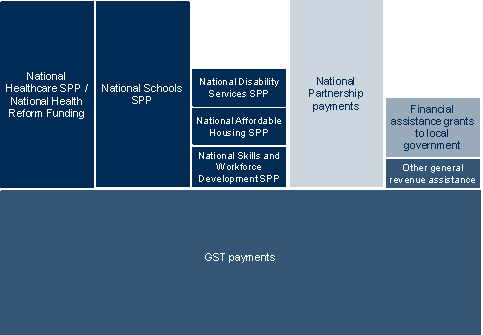
The framework rationalised a number of payments made to the States, centralised payment arrangements and provides greater funding certainty and flexibility to the States. The payment structure of the framework is shown schematically in Chart A.2.
Chart A.2: Schematic of payments to the States under the
federal financial relations framework
Greater flexibility
The federal financial relations framework gives the States greater flexibility to direct resources to areas where they will produce the best results in each State. In the Intergovernmental Agreement, the Commonwealth has committed to move away from prescriptions on service delivery in the form of financial or other input controls, which inhibit state service delivery and priority setting. Rather than dictating how things should be done, the framework focuses on the achievement of mutually agreed outcomes, providing the States with increased flexibility in the way they deliver services to the Australian people.
Under the framework, the States are required to spend each National SPP in the relevant sector — for example, the States are required to spend the National Schools SPP in the schools sector — but they have budget flexibility to allocate funds within that sector in a way that ensures they achieve the mutually agreed objectives for that sector.
Improved public accountability
While the States have increased budget flexibility under the federal financial relations framework, they are also subject to greater accountability, through new reporting arrangements. Commonwealth and State governments have committed to improving service delivery, by ensuring that the appropriate government is accountable to the community, not just for its expenditure in delivering services, but more importantly, for the quality and efficiency of the services it delivers and the outcomes it achieves.
Under the Intergovernmental Agreement, National Agreements aim to establish what the Commonwealth and the States expect to achieve from their co‑operation, the role of each jurisdiction and the responsibilities for which they undertake to be accountable, and performance indicators and benchmarks which will inform the Australian public on progress towards achieving the outcomes and objectives of the agreement.
Opportunities to drive reforms
A central element of the framework is National Partnership payments, which are a mechanism to drive reforms or improve service delivery standards. National Partnership payments are provided to the States to:
- support the delivery of specified outputs or projects;
- facilitate reforms; or
- reward those jurisdictions that deliver on nationally significant reforms.
Each National Partnership payment is supported by a National Partnership agreement which defines the mutually agreed objectives, outputs and performance benchmarks or milestones.
As part of the Heads of Treasuries Review of National Agreements, National Partnerships and Implementation Plans outlined in Part 1, a new form of National Partnership agreement called a Project Agreement will be used to implement projects that are considered low value or low risk.
National Partnership project payments are a financial contribution to the States to deliver specific projects, including improving the quality or quantity of service delivery, or projects that support national objectives.
The Government also recognises the need to support States to undertake priority reforms. Consequently, in areas that are a national priority — for example, implementing the seamless national economy — National Partnership facilitation payments may be paid to the States in advance of progressing or achieving nationally significant reform, in recognition of administrative and other costs of initiating those reforms or pursuing continuous improvement in service delivery.
National Partnership reward payments are provided to States that deliver nationally significant reform. Reward payments are structured in a way that encourages achievement of ambitious performance benchmarks detailed in a National Partnership agreement. Reward payments are contingent on the achievement of performance benchmarks, with achievement for each jurisdiction assessed by the independent COAG Reform Council.
Centralised payment arrangements
A key feature of the framework is centralised payment arrangements which simplify payments to the States, aid transparency and improve the States' budget processes.
Previously, payments to the States were made by Commonwealth portfolio departments to the relevant state agencies, and each payment had its own administrative arrangements. Under the current arrangements, all payments are processed centrally by the Commonwealth Treasury and paid directly to each state treasury. State treasuries are responsible for distributing the funding within their jurisdiction.
In the Commonwealth, the Treasurer is accountable for the appropriations, estimates and payments under the framework. These arrangements are implemented through the Federal Financial Relations Act 2009.
Having state treasuries distribute Commonwealth sourced funding to state portfolio agencies helps reinforce that state agencies are primarily accountable to their respective parliaments and public for their service delivery performance, including their delivery of programs for which the Commonwealth provides a financial contribution.
Policy and payment accountability arrangements
Under the framework, policy outcomes and objectives have been separated from funding arrangements to ensure that the policy focus is on achieving better services for all Australians and addressing social inclusion.
National Agreements establish the policy objectives in the key service sectors and are not funding agreements. Funding is provided separately in National SPPs, which are specified in the Intergovernmental Agreement. The provision of funding under National SPPs is not contingent on achieving the outcomes or performance benchmarks outlined in National Agreements. The only condition on National SPPs is that the funding be spent in the sector for which it is provided.
National Agreements may be associated with a National SPP, but this is not a requirement. For example, the National Indigenous Reform Agreement outlines the mutually agreed objectives for Indigenous reform, with the Commonwealth and the States each having flexibility in funding the achievement of those reforms. There is no associated National SPP.
National Partnership agreements also outline the mutually agreed policy objectives to deliver specific projects, achieve service delivery improvements, or nationally significant reform.
For both National Agreements and National Partnership agreements, the primary responsibility for policy is with the relevant portfolio minister. The Treasurer is responsible for ensuring that National Agreements align with the design principles described in Schedule E — National Policy and Reform Objectives of the Intergovernmental Agreement.
National Agreements
National Agreements define the objectives, outcomes, outputs and performance indicators, and clarify the roles and responsibilities that will guide the Commonwealth and the States in the delivery of services across a particular sector.
There are currently six National Agreements in place across healthcare, education, skills and workforce development, disability services, affordable housing and Indigenous reform.
National Healthcare Agreement
The National Healthcare Agreement affirms the commitment of the Commonwealth and the States to:
- ensuring that there is a focus of health policy on the prevention of disease and injury and the maintenance of health, not simply the treatment of illness;
- meeting the primary healthcare needs of all Australians efficiently through timely and quality care;
- ensuring people with complex care needs can access comprehensive, integrated and coordinated services;
- providing timely and appropriate high quality hospital and hospital related care to all Australians;
- meeting the needs of older Australians through high quality, affordable health and aged care services that are appropriate to their needs, as well as enabling choice and seamless, timely transition within and across the different sectors;
- ensuring all Australians experience best practice care that is suited to their needs and circumstances;
- achieving health outcomes for Indigenous Australians which are comparable to the broader population and those living in rural and remote areas; and
- a sustainable health system that can respond and adapt to future needs.
Further reforms to national health care arrangements are envisaged with the negotiating and signing of a new National Health Reform Agreement by July 2011. Further detail of the new National Health Reform arrangements is set out in Part 1 of this Budget Paper.
National Education Agreement
The National Education Agreement affirms the commitment of the Commonwealth and the States to the objective that all Australian school students acquire the knowledge and skills to participate effectively in employment and society.
The agreement recognises that ensuring all young people have the best possible start in life is vital to the wellbeing of families, communities and the nation. High quality schooling, supported by strong community engagement, is central to Australia's future prosperity.
The agreement will contribute to shared outcomes, including:
- ensuring that all children are engaged in and benefiting from schooling, with a goal of lifting the Year 12 attainment rate to 90 per cent by 2015; and
- ensuring children meet basic literacy and numeracy standards and continuing to improve overall literacy and numeracy achievement.
National Agreement for Skills and Workforce Development
The National Agreement for Skills and Workforce Development aims to provide Australians with the opportunity to develop the skills and qualifications needed to participate in, and contribute to, the labour market.
Central to achieving this objective is a shared commitment to a national training system that is responsive to local needs, and delivers high quality and nationally consistent training outcomes. This will help to ensure that the skills provided by the national training system are responsive to changing labour market demand.
The reforms needed to achieve the objectives and outcomes in the agreement include reforming training products and services to meet a more demand‑driven and client‑driven system and driving further competition in training arrangements.
On 13 February 2011, COAG agreed to review the National Agreement for Skills and Workforce Development, to ensure that the agreement supports an effective Vocational Education and Training system that is responsive to contemporary economic conditions, as well as the needs of students and the economy.
National Disability Agreement
The National Disability Agreement commits the Commonwealth and the States, through the provision of disability support services, to assist people with disability and their carers to achieve an enhanced quality of life and participate as valued members of the community.
To meet these objectives, governments have agreed to reform their services, including to:
- improve the provision of the services and opportunities to enhance the capacity of people with disability;
- ensure that services are person‑centred and provide timely access to the necessary support needs;
- identify, plan and respond to the development and support needs of people with disability at an early stage and at key life transition points; and
- support the role of carers and families, including through strengthening their informal support networks.
National Affordable Housing Agreement
Through the National Affordable Housing Agreement, the Commonwealth and the States have committed to the aspirational objective that all Australians have access to affordable, safe and sustainable housing which will assist them to participate in the labour force and more broadly in the community.
The Commonwealth and the States have also committed to reform directions that will enhance housing programs and services, including by improving the:
- integration of homelessness services and other mainstream services, such as employment services;
- operational efficiency of public housing and the employment outcomes of public housing tenants; and
- efficiency in the supply of housing through planning reforms.
National Indigenous Reform Agreement
The National Indigenous Reform Agreement sets out the objectives, outcomes and outputs needed to close the gap in Indigenous disadvantage. COAG has agreed to 'closing the gap' goals, including to:
- close the current life expectancy gap within a generation;
- halve the gap in mortality rates between Indigenous and non‑Indigenous children under five within a decade;
- halve the gap in reading, writing and numeracy achievement between Indigenous and non‑Indigenous students within a decade;
- halve the gap in employment outcomes between Indigenous and non‑Indigenous Australians within a decade;
- in the year before formal schooling, provide all Indigenous children in remote communities with access to early childhood education within five years; and
- halve the gap for Indigenous students aged 20 to 24 years old in Year 12, or equivalent, attainment rates by 2020.
A new National Indigenous Reform Agreement commenced on 13 February 2011, superseding the original National Indigenous Reform Agreement. The new agreement introduced improvements to performance monitoring and established a list of agreed actions to be taken by jurisdictions to improve performance indicator data.
National SPPs
National SPPs are Commonwealth financial contributions to support State delivery of services in a particular sector. The Commonwealth supports the States' efforts in delivering services in the major delivery sectors through five National SPPs in healthcare, schools, skills and workforce development, disability services and affordable housing.
The provision of funding under National SPPs is not contingent on achieving the outcomes or performance benchmarks outlined in National Agreements. The only condition on National SPPs is that the funding be spent in the sector for which it is provided. National Agreements may be associated with a National SPP, but this is not a requirement.
The Federal Financial Relations Act 2009 provides a standing appropriation for the Commonwealth to make ongoing financial contributions to the States through these National SPPs. The Act sets the amount of base funding for each National SPP for 2009‑10 and provides for the funding to be indexed annually by a growth factor determined by the Treasurer. A State's share of a National SPP in a financial year is also determined by the Treasurer. Schedule D — Payment Arrangements of the Intergovernmental Agreement describes the detailed arrangements.
For National SPPs, the Treasurer is accountable for:
- negotiation of the funding levels and growth factors;
- the appropriations and the efficient processing of payments;
- estimates of payments;
- reporting in respect of payments; and
- ensuring that the States spend each National SPP within the relevant sector.
National SPPs — expenditure benchmarking
National SPPs are provided under the Federal Financial Relations Act 2009. Under the Act, the States are required to spend National SPPs in the sector for which they are paid. For example, the States are required to spend the National Affordable Housing SPP in the housing sector, but they have budget flexibility to allocate funds within that sector in a way that ensures that they achieve the mutually agreed objectives for that sector as outlined in the relevant National Agreement.
Each State Treasurer is required to report to the Ministerial Council for Federal Financial Relations within six months of the end of each financial year on:
- gross state expenditure in each sector;
- National SPPs received in respect of each sector;
- of the amount referred to in (b), how much was spent in the relevant sector; and
- a detailed explanation for any discrepancy between the amounts specified in (b) and (c).
To ensure this condition is met, the Heads of Treasuries monitor state expenditure in each sector relevant to the National SPPs.
Each State Treasurer provided this report to the Ministerial Council for Federal Financial Relations for the 2009‑10 year. These reports showed that each State met the requirements for funding provided by the Commonwealth.
National Partnerships
National Partnership agreements define the objectives, outputs and performance benchmarks related to the delivery of specific projects, to facilitate reforms or to reward those jurisdictions that deliver on national reforms or achieve service delivery improvements.
Portfolio ministers are responsible for policy relating to National Partnership agreements and for proposing new specific projects and reforms which could be implemented by a National Partnership agreement.
For Commonwealth Own Purpose Expenses, which can be provided to assist in the achievement of objectives under a National Partnership agreement, payment and policy are the responsibility of the relevant portfolio minister.
The Federal Financial Relations Act 2009 provides for the Treasurer, through a written determination, to credit amounts to the COAG Reform Fund for the purpose of making grants of National Partnership payments and general revenue assistance to the States. Under these arrangements, payments are transparent to the public and subject to parliamentary scrutiny. The Treasurer's determinations are legislative instruments and are registered on the Federal Register of Legislative Instruments. Parliamentary scrutiny is also provided by requiring that the Treasurer gain approval for the maximum amount that he may credit to the COAG Reform Fund for the purpose of making these payments to the States.
While the annual Appropriation Acts no longer provide the appropriation for these types of payments, the maximum amount that the Treasurer may credit to the COAG Reform Fund in a particular financial year is legislated. A general drawing rights limit restricts the total amount that may be covered by drawing rights under the Financial Management and Accountability Act 1997 (the FMA Act) and, hence, the amount that can be paid out from the Fund in a financial year. Limiting the ability to issue drawing rights is an effective mechanism because the FMA Act does not permit expenditure without the person making the payment having been issued with a valid drawing right. This ensures that the Parliament's role in approving Commonwealth expenditure is preserved.
Under the Intergovernmental Agreement, each State Treasurer is required to provide a report to the Ministerial Council for Federal Financial Relations within six months of the end of each financial year on expenditure under National Partnership agreements. The report includes total expenditure under the relevant National Partnership agreement, expenditure of Commonwealth project and facilitation funding, and where these are required by the National Partnership agreement, State co‑contributions. Each State Treasurer provided this report for the 2009‑10 year.
General revenue assistance
The Treasurer has accountability for the estimates of, appropriations for, and efficient payment of, GST payments and other general revenue assistance. The terms and conditions upon which payments are made are set out in Schedule D — Payment Arrangements of the Intergovernmental Agreement. The Federal Financial Relations Act 2009 provides a standing appropriation for the Treasurer to make GST payments to the States and provides for the Treasurer to determine the distribution between the States, based on the recommendations of the Commonwealth Grants Commission. The Federal Financial Relations Act 2009 also provides for the Treasurer to credit amounts to the COAG Reform Fund for payments of general purpose financial assistance other than GST payments. Schedule D — Payment Arrangements of the Intergovernmental Agreement describes the detailed arrangements.
Where there is policy or legislation associated with general revenue assistance, for example, revenue sharing arrangements of royalties in the Offshore Petroleum and Greenhouse Gas Act 2006, policy responsibility rests with the relevant portfolio minister, and the Treasurer is accountable for payments.
Performance reporting framework
The performance reporting framework focuses on the achievement of objectives and outcomes, efficient service delivery and timely public reporting.
Chart A.3 outlines the progression of information within the performance reporting framework.
Chart A.3: Performance reporting information flows
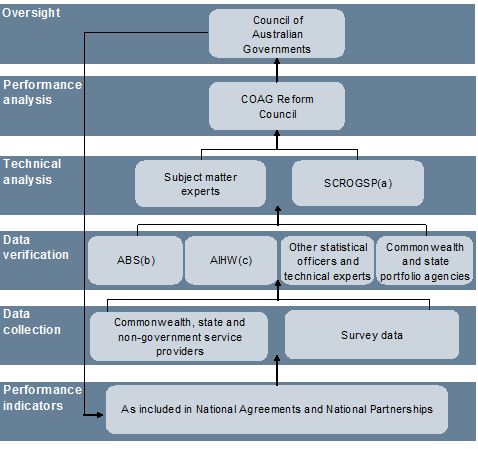
- Steering Committee for the Review of Government Service Provision.
- Australian Bureau of Statistics.
- Australian Institute of Health and Welfare.
Determining achievement against outcomes and benchmarks
The performance of the Commonwealth and the States in achieving mutually agreed outcomes and performance benchmarks specified in National Agreements is monitored and assessed by the COAG Reform Council. Specifically, the COAG Reform Council:
- publishes performance information for all jurisdictions against National Agreement outcomes and performance benchmarks;
- produces an analytical overview of performance information for each National Agreement, and National Partnerships to the extent they support the objectives in a National Agreement;
- independently assesses whether predetermined performance benchmarks have been achieved before a reward payment is made to reward nationally significant reforms under National Partnership agreements;
- highlights examples of good practice and performance so that, over time, innovative reforms or methods of service delivery may be adopted by other jurisdictions; and
- monitors the aggregate pace of activity in progressing COAG's agreed reform agenda.
In preparing its performance reports, the COAG Reform Council may draw upon other data collection agencies and subject experts it considers relevant to its work.
The Steering Committee for the Review of Government Service Provision is responsible for collecting and providing the agreed performance information to the COAG Reform Council. The Commonwealth and the States provide the COAG Reform Council with any additional information necessary for it to fulfil its role.
In relation to the performance reporting framework, the Ministerial Council for Federal Financial Relations is responsible for:
- progressing the implementation of the performance reporting framework, including continually improving the quality and timeliness of data, and development and oversight of a national performance reporting system; and
- maintaining a register of the National Minimum Data Sets required to allow comparative reporting of governments' achievements against agreed objectives and outcomes (which is publicly available on the Ministerial Council for Federal Financial Relations website).
The Ministerial Council for Federal Financial Relations consults with other relevant Ministerial Councils and data collection agencies in undertaking its roles.
The development of the performance reporting framework provides the opportunity to move, as far as possible, to a single, integrated, national reporting system that will reduce collection costs and confusion in interpreting performance.
Implementing the performance reporting framework
The COAG Reform Council has published baseline performance reports for all six National Agreements. These reports provide baseline data against the performance indicators in the agreements.
The COAG Reform Council has begun the next cycle of performance reports for each of the National Agreements. These reports focus on reporting progress against targets and performance indicators compared to the baseline data.
In September 2010, the COAG Reform Council published the second performance reports for the National Education Agreement, and the National Agreement on Skills and Workforce Development. The performance reports on the National Healthcare Agreement, National Disability Agreement, National Affordable Housing Agreement, and the National Indigenous Reform Agreement are expected to be publicly available in June 2011.
In its reports on National Agreements, the COAG Reform Council provides advice to COAG on potential improvements to performance reporting. COAG has agreed to implement a number of changes to performance reporting measures in line with COAG Reform Council recommendations in the baseline reports.
In addition, on 13 February 2011, COAG agreed to review the performance frameworks of each of the National Agreements to ensure that progress is measured and that all jurisdictions are clearly accountable to the public and COAG for their efforts. These reviews are being conducted during 2011 and 2012.
Heads of Treasuries Review of National Agreements, National Partnerships and Implementation Plans under the Intergovernmental Agreement
At its 7 December 2009 meeting, COAG noted the considerable progress made in implementing the Intergovernmental Agreement in its first year of operation. COAG also agreed that Heads of Treasuries, in consultation with Senior Officials, would undertake a review of National Agreements, National Partnerships and related Implementation Plans and report through the Ministerial Council for Federal Financial Relations to COAG in respect of whether agreements:
- have clear objectives, outcomes and outputs;
- clearly specify roles and responsibilities, particularly in National Agreements;
- constitute the appropriate form for implementing a policy proposal;
- have the appropriate quantity and quality of performance indicators and benchmarks, including whether they meet the requirement that performance reporting contributes to public transparency; and
- are consistent with the Intergovernmental Agreement, in particular the extent to which they are aligned with the design principles set out in Schedule D — Payment Arrangements and Schedule E — National Policy and Reform Objectives of the Intergovernmental Agreement.
In accordance with the Terms of Reference for the review, Heads of Treasuries reported to the Ministerial Council for Federal Financial Relations in December 2010. The review was considered by COAG at its February 2011 meeting.
The report found that the underlying principles of the Intergovernmental Agreement provide a strong foundation for pursuing the COAG reform agenda and that, while implementation has generally progressed well, some challenges remain. The recommendations of the review provide a basis for addressing these challenges to ensure that the federal financial relations framework remains sustainable and mutually beneficial.
COAG agreed that, through a joint Steering Committee, State and Territory first ministers' departments and treasuries will be responsible for oversighting implementation of the review. The Steering Committee will also oversee reviews of the performance reporting frameworks of the six National Agreements, as well as responding to recommendations of the COAG Reform Council.
If www.budget.gov.au responds slowly or you are having trouble downloading a document, try one of the Budget Website Mirrors
Note: Where possible, Budget documents are available in HTML and for downloading in Portable Document Format(PDF). If you require further information on any of the tables or charts on this website, please contact The Treasury.