




Detailed domestic forecasts
Australia's real GDP is forecast to grow 3¼ per cent in both 2011‑12 and 2012‑13. Compared with Budget, the forecasts have been downgraded by ¾ of a percentage point in 2011‑12 and ½ of a percentage point in 2012‑13, largely reflecting the deterioration in global economic and financial conditions. Economic growth is expected to be underpinned by business investment and commodity exports.
Household consumption is forecast to grow below trend, increasing 3 per cent in both 2011‑12 and 2012‑13. This is weaker than expected at Budget, reflecting a slower anticipated pace of employment and wages growth over the forecast horizon. House price falls and the recent global volatility, which have led to falls in household net worth and consumer confidence, are expected to weigh on consumption growth in the near term. Household consumption is forecast to grow broadly in line with household disposable income, with the household saving ratio expected to remain elevated.
Dwelling investment is forecast to grow 1½ per cent in both 2011‑12 and 2012‑13. New dwelling investment grew 5.2 per cent in 2010‑11, the strongest performance since 2002‑03, underpinned by a high level of construction activity in the Victorian market. However, with few signs of growth in other states, the further weakening in building approvals is expected to see growth ease over the forecast period, in line with broader softness in the housing market.
New business investment is expected to grow 14 per cent in 2011‑12 and 14½ per cent in 2012‑13, reflecting strong forecast growth in resources investment but a weaker outlook for investment in other parts of the economy. Sustained strong demand for Australia's key non‑rural commodity exports continues to drive record investment intentions in the mining sector. New engineering construction is expected to grow 29½ per cent in 2011‑12 and 23 per cent in 2012‑13, underpinned by liquefied natural gas, iron ore and coal projects. The resources sector is also expected to drive higher levels of investment in new machinery and equipment, with growth forecast to be 14 per cent in 2011‑12 and 14½ per cent in 2012‑13. The weakness in non‑mining investment is most evident in new non‑residential building activity, which is forecast to decline 5 per cent in 2011‑12 before recovering by 2 per cent in 2012‑13.
Public final demand is forecast to grow 1¼ per cent in 2011‑12, before falling 1¼ per cent in 2012‑13. The public final demand forecasts reflect the withdrawal of fiscal stimulus and the fiscal consolidation plans of the Commonwealth and State governments. The withdrawal of fiscal stimulus is expected to detract around ½ of a percentage point from real GDP growth in 2011‑12 and have no impact on real GDP growth in 2012‑13, as the withdrawal of fiscal stimulus will be complete.
Export growth forecasts have been downgraded since Budget for 2011‑12, but remain solid. The downgrade largely reflects a slower‑than‑expected recovery in Queensland coal exports following the floods, ongoing delays nationally in commodity export capacity expansions coming on line and weaker forecast growth in Australia's major trading partners. Nevertheless, non‑rural commodity exports are expected to grow strongly over the period. Services and manufacturing export growth is expected to remain weak, in line with the weaker outlook for Australia's major trading partners and the high exchange rate. Farm production and consequently rural exports surged in 2010‑11 and are expected to remain elevated in 2011‑12 owing to continuing favourable weather conditions. In 2012‑13, rural output and exports are expected to decline to more normal levels, in line with an assumed return to average weather conditions. Total exports are forecast to increase by 6 per cent in both 2011‑12 and 2012‑13.
Import growth forecasts have been downgraded slightly for 2011‑12, reflecting weaker domestic demand, and upgraded for 2012‑13, reflecting stronger expected capital imports associated with expenditure on major mining projects. Import volumes are forecast to grow 10 per cent in 2011‑12 and 9½ per cent in 2012‑13. Net exports are expected to detract 1¼ percentage points from real GDP growth in 2011‑12 and 1 percentage point in 2012‑13.
Forecast growth in the terms of trade has been revised up in year‑average terms in 2011‑12, reflecting higher‑than‑anticipated bulk commodity prices through to the September quarter. The terms of trade are expected to decline, albeit to still‑elevated levels, in 2012‑13, consistent with recent declines in coal and iron ore prices and the strong projected increase in the global supply of non‑rural commodities. The terms of trade are expected to increase 1¾ per cent in 2011‑12, before declining 5¼ per cent in 2012‑13.
The current account deficit is forecast to widen over the next two years. This reflects a widening net income deficit associated with rising mining profits generating increased equity income outflows and the movement of the trade balance from surplus to deficit. The current account deficit is expected to be 4 per cent of GDP in 2011‑12 and 5¾ per cent of GDP in 2012‑13.
The unemployment rate, currently around 5¼ per cent, is expected to rise slightly to around 5½ per cent by the June quarter of 2012 and to remain broadly stable through to the June quarter of 2013. The labour market outlook has weakened since Budget following slower employment growth during 2011 and a downgrade to the economic outlook, particularly in the non‑mining sectors of the economy where the majority of workers are employed. Employment is forecast to grow 1 per cent through the year to the June quarter of 2012 and 1½ per cent through the year to the June quarter of 2013, weaker than forecast at Budget.
Wages growth is expected to slow, consistent with the softer labour market outlook. The Wage Price Index is expected to grow 3¾ per cent through the year to the June quarters of both 2012 and 2013, weaker than forecast at Budget.
After spiking in 2010‑11 due to the impact of floods and cyclones on fruit and vegetable prices, headline inflation is expected to moderate in 2011‑12 and remain contained in 2012‑13, in line with the outlook for trend economic growth and relatively stable unemployment. Both underlying and headline measures of inflation are expected to be 2¼ per cent through the year to the June quarter of 2012. Underlying inflation is then expected to rise modestly to 2¾ per cent through the year to the June quarter of 2013, including a one‑off ¼ of a percentage point addition due to the carbon price; headline inflation, including the one‑off impact of the carbon price, is forecast to be 3¼ per cent through the year to the June quarter of 2013.
Nominal GDP is forecast to grow 6¼ per cent in 2011‑12 and 5 per cent in 2012‑13. Forecast growth in nominal GDP is unchanged in 2011‑12, but ¾ of a percentage point weaker in 2012‑13 than expected at Budget, reflecting the ½ of a percentage point downward revision to real GDP growth and a steeper forecast decline in the terms of trade.
Box 2.2: Iron ore prices
Most commodity prices have fallen significantly over recent months. While iron ore prices defied this broader trend initially, spot prices fell by more than US$50 (or over 30 per cent) in October to below US$120/tonne. This was the largest monthly fall in iron ore prices since the global financial crisis. Iron ore spot prices subsequently increased by around $US30 (or 25 per cent) in the first half of November, remaining below their early‑September peak, but at levels that are still high by historical standards (Chart 2.3).
Chart 2.3: Iron ore spot prices
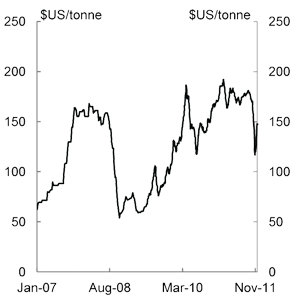
Note: Series is daily spot China import Iron Ore Fines 62 per cent Fe CFR. Data prior to December 2008 are spliced backwards using weekly spot China import Iron Ore Fines 63.5 per cent Fe CFR.
Source: Bloomberg and Treasury.
The substantial volatility in iron ore prices appears to have been driven by a reinforcing combination of demand and supply factors, some of which are expected to be temporary.
Activity in global steel markets traditionally softens in the latter part of the calendar year as production eases and significant maintenance work is undertaken. This seasonal softening appears to have been amplified this year by the announcement of large scale steel production cuts in Europe, tighter global credit conditions, and tighter financial conditions in China. While European demand is likely to remain lower than normal for some time, Chinese demand is expected to pick up in the near term as steel mills restock in the lead up to winter.
On the supply side, Australian iron ore producers have recently been exporting at record rates. Combined with redirected iron ore supplies from Europe and record Chinese domestic iron ore production, this additional supply has also weighed on prices in the face of temporarily weaker Chinese demand.
Prices rose in the first half of November and are expected to recover a little further in the near term as prices had fallen below the marginal cost of production for some producers. With a significant proportion of China's domestic iron ore production estimated to be high cost, some Chinese domestic supply could have been wound back or shut down if these lows had been sustained.
Over the longer term, the outlook for iron ore demand remains positive despite the recent financial market turbulence. Growth prospects for emerging Asia, particularly China, continue to be robust.
With iron ore accounting for 20 per cent of Australia's total exports in 2010‑11 (valued at $58 billion) and over 4 per cent of GDP, developments in the market have significant implications for the Australian economy and Government revenues.
Medium‑term economic projections
The fiscal aggregates in the MYEFO are underpinned by a set of forward estimates consisting of short‑term economic forecasts for 2011‑12 and 2012‑13 and a further 2 years of projections based on medium‑term assumptions.
Real GDP is projected to grow at around 3 per cent annually over the two projection years of the forward estimates (Chart 2.4). These projections are based on analysis of underlying trends in employment and productivity.
Chart 2.4: Real GDP growth over the forward estimates period
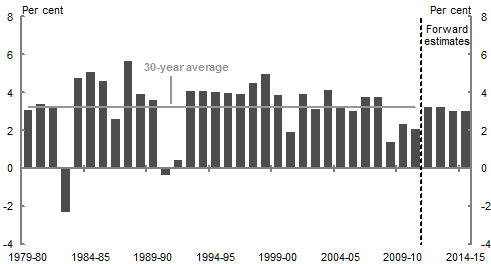
Source: ABS cat. no. 5204.0 and Treasury.
Beyond the forward estimates, real GDP is projected to grow at around 3 per cent until 2022‑23, when growth is projected to slow as population ageing generates a gradually falling participation rate.
The unemployment rate is projected to be 5 per cent over the medium term, the assumption that has long been used for medium‑term projections, and near the top of the band of current estimates of the NAIRU (4½ to 5 per cent). Inflation is projected to be 2½ per cent, consistent with the Reserve Bank of Australia's medium‑term target band.
The terms of trade are projected to decline by a total of around 20 per cent over a 15‑year period from 2012‑13, settling just above their 2006‑07 level. This reflects an expectation that current levels of commodity prices will not be sustained in the longer term, as supply increases gradually bring down prices over time.
The exchange rate is assumed to remain at recent levels during the forecast period. Over the projection period, the exchange rate is assumed to move in line with the long‑term historical relationship between the terms of trade and the real effective exchange rate. The terms of trade projections imply a fall in the real exchange rate of 0.9 per cent per annum over the projection period.
If www.budget.gov.au responds slowly or you are having trouble downloading a document, try one of the Budget Website Mirrors
Note: Where possible, Budget documents are available in HTML and for downloading in Portable Document Format(PDF). If you require further information on any of the tables or charts on this website, please contact The Treasury.