




International economic outlook
The Budget papers highlighted very considerable risks to the global economy. Unfortunately almost all of those risks have subsequently eventuated, with the world growth outlook deteriorating significantly since Budget. In particular, this reflects a dramatic intensification of the European sovereign debt crisis and a weaker‑than‑expected United States economy. Risks continue to be tilted strongly to the downside with considerable potential for damaging contagion from a downward spiral of events in Europe.
Emerging economies' growth is holding up relatively well on the back of strong domestic demand. However, the global uncertainty arising from Europe exposes these economies to the risks of sharp outflows of capital, a reduction in US dollar liquidity and a deterioration of trade finance. They would also inevitably be affected by a more severe slowing in European or US growth through trade and confidence effects.
Commodity prices have also been buffeted by weaker global growth prospects and uncertainties about the strength of demand from emerging markets.
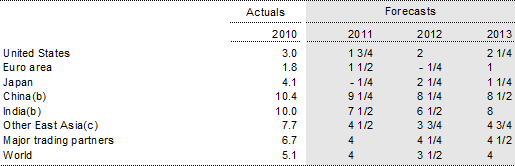
The deterioration in the global economic outlook means that world GDP is now expected to grow 4 per cent in 2011 and 3½ per cent in 2012, compared with Budget forecasts of 4¼ per cent in 2011 and 4½ per cent in 2012. The global recovery remains vulnerable to shocks, most notably emanating from Europe. Growth in emerging economies, led by China, while slowing, is holding up and is forecast to continue to drive global growth. However, a further sharp deterioration in the situation in Europe or the US would be expected to have spill‑over effects on the growth performance of emerging market economies.
Table 2.2: International GDP growth forecasts(a)
- World, euro area and other East Asia growth rates are calculated using GDP weights based on purchasing power parity (PPP), while growth rates for major trading partners are calculated using export trade weights.
- Production‑based measure of GDP.
- Other East Asia comprises the newly industrialised economies (NIEs) of Hong Kong, South Korea, Singapore and Taiwan and the Association of Southeast Asian Nations group of five (ASEAN‑5), which comprises Indonesia, Malaysia, the Philippines, Thailand and Vietnam.
Source: National statistical agencies, IMF World Economic Outlook September 2011, Thomson Reuters and Treasury.
Growth of Australia's major trading partners (MTPs) is forecast to remain solid, albeit lower than at Budget, reflecting the uncertainty arising from developments in Europe. Following strong MTP growth of 6.7 per cent in 2010, growth is forecast to ease to 4 per cent in 2011, before picking up to 4¼ per cent in 2012 and 4½ per cent in 2013. The more robust prospects for growth in Australia's MTPs compared with growth in world GDP reflects the composition of our MTPs, which is increasingly weighted towards the fast growing emerging Asian economies.
The 26 October 2011 euro area leaders' summit made some welcome decisions to address the European sovereign debt crisis. Those measures included a plan to write‑down more Greek debt, recapitalise European banks and increase the fire‑power of the euro area bailout fund. However, many details remain unresolved and concerns linger that the measures may not be enough to combat the crisis. There are also clear implementation risks as political instability in Greece casts doubt on Greece's ability to stave off default. Indeed, questions about the extent of political commitment to tackle the crisis remain the single largest source of uncertainty. For Europe, the task at hand is enormous, with most countries pursuing contractionary fiscal policies, yields on Italian and Spanish debt at unsustainable levels and the prospect of deleveraging by European banks in the face of requirements to recapitalise. Italy, as the third largest economy in the euro area, is of particular concern given its large level of sovereign debt, weak growth prospects, poor economic reform record, political instability and rising risk premia being priced into its bonds.
The bank recapitalisation plan is vexed by the symbiotic links between the banking system and sovereign debt. If banks recapitalise by deleveraging rather than raising capital in markets, lending growth will be further constrained, hampering already weak economic activity in the region. In addition, the underlying problems facing the euro area, such as the need to enhance competitiveness and growth, and increase economic and fiscal integration, will be extremely difficult to address in circumstances of financial sector fragility. The confluence of these factors is expected to result in much of Europe returning to recession in 2012.
Given the poor outlook for Europe, sustaining the global recovery in the period ahead will rely primarily on the United States and China, the two largest economies in the world.
A confluence of temporary factors weighed on US GDP growth in the first half of 2011, including the disruption to motor vehicle supply chains caused by the Japanese earthquake, tsunami and nuclear accident, and high world oil prices. Data released in late July then saw downward revisions to US GDP which revealed that the recovery was much weaker, and the 2007‑09 recession much deeper, than previously estimated. The latest data show a modest pick‑up in growth as the impacts of the temporary factors continue to unwind. However, with US housing and labour markets remaining depressed, the US recovery will be weak and vulnerable to external shocks. In addition, given the ongoing political debate in the US concerning fiscal policy, we face the situation whereby failure to commit to a medium‑term fiscal consolidation program creates uncertainty, while any premature fiscal consolidation would risk further exacerbating current weakness. This risk has been exacerbated by the failure of the Congressional 'Super Committee' to agree on a comprehensive package of budget cuts. What is required is a clear, moderate but staged approach to improving the US' fiscal position.
Economic growth in China is expected to remain strong over the forecast horizon. However, the rate of expansion is likely to moderate relative to the robust investment‑driven growth in 2010 and 2011. Activity in the industrial and housing sectors has slowed as Government stimulus spending has declined and authorities have tightened monetary and credit policy settings in response to inflationary concerns. Recent financial market stress and continued sluggish growth in Europe and the US have reinforced downside risks from external conditions, which overlay existing pockets of domestic vulnerability flowing from the investment‑driven post‑GFC boom and the way in which sub‑national governments have financed growth. However, authorities remain well placed to respond to external shocks, or a faster‑than‑expected moderation in domestic activity, with targeted policy easing.
Elsewhere in the region, the outlook remains broadly positive, barring a further substantial deterioration in the global economy. Japan's recovery from the March disasters has been slower than expected at Budget, primarily reflecting delays in reconstruction efforts, although growth is expected to strengthen in 2012. In Indonesia, domestic demand continues to drive solid growth and this is forecast to continue. India's economic growth is forecast to slow in 2012 as past monetary policy tightening takes effect, before returning to trend in 2013. Growth in Asia's other trade exposed economies is holding up relatively well, although these economies remain vulnerable to a further substantial deterioration in global growth and financing conditions.
If www.budget.gov.au responds slowly or you are having trouble downloading a document, try one of the Budget Website Mirrors
Note: Where possible, Budget documents are available in HTML and for downloading in Portable Document Format(PDF). If you require further information on any of the tables or charts on this website, please contact The Treasury.