




Fiscal outlook
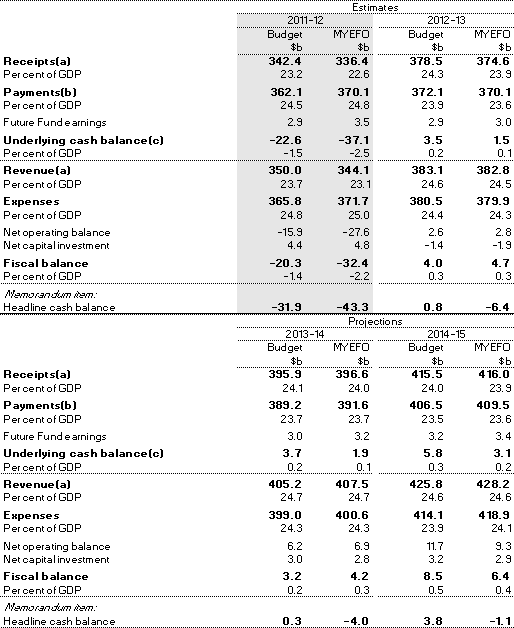
The Australian Government's underlying cash deficit for 2011‑12 is estimated to be $37.1 billion (2.5 per cent of GDP). In accrual terms, a fiscal deficit of $32.4 billion (2.2 per cent of GDP) is estimated for 2011‑12.
Table 3.4: Australian Government general government sector budget aggregates
- Includes expected Future Fund earnings.
- Equivalent to cash payments for operating activities, purchase of non‑financial assets and net acquisition of assets under finance leases.
- Excludes expected Future Fund earnings.
Underlying cash balance estimates
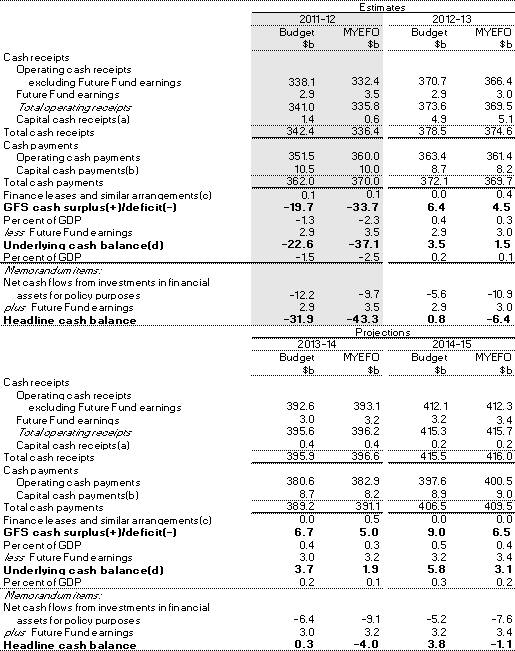
The 2011‑12 underlying cash deficit is expected to be $14.5 billion higher than forecast in the 2011‑12 Budget.
Table 3.5: Summary of Australian Government general government sector cash flows
- Equivalent to cash receipts from the sale of non‑financial assets in the cash flow statement.
- Equivalent to cash payments for purchases of non‑financial assets in the cash flow statement.
- The acquisition of assets under finance leases decreases the underlying cash balance. The disposal of assets previously held under finance leases increases the underlying cash balance.
- Excludes expected Future Fund earnings.
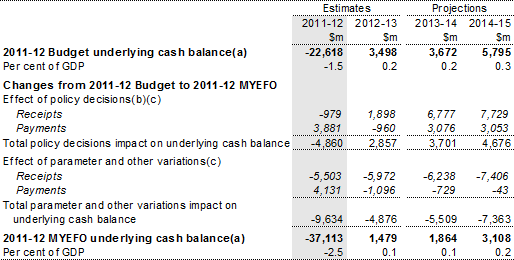
Table 3.6 provides a reconciliation of the variations in the underlying cash balance since the 2011‑12 Budget.
Table 3.6: Reconciliation of general government sector underlying cash
balance estimates
- Excludes expected Future Fund earnings.
- Excludes secondary impacts on public debt interest of policy decisions and offsets from the Contingency Reserve for decisions taken.
- A positive number for receipts indicates an increase in the underlying cash balance, while a positive number for payments indicates a decrease in the underlying cash balance.
Total policy decisions since the 2011‑12 Budget have increased the underlying cash deficit by $4.9 billion in 2011‑12, but improve the budget position over the forward estimates.
Total parameter and other variations since the 2011‑12 Budget have increased the underlying cash deficit by $9.6 billion in 2011‑12.
Further details of the impact of policy decisions and major variations arising from parameter and other variations on the fiscal outlook is provided in the receipt estimates and payment estimates sections below.
Receipt estimates
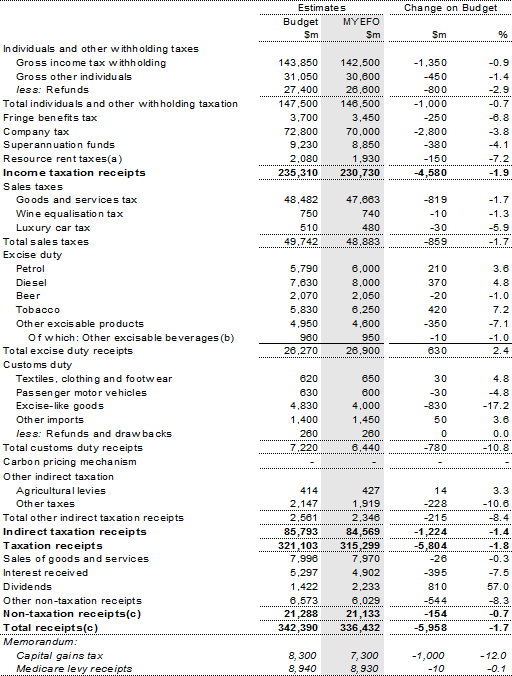
Since the 2011‑12 Budget, total tax receipts have been revised down by $5.8 billion in 2011‑12 and $9.8 billion over the four years to 2014‑15, resulting in a lower tax‑to‑GDP ratio in 2011‑12 and 2012‑13 relative to expectations at Budget. While the tax‑to‑GDP ratio is expected to continue to recover, it is projected to remain below its 2007‑08 level over the forward estimates.
International growth prospects have weakened since Budget. Although the Australian economy is forecast to grow at around its trend rate over the forward estimates, the deterioration in global conditions has contributed to a reduction in momentum in some parts of the economy. Volatile financial markets are weighing on Australian equity prices, which are affecting capital gains. Moreover, employment growth and wages growth are expected to be weaker than at Budget.
These downward revisions to employment and wages growth since Budget have resulted in reduced gross income tax withholding receipts, as well as indirect taxes due to the subdued consumption outlook associated with lower wages since Budget, combined with continuing consumer caution. Weakness in asset prices, driven particularly by the volatile international outlook, is also contributing to the downgrade in tax receipts.
Receipts for capital gains tax are now expected to grow at a softer pace than was expected at Budget, with the downgrade totalling $7.0 billion over the forward estimates. This has contributed to downward revisions to company tax. The revised outlook for capital gains, in conjunction with the revised labour market outlook, has also meant downgrades to tax receipts from gross other individuals and superannuation funds.
Abstracting from policy decisions, tax receipts are expected to be lower by $4.8 billion in 2011‑12 and $24.4 billion over the four years to 2014‑15 relative to Budget.
Table 3.7: Australian Government general government sector cash receipts —
2011-12
- Resource rent taxes in 2011‑12 only includes PRRT.
- Other excisable beverages are those not exceeding 10 per cent by volume of alcohol.
- Includes expected Future Fund earnings which are $524 million higher in 2011‑12 (and $980 million across the budget and forward estimates) than at the time of the 2011‑12 Budget. These earnings do not impact on the underlying cash balance.
Table 3.8: Australian Government general government sector cash receipts —
2012-13
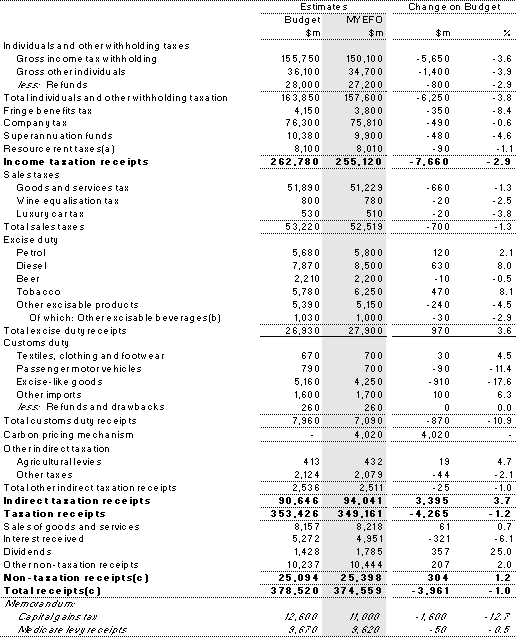
- Resource rent taxes include PRRT and gross receipts from the MRRT. The net receipts from the MRRT is $3.7 billion in 2012‑13, which represents the net impact on receipts across several different revenue heads. This includes the offsetting reductions in company tax (through deductibility) and interactions with other taxes.
- Other excisable beverages are those not exceeding 10 per cent by volume of alcohol.
- Includes expected Future Fund earnings which are $113 million higher in 2012‑13 (and $980 million across the budget and forward estimates) than at the time of the 2011‑12 Budget. These earnings do not impact on the underlying cash balance.
Policy decisions
Policy decisions since the 2011‑12 Budget have decreased receipts by $1.0 billion in 2011‑12 and increased receipts by $1.9 billion in 2012‑13.
The Government's plan for a clean energy future raises revenue from the sale of permits for carbon pollution and related measures, which is used to fund tax cuts and provide assistance to households and businesses. Overall this package has a net cost to the Budget of $3.3 billion (including the automatic CPI indexation of transfer payments which has been reflected as a parameter variation), on an underlying cash basis over the forward estimates period.
The revenue savings measures include decisions to reform certain tax expenditures and defer some measures as part of the Government's commitment to responsible economic management. Major policy decisions that have increased receipts over the budget and forward estimates include:
- placing an explicit price on greenhouse gas emissions through the carbon pricing mechanism. This measure is estimated to raise $17.8 billion on an underlying cash basis over the forward estimates period from the sale of carbon units, all of which will be used to help households, industry, community organisations, workers and regions adjust to the carbon price;
- deferring the commencement of the 2010‑11 Budget measure that provided a standard deduction for work‑related expenses and the cost of managing tax affairs by 12 months, to now commence on 1 July 2013. This measure is estimated to raise $1.2 billion on an underlying cash basis over the forward estimates period;
- applying an effective carbon price on aviation and non‑transport gaseous fuels by increasing the excise and excise‑equivalent customs duties on these fuels, proportional to the relevant emission rates. This measure is estimated to raise $920 million on an underlying cash basis over the forward estimates period and forms part of the revenue which will be redirected to households and industry to help them adjust;
- reforming the tax treatment of living‑away‑from‑home allowance and benefits, for periods commencing 1 July 2012 for both new and existing arrangements. These changes will better target this concession to a more appropriate range of circumstances and require individuals to substantiate that the allowance is being used for its intended purpose. This measure is estimated to raise $682 million on an underlying cash basis over the forward estimates period; and
- pausing indexation of the superannuation concessional contributions cap for one year in 2013‑14, improving the underlying cash balance by $485 million over the forward estimates period.
The impact of these policy decisions on receipts has been partially offset by a number of decisions that have reduced receipts, including:
- as part of the Government's Clean Energy Future package, increasing the statutory tax‑free threshold from $6,000 to $18,200 from 1 July 2012 for personal income tax. From 1 July 2015, the statutory tax‑free threshold will further increase to $19,400. Associated adjustments will be made to the low income tax offset and statutory marginal tax rates and thresholds. This measure has a cost to revenue estimated to be $8.0 billion on an underlying cash basis over the forward estimates period;
- deferring the commencement of the new Research and Development Tax Incentive by 12 months as a result of delays in the passage of the measure through parliament. The new incentive will now apply to income years commencing on or after 1 July 2011. This measure has an estimated cost to revenue of $760 million on an underlying cash basis over the forward estimates period. This measure is largely offset by the decrease in cash payments by $720 million in 2011‑12; and
- allowing small businesses to immediately write off depreciating assets costing less than $6,500 (up from $5,000), with effect from the 2012‑13 income year. This measure has an estimated cost to revenue of $200 million on an underlying cash basis over the forward estimates period.
Parameter and other variations
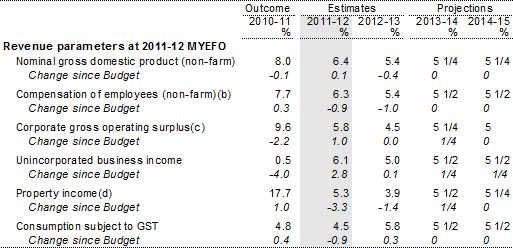
The key economic parameters that influence revenue are shown in Table 3.9. The table shows effects on the Australian Government's main tax bases of the changed economic circumstances and outlook since the 2011‑12 Budget.
Table 3.9: Key economic parameters(a)
- Current prices, per cent change on previous year.
- Compensation of employees measures total remuneration earned by employees.
- Corporate GOS is an Australian National Accounts measure of company profits.
- Property income measures income derived from rent, dividends and interest.
Parameter and other variations have decreased tax receipts since the 2011‑12 Budget by $4.8 billion in 2011‑12 and $6.1 billion in 2012‑13.
Income tax withholding receipts have been revised down by $1.3 billion in 2011‑12 and $3.2 billion in 2012‑13, reflecting a softening in the outlook for employment and wages growth.
Gross other individuals' taxation receipts have been revised down by $450 million in 2011‑12 and $940 million in 2012‑13, reflecting the revised economic outlook, as well as weakness in capital gains.
Refunds are around $800 million lower in both 2011‑12 and 2012‑13, consistent with recent outcomes and the downward revisions to individuals' income taxes.
Fringe benefits tax has been revised down by $250 million in 2011‑12 and $270 million in 2012‑13, due to a lower than expected 2010‑11 outcome and the revised labour market outlook.
Superannuation taxes are expected to be $380 million lower in 2011‑12 and $480 million lower in 2012‑13, as weaker employment and wages growth results in lower contributions, in addition to lower capital gains.
Company tax receipts have been revised down by $1.8 billion in 2011‑12 and $780 million in 2012‑13, partly due to lower capital gains in both years and increased company refunds in 2011‑12. The impact of the refunds is muted in 2012‑13 due to a range of revenue protection measures.
Resource rent taxes have been revised down by $150 million in 2011‑12 and $70 million in 2012‑13. The revisions reflect increased state royalties, weaker production expectations and lower commodity price assumptions, partly offset by the lower Australian dollar.
GST has been revised down by $820 million in 2011‑12 and $660 million in 2012‑13, reflecting lower consumption and subdued dwelling investment.
Since Budget, excise duty has been revised up by $590 million in 2011‑12 and $570 million in 2012‑13, while customs duty has been revised down by $770 million in 2011‑12 and $830 million in 2012‑13. The composition of receipts between excise and customs duties has been revised relating to the relocation of a large tobacco manufacturer. Abstracting from this, tax receipts from tobacco have been revised down since Budget.
Both the luxury car tax and the wine equalisation tax have been revised down in 2011‑12 and 2012‑13, reflecting the consumption outlook.
Analysis of the sensitivity of the taxation receipts estimates to changes in the economic outlook is provided in Attachment A to this part.
Payment estimates
Since the 2011‑12 Budget, estimated cash payments for 2011‑12 have increased by $8.0 billion reflecting new policy decisions of $3.9 billion and parameter and other variations of $4.1 billion.
Policy decisions
Major policy decisions since the 2011‑12 Budget that have increased cash payments in 2011‑12 and across the forward estimates include:
- assistance for households to meet additional costs under the Clean Energy Future package. This measure is expected to increase cash payments by $1.5 billion in 2011‑12 ($6.2 billion over four years);
- support, under the Clean Energy Future package, for emissions‑intensive coal mines, coal‑fired power stations, Australian steel and other manufacturing industries, and those activities in the economy that are the most emissions‑intensive and highly exposed to international competition to transition to a low carbon future. These measures are expected to increase cash payments by $1.4 billion in 2011‑12 ($6.1 billion over four years);
- accelerating funding for a range of Nation Building road and rail infrastructure projects, including the duplication of the Pacific Highway, works on the Bruce Highway, the Interchange at Mains and Kessels Road, the Hunter Expressway, Western Ring Road in Melbourne and the South Road Superway, the Gawler Line Modernisation project in Adelaide and the Blacksoil Interchange Project. These decisions are expected to increase cash payments by $1.4 billion in 2011‑12 (a net increase of $45 million over four years);
- new listings on the Pharmaceutical Benefits Scheme which are expected to increase cash payments by $67 million in 2011‑12 ($445 million over four years); and
- setting aside funding to meet the Commonwealth's share of the costs to the Social and Community Services sector for the equal remuneration case currently before Fair Work Australia.
The impact of these policy decisions on payments has been partially offset by a number of decisions that have reduced payments, including:
- a one‑off increase of 2.5 per cent to the efficiency dividend for most Commonwealth departments and agencies in the 2012‑13 financial year. This measure has no impact in 2011‑12 but is expected to reduce cash payments by $1.5 billion over the period 2012‑13 to 2014‑15;
- a 20 per cent reduction in funding provided under capital budgeting arrangements for relevant Commonwealth agencies and departments. This measure has no impact in 2011‑12 but is expected to reduce cash payments by $710 million over the period 2012‑13 to 2014‑15;
- implementing an effective carbon charge on the use of liquid and gaseous fuels through the fuel tax system by reducing the business fuel tax credit entitlement for the use of these fuels. This measure is expected to cost $2 million in 2011‑12 but deliver a net reduction in cash payments of $962 million over four years;
- reducing the maximum co‑contribution payable and rate at which the government matches eligible personal superannuation contributions for low to middle income earners from 1 July 2012. This measure is expected to reduce cash payments by $660 million over two years from 2013‑14;
- resetting the baby bonus to $5,000 per child from 1 September 2012 and pausing indexation from 1 July 2012. This measure is expected to cost $1 million in 2011‑12 but delivers a net reduction in cash payments of $320 million over four years;
- ceasing the student experience and quality learning components of Higher Education Reward Funding, reducing expected cash payments by $3 million in 2011‑12 ($241 million over four years). Funding will continue to be provided for the achievement of participation and social inclusion outcomes; and
- making the payment of Family Tax Benefit Part A supplement conditional on a child being fully immunised from 1 July 2012. From 1 July 2013, children will be required to receive vaccines for meningococcal C, pneumococcal and varicella to be assessed as fully immunised. From this date, Priorix‑Tetra®, a combination vaccine, will be added to the National Immunisation Program. This measure is expected to cost $13 million in 2011‑12, but deliver savings of $197 million over four years.
A full description of all policy measures since the 2011‑12 Budget can be found in Appendix A.
Parameter and other variations
Major increases in expected cash payments in 2011‑12 as a result of parameter and other variations since the 2011‑12 Budget include:
- natural disaster relief payments to the States and Territories under the Natural Disaster Relief and Recovery Arrangements reflecting: a further advance payment of $1.4 billion in 2011‑12 to meet the cost of claims by the Queensland Government to ensure reconstruction work can progress as quickly as possible; higher than expected costs for the Queensland 2010‑11 floods and Cyclone Yasi; and delays in claims for reimbursement for disaster restoration work undertaken in 2008, 2009 and 2010. These adjustments increase estimated cash payments by $2.3 billion in 2011‑12 ($1.0 billion over four years);
- child care fee assistance which is expected to increase by $100 million in 2011‑12 ($1.4 billion over four years), in part reflecting higher growth in child care demand than was expected at Budget;
- private health insurance payments which are expected to increase by $910 million in 2011‑12 ($1.3 billion over four years). The increase in 2011‑12 is largely driven by the delay of the 2009‑10 Budget Measure: Private health insurance — fair and sustainable support for the future which increases expected payments by $732 million in 2011‑12. The Government announced this measure in the 2009‑10 Budget; however, the enabling legislation has not been passed by Parliament. This measure remains the Government's policy. The remaining increase in expected payments of $178 million in 2011‑12 ($571 million over four years) reflects a higher than anticipated number of people with health insurance and higher levels of coverage by individuals;
- residential aged care subsidies which are expected to increase by $444 million in 2011‑12 ($1.9 billion over four years), owing to an increase in the estimated average subsidy for aged care residents as a result of older Australians entering residential aged care facilities with greater care needs than previously anticipated;
- onshore processing costs related to irregular maritime arrivals, which are expected to increase by $1.3 billion over four years as a result of an increase in expected arrival rates compared to those at Budget. This is partly offset by $1.1 billion in reduced costs and savings associated with not progressing offshore processing arrangements at this time, leaving a net impact on the budget of $197 million over four years;
- payments related to the Research and Development Tax Offset, which are expected to increase by $327 million in 2011‑12 reflecting updated forecasts for claims in 2011‑12;
- payments related to Fuel Tax Credits which are expected to increase by $304 million in 2011‑12 ($1.7 billion over four years), reflecting updated production forecasts and associated fuel consumption;
- Remote Indigenous Housing National Partnership payments, which are expected to increase by $234 million in 2011‑12 (no net impact over four years), reflecting the acceleration of building and refurbishing housing in a number of States and Territories;
- Medicare Services payments which are expected to increase by $231 million in 2011‑12, primarily stemming from the extension of the Chronic Disease Dental Scheme (CDDS) to 31 March 2012 as a result of the Senate disallowing the determination to close the Scheme. The closure of the CDDS remains the Government's policy;
- the impact of foreign exchange rate movements which have increased cash payments by $216 million in 2011‑12 ($891 million over four years), primarily reflecting higher capital purchase costs for the Department of Defence;
- payments to Job Services Australia which are expected to increase by $180 million in 2011‑12 ($735 million over four years), largely reflecting a greater than expected use, since Budget, of the Employment Pathway Fund to assist job seekers; and
- the re‑profiling of existing renewable energy technology programs which has increased expected cash payments in 2011‑12 by $161 million ($425 million over four years).
Major reductions in expected cash payments in 2011‑12 as a result of parameter and other variations since the 2011‑12 Budget include:
- GST payments to the States and Territories which are expected to fall by $412 million in 2011‑12 ($2.6 billion over four years), consistent with a reduction in GST receipts. The reduction in GST receipts in 2011‑12 is partly offset by higher than estimated GST receipts in 2010‑11 which, as noted in the Final Budget Outcome 2010‑11, will be paid in 2011‑12;
- Pharmaceutical Benefits Scheme payments which are expected to fall by $265 million in 2011‑12 ($1.8 billion over four years), largely reflecting lower than expected usage of medicines such as higher cost cancer therapies. These estimates do not account for future drug listings; and
- National Healthcare specific purpose payments which are expected to fall by $110 million in 2011‑12 ($723 million over four years), reflecting changes to hospital utilisation rates and a fall in the five year average growth of the Australian Institute of Health and Welfare health price index.
Consistent with previous budgets, the underlying cash balance has been improved by the regular draw down of the conservative bias allowance. Details of this drawdown are provided at Attachment C.
If www.budget.gov.au responds slowly or you are having trouble downloading a document, try one of the Budget Website Mirrors
Note: Where possible, Budget documents are available in HTML and for downloading in Portable Document Format(PDF). If you require further information on any of the tables or charts on this website, please contact The Treasury.