




Statement 1: Budget Overview (Continued)
Economic outlook
The fundamentals of the Australian economy remain strong and the outlook remains positive, with the economy forecast to grow around trend, the unemployment rate expected to remain low and inflation likely to be well‑contained. Prospects continue to be underpinned by strong growth in our regional trading partners and an unprecedented pipeline of mining investment.
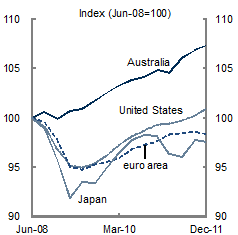
The Australian economy's level of output is well above pre‑global financial crisis levels and the economy is expected to grow around its trend rate over the next two years. Since the global financial crisis the Australian economy has outperformed every major advanced economy and is expected to continue to perform more strongly than these economies over the next two years (Chart 1).
Chart 1: GDP and Employment International Comparison
GDP
Employment
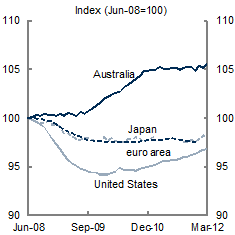
Note: Euro area employment data are quarterly. Employment data for Japan from March 2011 to August 2011 are not available due to the impacts of the Japanese earthquake and tsunami.
Source: ABS cat. no. 5206.0, 6202.0, national statistical agencies, Thomson Reuters and Treasury.
The economy is forecast to grow around trend over the next two years, driven by strong growth in the resources sector. Real GDP is forecast to grow 3 per cent in 2011‑12, 3¼ per cent in 2012‑13 and 3 per cent in 2013‑14 (Table 2). The impact of the Government's fiscal consolidation, particularly in 2012‑13, should be more than offset by growth in private demand.
Table 2: Major economic parameters(a)
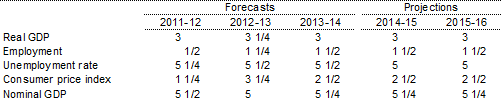
(a) Real and nominal GDP are year‑average growth. Employment and CPI are through‑the‑year growth to the June quarter. The unemployment rate is the rate for the June quarter.
Global financial market tensions eased in the early months of 2012, after the period of acute instability in late 2011, but there are still substantial downside risks to the global economic outlook. Many advanced economies are yet to return to pre‑global financial crisis output levels and face the substantial task of putting public finances on a sustainable footing while simultaneously supporting growth. While there have been some encouraging signs in the United States, the euro area appears to have re‑entered recession and there have been renewed concerns regarding its fiscal and financial stability. In addition, the United Kingdom has re‑entered recession.
Against this backdrop, there are dramatic structural changes underway in the global economy, with the weight of economic activity shifting towards Asia. Emerging economies, particularly China and India, are expected to account for a large part of global growth over the next two years.
This pattern of growth has significant implications for Australia. Strong demand from Asia, particularly China, is expected to continue to support historically high commodity prices, drive record levels of investment in resources projects in Australia and underpin solid growth in non‑rural commodity export volumes. Strong growth in emerging Asia will also increasingly provide opportunities for Australia's services sector and other parts of the economy.
Businesses expect to invest a record $120 billion in the resources sector in 2012‑13. The resources investment pipeline is currently over $450 billion, with more than half of these projects already committed or under construction. Over the forecast period, new business investment as a proportion of GDP is expected to reach the highest level since records were kept.
Strong growth in the resources sector is expected to continue to spill over into other sectors, including parts of the construction sector, parts of manufacturing and parts of the services sector.
Nonetheless, the outlook for some other parts of Australia's patchwork economy is uneven with unsettled global conditions, the high Australian dollar, ongoing consumer caution and changes in expenditure patterns all expected to weigh heavily on some sectors. While some of the headwinds outside of the resources sector are likely to be temporary, some are structural, reflecting the broad structural transition that is currently underway across the economy.
The pattern of growth in the Australian economy is uneven with the resources and resources‑related parts of the economy growing strongly, but some other parts of the economy facing challenging conditions. However, the patchwork economy is multifaceted. While growth in the resources parts of the economy has been exceptional in recent years, there has also been strong growth in a number of other sectors including, for example, health care and social assistance and professional scientific and technical services. There have also been pockets of strength in sectors such as manufacturing and elsewhere, even though many businesses in these sectors have been facing challenging conditions. There is a complex structural transition occurring in the economy and it is having wide‑ranging effects on many sectors and regions.
Notwithstanding the challenging conditions being experienced by some parts of the economy, Australia's unemployment rate has been relatively stable and at just above 5 per cent, is lower than most other advanced countries. The unemployment rate is around half that in Europe and significantly below that in the United States. In aggregate, employment is expected to grow 1¼ per cent through the year to the June quarter of 2013 and 1½ per cent through the year to the June quarter of 2014. The unemployment rate is expected to drift up to 5½ per cent by the June quarter of 2013.
With the economy expected to grow around trend, inflation is expected to be well‑contained. Headline inflation is forecast to be 1¼ per cent through the year to the June quarter of 2012, and 3¼ per cent through the year to the June quarter of 2013, including a one‑off ¾ of a percentage point increase due to the introduction of the carbon price, before declining to 2½ per cent through the year to the June quarter of 2014.
The commencement of the carbon price on 1 July 2012 is not expected to have a material impact on the domestic economic outlook with real GDP growth and employment growth expected to be reduced by less than ¼ of a percentage point in 2012‑13, with no discernible impact on the forecast unemployment rate.
Although the outlook for the Australian economy is positive, substantial downside risks remain. The key international risk is the potential for a re‑escalation of the euro area sovereign debt crisis. The capacity of many advanced economies to respond is limited and any further weakness could flow through to the emerging economies of Asia and to Australia.
If www.budget.gov.au responds slowly or you are having trouble downloading a document, try one of the Budget Website Mirrors
Note: Where possible, Budget documents are available in HTML and for downloading in Portable Document Format(PDF). If you require further information on any of the tables or charts on this website, please contact The Treasury.