




Statement 1: Budget Overview (Continued)
Fiscal strategy and outlook
Consistent with an economy forecast to grow around trend, the Government will return the budget to a surplus in 2012‑13, notwithstanding the challenges imposed by a further substantial write‑down in revenue.
Fiscal strategy
The Government's fiscal strategy is designed to ensure fiscal sustainability, while providing the necessary flexibility for the budget position to vary in line with economic conditions.
The medium‑term fiscal strategy, which has remained unchanged since the Government's first budget in 2008‑09, is to:
- achieve budget surpluses, on average, over the medium term;
- keep taxation as a share of GDP, on average, below the level for 2007‑08 (23.7 per cent); and
- improve the Government's net financial worth over the medium term.
To ensure a timely return to surplus and recovery in the fiscal position, since the beginning of the global financial crisis the Government has further committed to:
- allow the level of tax receipts to recover naturally as the economy improves, while maintaining the Government's commitment to keep taxation as a share of GDP below the 2007‑08 level on average; and
- build growing surpluses by holding real growth in spending to 2 per cent a year, on average, until the budget surplus is at least 1 per cent of GDP, and while the economy is growing at or above trend.
Why returning the Budget to surplus is appropriate
The Government's medium‑term fiscal strategy guided the Government's successful response to the global financial crisis and provides the basis for the Government's determination to return the budget to surplus.
Consistent with the strategy, the Government delivered a timely, targeted and temporary fiscal stimulus at the height of the global financial crisis to support economic growth and jobs at a time when the private sector was in retreat, and charted a clear path to return the budget to surplus at the same time.
Returning the budget to surplus in 2012‑13 remains appropriate given domestic economic conditions. The economy is forecast to grow around trend over the next two years, the unemployment rate is expected to remain low and mining investment is expected to reach record highs.
The return to surplus also recognises that fiscal policy should be set in a medium‑term framework. In normal circumstances monetary policy should play the primary role in managing demand to keep the economy growing at close to capacity consistent with achieving its medium‑term inflation target.
Importantly, the Budget forecast of around‑trend growth takes account of the impact of the substantial fiscal consolidation in 2012‑13. Returning the budget to surplus now will provide ongoing scope for monetary policy to respond to economic developments, if needed.
A return to surplus is also important for sustaining confidence in the strength of Australia's public finances. The European sovereign debt crisis has underscored that maintaining strong fiscal discipline and credibility is now more important than ever, with financial markets punishing those economies without it.
Global credit rating agencies have highlighted the importance of the Government's strategy of returning to surplus, which, along with Australia's very low level of public debt, is a key reason behind the Government receiving the AAA credit rating from all three major rating agencies for the first time in Australia's history.
The savings made to return the budget to surplus will also contribute to the sustainability of Australia's public finances and support Australia's capacity to respond to unanticipated events in uncertain global economic times.
Fiscal outlook — delivering on the Government's fiscal strategy
Consistent with the fiscal strategy, the return to surplus is being achieved through a combination of targeted and responsible savings and allowing the natural increase in tax receipts associated with a strengthening economy to flow through to the budget.
An underlying cash deficit of $44.4 billion (3.0 per cent of GDP) is expected in 2011‑12, with a surplus of $1.5 billion (0.1 per cent of GDP) expected in 2012‑13 and growing to $7.5 billion (0.4 per cent of GDP) in 2015‑16.
Slower than expected recovery in revenue
While tax receipts continue to recover from their post‑crisis lows, the recovery is weaker than previously expected, and tax receipts remain well below the unsustainable peaks reached in the period leading up to the crisis.
Continued weakness in capital gains receipts, lower than expected company tax collections relating to the 2010‑11 income year, and consumer caution have resulted in a write‑down to tax receipt estimates of $5.7 billion in 2011‑12 compared with expectations at MYEFO.
Most of these downgrades will flow through to 2012‑13 and the remainder of the forward estimates, with tax receipts revised down by $28.0 billion over the four‑year period from 2011‑12.
Tax receipts are projected to reach 22.9 per cent of GDP in 2015‑16, around 1 percentage point below the unsustainable levels reached in the mid‑2000s. This means that tax as a proportion of GDP in 2011‑12 and the previous two years is the lowest it has been since 1993‑94.
Prior to the global financial crisis, tax receipts were benefitting from a combination of factors that created buoyant revenue growth. These factors included a commodity price boom combined with higher production largely driven by the expansion of existing projects, very strong equity and house price growth, significant growth in household consumption expenditure, and a relatively low Australian dollar.
Since the global financial crisis there has been a fundamental change in structure of the domestic economy that is expected to affect tax receipts for some years to come.
While commodity prices remain high, the current phase in the mining boom is centred more on investment in new projects. As these projects typically have higher depreciation deductions, growth in mining gross profits is not translating into a commensurate rise in mining company tax receipts.
At the same time, house and equity price growth is much weaker than it was, and capital gains tax receipts are lower. Furthermore, a combination of consumer caution and shifting spending patterns, partly as a result of the higher Australian dollar, is weighing on GST and company tax receipts from the retail sector.
Targeted and responsible savings
Notwithstanding the further write‑down in tax receipts, targeted and responsible savings have ensured that the budget returns to surplus in 2012‑13 and beyond.
This Budget makes $33.6 billion in savings, building on the $11.5 billion of savings identified in MYEFO and over $100 billion of savings identified in the four Budgets since 2008‑09.
Less than half of the savings in this Budget are from changes in tax receipts. The overall impact of savings and new spending in this Budget is a net saving of $17.0 billion over the forward estimates.
In making these difficult savings decisions the Government has applied a targeted and responsible approach, with a view to fairness, placing the budget on firmer ground and getting more value for taxpayers' money.
For example, the Government will limit access to Family Tax Benefit Part A to children under 18 or in full‑time secondary school with young adults having access to Youth Allowance subject to normal participation requirements. The Government is also improving the sustainability of the Pharmaceutical Benefits Scheme (PBS) through lower prices on medicines, improving the safety net arrangements under the Medicare Benefits Schedule by capping high cost consultations, and making the Net Medical Expenses Tax Offset fairer by introducing an income test.
The Government has also sought greater efficiencies from the Australian Public Service. As announced at MYEFO, an additional efficiency dividend of 2.5 per cent will apply to the majority of Commonwealth agencies for 2012‑13.
Spending is projected to fall to 23.5 per cent of GDP in 2012‑13 and remain around this level across the forward estimates. This would be the longest sustained run of payments below 24 per cent since the early 1980s. Real growth in spending averages 1.8 per cent per annum over the five years from 2011‑12.
The recovery in revenue is also being supported by measures to improve the integrity, fairness and sustainability of the tax system, including reforming the tax concessions for golden handshakes and living‑away‑from‑home allowances and benefits. The Government is also making the superannuation system fairer by reducing the tax concession received by very high income earners on their superannuation contributions, so it is more in line with the concession received by average income earners.
Additional measures include not proceeding with the standard deduction for work‑related expenses and the tax discount on interest income, in light of the simplification benefits of tripling the tax‑free threshold and freeing over a million taxpayers from needing to lodge a return, feedback from public consultation and significant growth in household savings.
The Government is also reforming the company tax system to support businesses during a time of transition by introducing a loss carry‑back reform which builds on the instant asset write‑off due to start on 1 July 2012. This is part of the Government's reforms to boost productivity to help businesses invest, innovate and take sensible risks.
A strong balance sheet
The Government's ongoing commitment to fiscal discipline, and the return to surplus in 2012‑13, will ensure Australia's balance sheet remains one of the strongest in the developed world.
The strength of Australia's public finances is a key reason behind Australia being one of only 8 countries to have a AAA rating with a stable outlook from all three major rating agencies.
Net debt is expected to peak at 9.6 per cent of GDP in 2011‑12 and decline over the remainder of the forward estimates. The peak is higher than previously expected, reflecting an increase in the market value of the existing stock of Commonwealth Government Securities on issue, and a further increase in issuance owing to the weaker fiscal outlook in 2011‑12.
Still, the Australian Government's net debt position remains very low by international standards, with the average net debt position of the major advanced economies expected to be around 93 per cent of GDP in 2016 and 2017 (Chart 2). A return to surplus in 2012‑13 will be achieved ahead of any major advanced economy (Chart 3).
Chart 2: Comparison of Government net debt for selected economies, 2011‑2017
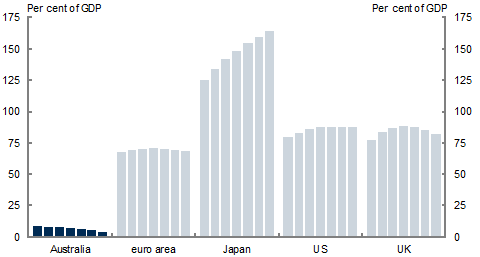
Note: Australian data are for the Australian Government general government sector and refer to financial years beginning 2011‑12. Data for all other economies are total government and refer to calendar years beginning 2011.
Source: IMF Fiscal Monitor April 2012 and Treasury.
Chart 3: Comparison of Budget balances for selected economies, 2011‑2017
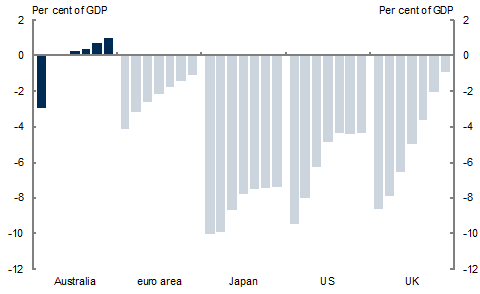
Note: Australian data are for the Australian Government general government sector underlying cash balance and refer to financial years beginning 2011‑12. Data for all other economies are total government and refer to calendar years beginning 2011.
Source: IMF Fiscal Monitor April 2012 and Treasury.
If www.budget.gov.au responds slowly or you are having trouble downloading a document, try one of the Budget Website Mirrors
Note: Where possible, Budget documents are available in HTML and for downloading in Portable Document Format(PDF). If you require further information on any of the tables or charts on this website, please contact The Treasury.