




Statement 4: Building Resilience Through National Saving (Continued)
Higher national saving improves macroeconomic resilience
Increases in national saving help improve the economy's resilience to economic shocks. Part of the recent rise in saving, especially by households, is likely to represent a response to increased risks in the post‑GFC economic environment.
Higher saving can help increase macroeconomic resilience by reducing financial vulnerability to adverse shocks. This vulnerability can arise from three main sources:
- financing risk — the risk that the ability to issue new debt or roll over maturing debt is disrupted and forces a sharp contraction in spending;
- debt servicing risk — the risk that debt cannot be serviced in the event of a fall in incomes, resulting in defaults and forced asset sales; and
- balance sheet risk — the risk (magnified by leverage) of wealth losses due to falls in asset prices, resulting in falls in spending.
Superannuation is a growing source of domestic finance
Superannuation is an increasing source of financing to the rest of the economy, which has helped to reduce financing risks, particularly since the GFC. By contributing to higher national saving, superannuation also increases national income either through higher investment or by earning more investment income for Australians.
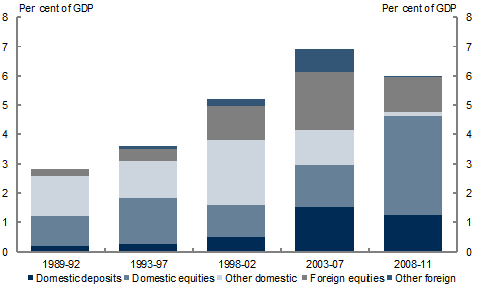
Since 2008 there has been a substantial shift in superannuation funds' asset acquisition away from foreign equities and debt securities towards domestic equities (Chart 8). Around 50 per cent of net equity financing for both banks and non‑financial corporations over this period has come from superannuation funds. Holdings of domestic deposits by superannuation funds have also increased since the early‑2000s. This has helped Australian banks and non‑financial firms shift toward safer forms of financing in an environment where debt financing is less readily available and is seen as more risky than prior to the GFC. This was particularly important when global debt markets were impaired during the GFC.
Chart 8: Superannuation funds' net acquisition of financial assets
Note: Years ending 31 December.
Source: ABS cat. no. 5206.0, 5232.0 and Treasury.
Our reliance on external debt has fallen
The rise in national saving has also reduced Australia's reliance on external financing to fund domestic investment. In Australia, most of this external financing has historically come in the form of debt, so higher national saving can reduce aggregate financing risk. After rising from around 42 per cent of GDP at the start of 2002, Australia's net foreign debt (public and private) has remained flat at around 52 per cent of GDP since the start of 2008.
Had private saving behaviour remained unchanged, Australia's exposure to international financial shocks would have increased at a time when global financial markets have become much more volatile.
Moreover, it is likely that any additional external borrowing would have been channelled primarily through the banking system, as was the case before the GFC. While Australian banks are amongst the strongest in the world, the GFC demonstrated starkly the risks seen in other countries from an excessive reliance on short‑term funding from wholesale debt markets.
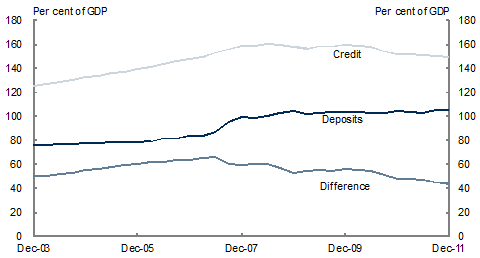
Since the GFC, Australian banks and other depository institutions have substantially reduced their reliance on short‑term funding. The recent change in household saving behaviour has made an important contribution to reducing this exposure, through both reduced household demand for credit and increased deposit saving. As a result, the gap between credit and deposits — representing the requirement for market funding — has fallen by around 20 per cent of GDP since 2007 (Chart 9).
Chart 9: Authorised Deposit‑taking Institution deposits and credit
Note: Deposits exclude intra‑group deposits.
Source: ABS cat. no. 5206.0, APRA, RBA and Treasury.
The reduction in debt accumulation that has underpinned the recent recovery in household saving is also reducing households' vulnerability to adverse developments, reducing debt servicing and balance sheet risks.
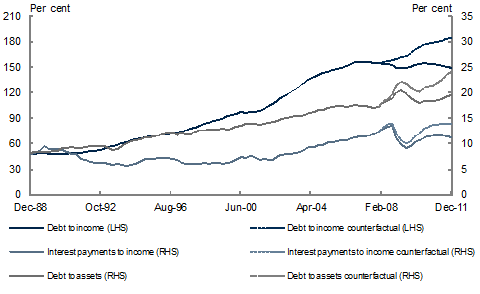
While the household debt‑to‑income ratio has fallen only modestly from a peak of 156 per cent to 150 per cent (Chart 10), this ratio would have continued to rise in the absence of a change in household behaviour. For instance, if household net borrowing had continued at the average rate seen from 2002 to 2007, the household debt‑to‑income ratio would currently be around one‑quarter higher at 185 per cent, with commensurate increases in both debt servicing and gearing ratios.
Chart 10: Household finance ratios
Source: RBA and Treasury.
Another aspect of the increase in household saving that assists in reducing vulnerability to macroeconomic risks is that around one‑half of households with mortgages have been making substantial repayments in excess of the minimum required. Indeed, excess repayments, on average, have been almost as large as the required debt‑servicing payments, implying that these borrowers have sizeable buffers to draw on should their incomes fall (RBA 2012).
If www.budget.gov.au responds slowly or you are having trouble downloading a document, try one of the Budget Website Mirrors
Note: Where possible, Budget documents are available in HTML and for downloading in Portable Document Format(PDF). If you require further information on any of the tables or charts on this website, please contact The Treasury.