




Statement 4: Building Resilience Through National Saving (Continued)
Government saving promotes macroeconomic stability and fiscal sustainability
Fiscal policy plays an important role in helping to stabilise the economy through the operation of the automatic stabilisers and during exceptional circumstances where monetary policy alone may not be able to respond with sufficient speed and force. The Government's fiscal stimulus during the GFC is a prime example of this important role. The Government stepped in to support aggregate demand when the private sector retreated, with a credible strategy for returning the budget to surplus as the economy recovered to trend growth.
Another crucial objective of fiscal policy is fiscal sustainability. Maintaining fiscal sustainability is particularly important at this time of ongoing global economic uncertainty and when fiscal deficits and high national debt have been a proximate cause of distress in many countries around the world. Fiscal sustainability is essential to maintaining macroeconomic stability, reducing economic vulnerabilities, and achieving sustained growth in living standards.
The Government gives effect to promoting fiscal sustainability through its objective of achieving budget surpluses on average over the medium‑term. Government saving is the difference between revenue and recurrent spending. This means that investment financed from current revenue adds to government saving, even though it does not add to the underlying cash balance. As a result, a surplus objective implies a larger positive level of gross government saving.
As well as directly affecting fiscal sustainability, the overall budget position can affect expectations and confidence. Public finances that are viewed as unsustainable generate uncertainty, as governments are expected to act to secure finances by reducing expenditure or increasing taxes, or face the risk of default. A credible strategy to maintain fiscal sustainability, therefore, provides a positive foundation for long‑term decision‑making by households and businesses.
Fiscal sustainability is also important because of the longer‑term challenges arising from population ageing and climate change. These challenges result substantially from decisions made by preceding generations from which they benefitted: in the former case, establishing spending programs with unsustainable future fiscal costs; in the latter case, burning of fossil fuels with unsustainable future environmental costs.
Responsible fiscal policy requires the budget to be returned to surplus
Under the Government's macroeconomic policy framework, the primary objective of fiscal policy is to maintain the budget in a sustainable position from a medium‑term perspective. Monetary policy has primary responsibility for managing the level of demand to keep the economy on a stable growth path consistent with low inflation over the medium‑term.
There are circumstances in which fiscal policy needs to support monetary policy in managing short‑term changes in demand, beyond the automatic stabilisers. This may be either because the effectiveness of monetary policy is impeded or, as occurred during the GFC, adverse shocks affecting the economy are sufficiently large, and arrive sufficiently quickly, that a monetary policy response alone would be insufficient to respond to them. Outside of these circumstances, fiscal policy should revert to its medium‑term focus.
In current circumstances, fiscal policy should be concerned with restoring the budget to a position consistent with the Government's objective of achieving budget surpluses on average over the medium‑term. With the economy forecast to grow around trend, a low unemployment rate and commodity prices still close to historical highs, it is appropriate to bring the budget back to surplus in 2012‑13.
By returning to surplus at this time, the Budget recognises that in normal circumstances, with fiscal policy focussed on the medium‑term, monetary policy should play the primary role in managing demand to keep the economy stable.
Importantly, the Budget forecast of around‑trend growth takes account of the impact of the substantial fiscal consolidation in 2012‑13. Returning the budget to surplus ensures that monetary policy has scope to respond to economic developments, as appropriate and consistent with the medium‑term inflation target.
Against a backdrop of continuing global uncertainty, it is also prudent to strengthen the government's balance sheet while economic conditions remain favourable to support Australia's capacity to respond to future adverse shocks.
Returning the budget to surplus will also help maintain confidence in the strength of Australia's public finances as reflected in Australia's AAA credit rating by all three major rating agencies. Financial markets and international organisations are strongly focused on fiscal credibility, which places a premium on meeting the commitment to return the budget to surplus and adhering to the medium‑term fiscal strategy.
Return to surplus achieved despite revenue weakness
However, the return to surplus has been made more difficult by the weakness in revenues. In the years prior to the GFC, rapidly rising commodity prices provided a major boost to company profits and wage growth in resources and resources‑related industries. Combined with strong asset price growth, a maturing capital gains tax system, and strong household consumption growth, this resulted in robust growth in tax receipts. However, tax receipts are now expected to remain well below their mid‑2000s level relative to GDP over the forward estimates. This lower tax take reflects both the ongoing impacts of the GFC and structural factors such as the investment intensive nature of the current phase of the mining boom (see Statement 5 for more details).
Despite these challenges, the Government is returning the Budget to surplus in 2012‑13, with surpluses growing over the forward estimates. The return to surplus is being achieved by the Government making net savings and lower payments than expected at the Mid‑Year Economic and Fiscal Outlook 2011‑12 (see Statement 3 for more details).
In total, the Government's fiscal consolidation is expected to improve total government saving by around 3 per cent of GDP over the next three years.
Government saving is important for managing demographic challenges
Higher government saving over the medium‑term, consistent with the medium‑term fiscal strategy, will also mean the government is better placed to deal with the budgetary pressures arising from population ageing by ensuring that public finances start from a strong position.
The 2010 Intergenerational Report projected that with unchanged policies Australian government spending on health, age‑related pensions and aged care would increase by 5.3 per cent of GDP over the following 40 years. To avoid exacerbating these pressures, it will be important to maintain fiscal discipline while demographic influences remain favourable.
Government saving will help in managing the high terms of trade
Government saving can also play a role in ensuring that the benefits of the high terms of trade are sustained over a longer period, as well as helping to manage its immediate macroeconomic impacts.
A key lesson from Australia's experience during the initial phase of the mining boom is the importance of increasing government saving as revenues increase due to the impacts of high commodity prices. The period prior to the GFC saw very strong revenue growth, but rather than being saved, these revenues were in substantial part channelled back into the economy, which fed into increased household spending (Box 2).
In an economy that entered the boom with relatively limited spare capacity, this added to demand pressures associated with the massive expansion in mining investment. This contributed to the significant rise in inflation that occurred in 2007‑08. It also meant that monetary policy had to be significantly tighter than otherwise.
The Government's fiscal strategy is consistent with ensuring a further rise in government saving in the event that the high terms of trade support strong economic activity and incomes over the medium‑term. This would continue to reduce pressures on interest rates and temper the pace of structural adjustment.
Box 2: Revenue changes and the underlying cash balance
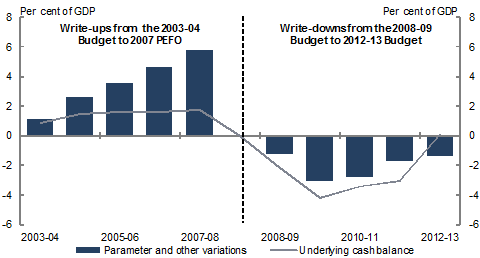
The initial phase of the mining boom delivered a surge in tax revenue that was in substantial part channelled back into the economy. This led to increased household consumption, adding to demand pressures associated with the terms of trade boom and contributing to the significant rise in inflation that occurred in 2007‑08.
The revenue surge increased each year from the beginning of the mining boom and reached almost 6 per cent of GDP by 2007‑08. Over this period the underlying cash balance rose from 0.9 in 2003‑04 to 1.7 per cent of GDP (Chart A). Had the entire surge been saved, the underlying cash balance, and therefore government saving, would have increased substantially more over the period.
Chart A: Revenue write‑ups and write‑downs and the underlying cash balance
Note: Revenue write‑ups and write‑downs reflect parameter and other variations and exclude GST.
Source: Treasury.
In contrast to the around 18 per cent of GDP revenue write‑ups (parameter variations only) in the five years prior to the GFC, revenue write‑downs since the GFC have amounted to around 10 per cent of GDP.
Proposals for saving through a sovereign wealth fund
With the return to surplus, the Government's first priority is to strengthen its balance sheet by reducing net debt from already very low levels.
The Government is committed to maintaining a liquid and efficient Commonwealth Government Securities market. This means that continued surpluses will require the Government to accumulate financial assets in some form once gross debt is reduced sufficiently, while continuing to reduce the level of net debt outstanding.
Some commentators have argued that ensuring the benefits of the high terms of trade are sustained, as well as managing its immediate macroeconomic impacts, may be best achieved by investing some portion of government revenues arising from the high terms of trade in financial assets through a sovereign wealth fund that operates at arms‑length from government, thereby quarantining these revenues from spending.
What matters in this regard is not the establishment of such a fund per se, but whether national (and not just government) saving rises in response to unusually high resource revenues. From the perspective of the government balance sheet, establishing a sovereign wealth fund without a change in fiscal objectives would not alter either current or future levels of government saving and net financial worth, as accumulating financial assets has the same effect as repaying borrowings (Garton and Gruen 2012).
There are two broad types of sovereign wealth funds. The first involves building a stock of financial assets for long‑term saving. This is the type of fund established in Norway, which has invested all government petroleum revenues in its sovereign wealth fund since 1996.
Superannuation performs the function of a long‑term savings fund
The superannuation system already serves as a decentralised means of accumulating financial assets on a large scale.
Australia's compulsory superannuation system has some similarity to Norway's sovereign wealth fund as they both involve increasing saving via the accumulation of financial assets over a long period of time. As a share of GDP, Australia's superannuation assets are of a similar order of magnitude to Norway's sovereign wealth fund and private pension assets combined, and are set to increase further with the increase in the superannuation guarantee from 9 per cent to 12 per cent. Instead of saving through a centrally managed fund, however, superannuation assets are kept in individual retirement accounts that cannot be accessed until individuals reach their preservation age.
There are also a number of important differences between Australia's circumstances and those of Norway (Garton and Gruen 2012). First, the remaining life of Norway's oil and gas reserves is much more limited than for reserves of Australia's key commodities (iron ore and coal). Second, Norway's economy and government revenues are far more dependent on revenues from the resources sector than is the case in Australia. Finally, Norway faces greater long‑term fiscal challenges than Australia. This implies a stronger case for Norway to save these revenues to smooth consumption over time and for intergenerational equity.
In terms of intergenerational equity, the Minerals Resource Rent Tax is central to the Government's plan to spread the benefits of the mining boom and help ensure the gains provide benefits for generations to come. In particular, revenue from the Minerals Resource Rent Tax will help fund critical investment in roads, bridges and other infrastructure, relieving capacity constraints particularly in mining regions. Furthermore, revenue from the tax will also contribute to funding the revenue cost of the increase in the superannuation guarantee.
Australia's fiscal rules and institutions mean a stabilisation fund is not warranted at this time
The second type of fund is a stabilisation fund that involves setting aside revenues in a fund during periods in which commodity prices are unusually high, which can then be drawn down to support the budget in the event that commodity prices fall. The purpose of this type of fund is to enhance the government's capacity to implement counter‑cyclical fiscal policy, thereby helping to moderate the macroeconomic impacts of commodity price fluctuations. This type of fund has been in place in Chile since 2000.
The Government's fiscal rules mean that it is able to implement counter‑cyclical fiscal policy without the need for a mechanism of the kind adopted in Chile. The medium‑term fiscal strategy provides the Government with scope to increase government saving during periods of steady economic growth while allowing government saving to fall during economic downturns, as it did to support demand and jobs during the GFC.
Government saving over coming years will occur through a combination of debt repayment from already very low levels, accumulation of financial assets and investments in infrastructure. The Government will also contribute to national saving through its superannuation policies. As decisions are made over coming years on how to use the proceeds from continued high terms of trade, it will be important to consider which allocation of saving between these forms will best contribute to maintaining prosperity into the future.
If www.budget.gov.au responds slowly or you are having trouble downloading a document, try one of the Budget Website Mirrors
Note: Where possible, Budget documents are available in HTML and for downloading in Portable Document Format(PDF). If you require further information on any of the tables or charts on this website, please contact The Treasury.