




Defence
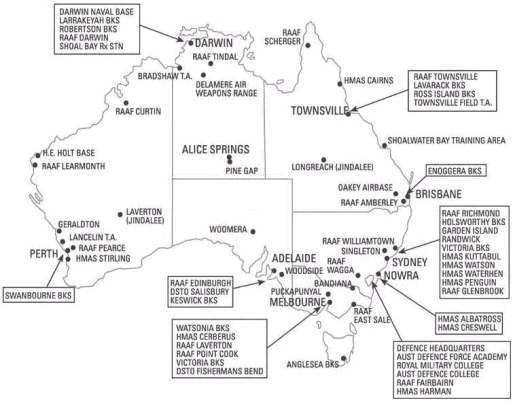
The Department of Defence and the Australian Defence Force (ADF) make a significant contribution to the development of regional Australia through the establishment of defence facilities and by fostering linkages with the communities in which Defence members are based. Defence activities provide considerable indirect support to regional communities surrounding its facilities. Thirty per cent (approximately 30,000 full-time and Reserve personnel) of the ADF is located in regional Australia (Darwin and outside of Australia's major cities), with the defence footprint evident through employment, industry, community involvement and services, childcare facilities, housing, cooperation on heritage issues, Indigenous affairs and economic activity. Figure 2 depicts the location of major Defence facilities across Australia.
Figure 2: Location of Major Defence Facilities across Australia
Current Initiatives
Defence infrastructure / capital facilities projects
Defence bases and facilities around the country are being redeveloped and upgraded to deliver increased capability and support the ADF. In 2012‑13 capital infrastructure projects located in regional Australia include:
- HMAS Albatross Redevelopment Stage 3 - This project will replace ageing and obsolete engineering services and infrastructure and provide a combination of new and refurbished facilities to support operational and training outcomes as well as enabling functions. The project received Parliamentary clearance in March 2012. Construction is scheduled to commence in early 2013.
- RAAF Base East Sale Redevelopment - This project will replace ageing and obsolete engineering services and infrastructure and provide a combination of new and upgraded facilities to support operational and training outcomes as well as enabling functions. The project received Parliamentary clearance in March 2012. Construction will commence in late 2012.
- Scottsdale: Specific Nutritional Capability - This project provides a reinvestment in the existing Defence Science and Technology Organisation nutritional capability at Scottsdale through the construction of replacement food technology laboratories and working facilities. Construction is scheduled to commence in mid-2012, with completion scheduled in late 2013.
ADF support for natural disaster recovery
The ADF continues to provide significant assistance to the Australian community following natural disasters, and has demonstrated its adaptable nature and ability to respond to challenging and complex tasks at short notice, when called upon by the Government. Most recently, the ADF has assisted communities in regional Australia devastated by flooding in Southern Queensland, Northern New South Wales, Wagga Wagga (New South Wales) and the Shepparton area (Victoria) and by storms in Townsville (Queensland). Tasks performed by the ADF included aeromedical and land evacuation of residents, search and recovery operations, reinforcement of levees, airlift and land movement of emergency supplies, clearance of debris and filling sandbags.
Defence Community Organisation Program
Defence, through the Defence Community Organisation (DCO), conducts functions that promote the engagement of ADF families with their local communities. These activities and the extent of the engagement vary by location, but tend to be strongest in regional areas. Activities include annual welcome functions and local information sessions. DCO also administers Defence's Family Support Funding Program (FSFP), which offers non-recurrent annual grants to community organisations that have a focus on supporting Defence families. The emphasis of FSFP is on supporting groups that encourage engagement with the wider community.
DCO has commenced a program of community capacity building that is designed to promote connection between Defence families and their local communities. In time this will also enhance the ability of local communities to support the families of ADF members because of increased awareness of the contribution that Defence families bring to their communities.
ADF Transition Centres are located across Australia, to provide practical guidance and information to ADF members who are planning to leave Defence. Support services include practical information seminars, personalised assistance to prepare for transition, referrals, help with administration, and support for post Service training and employment. ADF members and their families are linked into other Defence and government support services (such as the ADF Rehabilitation Program, Department of Veterans' Affairs, ComSuper and Centrelink) and community resources.
Defence Housing Australia
The main function of Defence Housing Australia (DHA) is to provide housing and related services to members of the ADF and their families. DHA adds new properties to its portfolio across Australia, including in regional areas, with a significant ADF presence, through the renewal of expiring leases, constructions, acquisitions and leasing from private investors or in bulk from property developers. DHA has also supported the creation of 10 apprenticeship places in regional locations in the residential construction industry.
Defence industry development
A range of defence industry segments are located in regional communities. Facilities in the Hume (Victoria) and Riverina (New South Wales) regions, provide the munitions and explosives for use by the ADF; regional workers in Loddon Mallee (Victoria) assemble Australia's Bushmaster vehicles; and a range of companies support major prime contractors at bases or facilities in Kwinana (Western Australia), Katherine (Northern Territory), North Queensland (Queensland) and Port Adelaide (South Australia), to name just a few.
Australia's defence industry maintains and supports the ADF's equipment wherever it is home-based. In regional Australia, Defence maintains, as a minimum, operational level support; if not deeper maintenance support capabilities. Examples of Defence maintenance and support locations in regional Australia include: Oakey, Townsville, Darwin and Nowra for helicopters; Bandiana and Darwin for military fighting vehicles; Lithgow for weapons manufacture and maintenance; and in the Northern Territory and Western Australia for the Defence Materiel Organisation (DMO) provided base support.
The DMO continues to promote efficiency, competition and value for money in defence procurement through its suite of industry programs. This includes programs aimed at up-skilling Australian industry, rewarding innovation in defence capabilities and promoting Australia's capabilities overseas. Many of the small to medium enterprises that receive support under these programs are based in Australia's regional areas. The DMO will continue to support defence industry in both metropolitan and regional areas to ensure the best possible support to the ADF.
Defence Force Posture Review
On 22 June 2011 the Minister for Defence, the Hon Stephen Smith MP, announced a Force Posture Review (the Review) to assess whether the ADF is correctly geographically positioned to meet Australia's current and future strategic challenges. The Review focused at the strategic level, rather than focusing primarily on individual bases and training areas, to guide subsequent specific decisions that may be taken regarding ADF disposition and the Defence Estate, including in regional Australia. It builds on assessments made in the 2009 Defence White Paper, and Defence's existing assessment of its basing requirements over the next 25 years. It also complements current work underway with the United States (US) on the US Global Force Posture Review.
The final report of the Review was released by the Prime Minister and Minister for Defence on 3 May 2012. The Review's findings will feed into the next scheduled Defence White Paper in 2013. Further information is available at: http://www.defence.gov.au/oscdf/adf-posture-review.
If www.budget.gov.au responds slowly or you are having trouble downloading a document, try one of the Budget Website Mirrors
Note: Where possible, Budget documents are available in HTML and for downloading in Portable Document Format(PDF). If you require further information on any of the tables or charts on this website, please contact The Treasury.