




Education, Employment and Workplace Relations
The Education, Employment and Workplace Relations portfolio is committed to supporting rural and regional communities in Australia. A number of portfolio programs specifically target regional Australia in the areas of educational support, employment participation and in enhancing opportunities for Indigenous Australians. Other programs provide considerable support to regional Australia through the Government's priorities for early childhood development, quality education outcomes, a skilled workforce with greater participation, and the achievement of productive workplaces.
Spatial Reporting
Table 4 illustrates a summary of expenditure by program disaggregated between regional Australia, non-regional and non-specific location for the budget year and forward estimates for the Education, Employment and Workplace Relations portfolio.
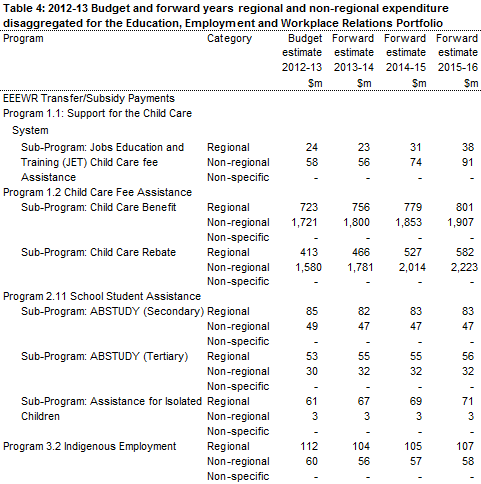
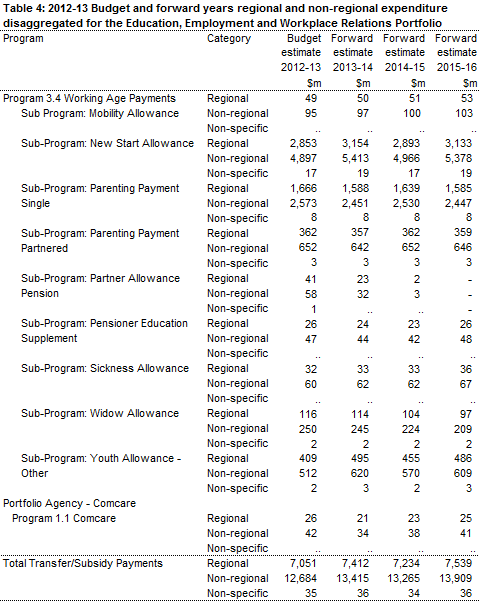
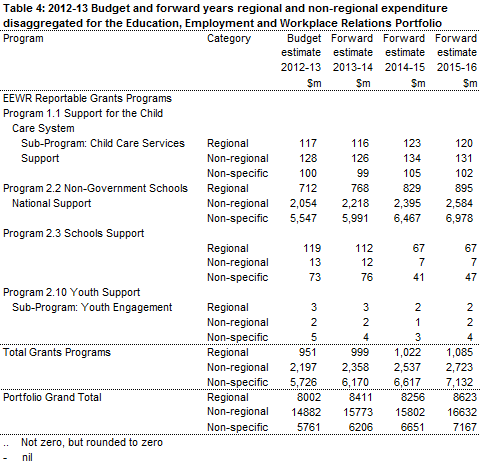
The portfolio administers a number of programs on behalf of the Australian Government which seek to improve participation and outcomes in education, training and employment in regional Australia. A number of programs specifically target regional Australia, while other programs provide support to regional Australians through the Government's priorities for early childhood development, quality education outcomes, a skilled workforce with greater participation, and the achievement of productive workplaces.
Information regarding spatial expenditures for material programs (those programs with annual expenditure outlays exceeding $50.0 million), are included in Table 4. It should be noted that the portfolio also supports the Australian Government's agendas via other administered program purchasing arrangements, and through the delivery of a number of Specific Purpose and National Partnership programs that are expressly excluded from the above tables consistent with the delivery arrangements supported by the Federal Financial Relations Framework.
In relation to the transfer payment programs reported in Table 4, the regional split of funding has been derived for the 2012‑13 Budget and forward estimates years based on the location of current customers in receipt of the relevant benefits and payments. The applicable percentage of recipients, as determined under the major cities Australian Bureau of Statistics (ABS) Australian Standard Geographic Classification (ASGC) Remoteness Structure, has then been applied against the current program forward estimates.
Reportable grants program expenditures have been based on the portfolio programs that are currently committed in accordance with the Commonwealth Grant Guidelines, and published on the Education, Employment and Workplace Relations website as at 31 March 2012. Due to the amounts being based on current contractual commitments as at that date, the table may not reconcile to the full program estimates for these grants programs over the period 2012‑13 to 2015-16 as set out in the Portfolio Budget Statements.
New Initiatives
Early Childhood Education and Care
Jobs, Education & Training Child Care Fee Assistance program — Improving Education and Employment Outcomes
The Government will provide an additional investment of $225.6 million over five years to assist more parents to access Jobs, Education and Training Child Care Fee Assistance (JETCCFA). This package also better targets JETCCFA to support work, study and job outcomes for eligible parents in line with the Government's skills reform agenda.
This package will assist parents on eligible income support payments, predominantly sole parents, to enhance their skills by undertaking appropriate work, study or training to enable them to enter or re-enter the workforce, by providing significant support with the cost of child care so that it does not pose a barrier to participation.
This initiative will benefit parents in rural and remote areas of Australia who wish to undertake work, study or training to better enable them to take advantage of employment opportunities.
Stronger Futures in the Northern Territory — continued support for crèches established under the Northern Territory Emergency Response
Ongoing support will be provided for nine crèches in very remote Indigenous communities through a $30.2 million allocation over ten years. The nine Northern Territory Emergency Response crèches funded under this measure are located in small remote communities in which there is little or no other form of early childhood education and care and in which the population would not support a larger service model, for example, a long day care centre. These crèches will continue to play an important role in better preparing up to 225 children for school, and can provide an effective platform for delivering a range of programs aimed at improving their health and development.
Home Interaction Program for Parents and Youngsters (HIPPY)
The Government has committed $55.7 million to expand the Home Interaction Program for Parents and Youngsters (HIPPY) in 100 locations. $13.8 million will be provided over three years to continue HIPPY in the existing 50 locations for one additional cohort of children operating over the 2013 and 2014 school years. An additional $41.9 million will be provided over four years to extend HIPPY to 50 additional locations, with a focus on Indigenous remote locations, commencing from the 2014 school year.
This expansion will continue to complement the suite of existing early childhood initiatives aimed at enhancing life experiences for children, increasing parental and community skills and closing the gap targets for Aboriginal and Torres Strait Islander children.
HIPPY is a two year home based parenting and early childhood enrichment program that empowers parents and carers to be their child's first teacher. The program builds the confidence and skills of parents and carers to create a positive learning environment to prepare their child for school. Parents and their children enrol in the program in the year before the child commences formal school and they participate in the program for two years.
The program specifically targets disadvantaged communities with a high proportion of families with young children and is spread across metropolitan, regional and remote communities, including Aboriginal and Torres Strait Islander communities.
The expansion of HIPPY to 100 sites ensures a continuation of support for children and parents in the existing 50 sites as well as expanding the program into 50 Indigenous specific sites, and will continue to provide employment outcomes for parents who have the opportunity to be trained and employed as tutors through the program.
Schools
Stronger Futures in the Northern Territory
Stronger Futures in the Northern Territory is a comprehensive ten-year plan to support Aboriginal people in remote areas of the Northern Territory to live productive, independent lives. The Government will provide $582.6 million for education initiatives to ensure Indigenous children across the Northern Territory continue to have better access to improved education and are actively engaged in learning.
Stronger Futures in the Northern Territory — Building a Quality School Workforce
Additional Teachers
The Government will continue to support an extra 200 teachers and engagement officers in remote Northern Territory schools.
Quality Teaching
The Government is also providing better support for those teachers so they are ready to teach in remote communities. Initiatives include a ten-year investment in training and support to ensure teachers have the skills to obtain better literacy and numeracy results for Aboriginal children, and to ensure that teachers can achieve the best possible outcomes for students for whom English is a second language or for who may experience hearing or learning difficulties.
The Government is also continuing funding to build career paths and improve qualifications so local people can become teachers and educational workers in their communities.
Teacher Housing
The Government will build around 100 teacher houses in remote Northern Territory communities over the next ten years to address critical staff housing shortages and help attract and retain high quality teachers in remote schools.
Stronger Futures in the Northern Territory — Expansion of the School Enrolment and Attendance Measure
Aboriginal people in the Northern Territory have been clear that they want children to attend school regularly and that parents have a responsibility to help make this happen. As announced in the 2011‑12 Mid-Year Economic and Fiscal Outlook the Australian Government has provided $85.6 million over 11 years to both improve and expand the current School Enrolment and Attendance Measure (SEAM) so that it aligns with the NT Government's Every Child Every Day attendance policy to provide a clear and consistent set of supports and consequences for parents whose children do not attend school regularly.
This funding also helps manage unacceptable levels of under-enrolment. Education authorities and Centrelink will now be able to share data to ensure children are enrolled in a school and attending school even if they move during the school year. This will prevent children from falling through the cracks, especially where families move frequently.
The measure will apply to all parents on income support in affected areas.
Stronger Futures in the Northern Territory — School Nutrition Program
The School Nutrition Program provides nutritionally sound meals to approximately 5,000 students in participating schools in the Northern Territory. Good nutrition has been shown to help improve student behaviour, attention and health. The Government will continue to provide funding for the program over the next ten years.
Teach Remote Stage 2
As well as specific work in the Northern Territory, the Government is helping to create a more stable teaching and learning environment for all students living in remote and very remote locations in Australia. Funding of $14.3 million over three years for Teach Remote Stage 2, will help the National Alliance of Remote Indigenous Schools (NARIS) to continue its work to attract and retain high calibre teachers in remote areas. This funding will help by:
- providing a new funding pool of up to $6.0 million over two years, to allow NARIS schools to offer salary supplements in order to attract and retain up to 200 highly qualified and experienced staff in remote schools;
- providing a professional development bonus for new teachers so they can undertake focused training in best practice in working with Aboriginal and Torres Strait Islander students in remote settings;
- resolving teacher registration and mobility issues; and
- partnering new teachers with an experienced principal or teacher mentor.
Clontarf Foundation and Engagement Strategies for Girls
The Government is providing $4.8 million over three years through the Sporting Chance program to encourage improved educational outcomes for Aboriginal and Torres Strait Islander students through sport and recreation activities. This funding will support the Clontarf Foundation to establish and operate new school-based academies targeting 348 Indigenous secondary school boys in New South Wales.
Girls are currently under-represented in this successful program and this funding will enable it to be expanded to target an additional 348 Indigenous secondary school girls through new girls only academies.
Employment
Remote Jobs and Communities Program
Following extensive consultations with remote communities, service providers, employers and other stakeholders, the Government will introduce a new Remote Jobs and Communities Program in remote Australia from 1 July 2013.
The program will replace four major programs in remote Australia: Job Services Australia (JSA), Community Development Employment Projects (CDEP) program, Disability Employment Services (DES), and the Indigenous Employment Program (IEP).
The Government will provide $1.5 billion over five years from 2013‑14 to fund the program.
Under the new arrangements, each of 65 remote servicing regions will be serviced by a single provider, and each provider will have a permanent presence in their region. Providers will work in close partnership with communities and they will jointly develop Community Action Plans that will direct effort to meet the needs of individual job seekers and communities.
There will be a 'jobs-first' focus which will see job seekers participating in activities in line with their participation requirements and capacities and that are meaningful to them because they provide work-related skills and help build better communities. A Participation Account will provide funds to address vocational and non-vocational barriers that are preventing people from getting work or participating in their communities. A new Remote Youth Leadership and Development Corps will be the flagship program for youth. The Youth Corps will assist young people aged 24 and under to make better transitions to work by providing up to 12,000 places over five years.
A Community Development Fund will provide grants for larger projects to buttress community capacity building and economic development. This will open up opportunities for communities to become more involved in services delivered in their communities.
This initiative is being implemented by the Departments of Education, Employment and Workplace Relations and Families, Housing, Community Services and Indigenous Affairs.
Community Based Employment Advice Services
This measure provides ongoing funding for five Community Based Employment Advice Services (CBEAS) through the provision of Government grants to the Working Women's Centres in Queensland, the Northern Territory and South Australia, the Employment Law Centre of Western Australia, and JobWatch in Victoria. From 2012‑13 the Government will significantly increase existing funding levels for the CBEAS by committing $7.1 million over four years to enable the centres to continue their important services.
The CBEAS are not-for-profit organisations which play a valuable role in providing advice, assistance and information to Australians who experience difficulties in asserting and exercising their workplace rights. Some of the services that CBEAS offer include self-help information sessions for people representing themselves before Fair Work Australia, evening legal advice services, community legal education and research services, and telephone advisory services.
CBEAS provide vital services to local communities, including regional, remote and rural areas. By increasing existing funding levels, the Government will further the capacity of CBEAS to meet the demands of clients in regional areas who have restricted access to employment services.
Current Initiatives
Early Childhood Education and Care
Early Childhood Education and Care — Childcare Reform Agenda Workforce
The Childcare Reform Agenda Workforce Package consists of two initiatives which will build the early childhood education and care workforce. The Government is investing $9.2 million over four years from 2011‑12 to support the early childhood workforce by improving the quality and uptake of Recognition of Prior Learning (RPL) for experienced early childhood educators; with a focus on rural and remote areas of Australia.
Building the capacity of the early childhood workforce will support the successful delivery of the existing early childhood reform agenda, including the introduction of the National Quality Framework for early childhood education and care services and the delivery of universal access to early childhood education. The Government is also investing $500,000 to consider the inclusion of competencies in early childhood mental health and wellbeing, within early childhood qualifications.
Early Childhood Education and Care — Australian Early Development Index
The Government has committed to ongoing three yearly cycles of the Australian Early Development Index (AEDI) which represents an investment of approximately $28.0 million every three years.
The AEDI is a population-based measure of how children have developed by the time they start school across five areas of early childhood development: physical health and wellbeing, social competence, emotional maturity, language and cognitive skills, communication skills and general knowledge.
The AEDI was implemented nationally for the first time in 2009, and was a key component of the Australian Government's early childhood reform agenda. The AEDI has also been endorsed by the Council of Australian Governments as a national progress measure for early childhood development.
The Government's ongoing commitment will enable data to be collected nationally every three years (2012, 2015, 2018, etc) from approximately 270,000 children in their first year of full-time school.
The AEDI results provide Government and communities, including regional, remote and Indigenous communities, with the information they need to inform policy and planning around early childhood development.
The ongoing commitment includes funding for AEDI coordination and targeted community engagement activities in each State and Territory; the aim of which is to support communities, schools, teachers and government agencies to participate in the AEDI data collection and engage with the results.
Budget Based Funded Child Care Services — improved standards
The Australian Government has provided $59.4 million over four years from 2010‑11 to assist centre-based Budget Based Funded (BBF) services meet key aspects of the new National Quality Agenda for early childhood education and care. In particular, the investment will improve the existing infrastructure of centre based BBF services, increase the qualifications of staff in all such child care services and improve their governance. Ongoing funding for repairs and maintenance of infrastructure as well as the increased costs for qualified staff will also be provided. BBF child care services support some of our most vulnerable and disadvantaged children and operate largely in rural, remote and Indigenous communities, where the childcare market is unable to provide services.
Early Childhood Education and Care — National Quality Framework Implementation
In the 2010‑11 Budget, the Government allocated $273.7 million over four years to deliver the National Quality Framework which was introduced from January 2012. This included additional Australian Government funding to support jurisdictions' transitional and ongoing costs and funding for the establishment of the Australian Children's Education and Care Quality Authority. This Authority will help to make important changes to early childhood education and care that will ensure that Australian children across all regions get the best possible start.
National Partnership Agreement on Early Childhood Education
Under the National Partnership Agreement on Early Childhood Education (NP ECE), the Government is providing $955.0 million to States and Territories over five years, to achieve universal access to early childhood education — so that by 2013 every child, wherever they live, will have access to affordable, quality early childhood education in the year prior to formal schooling.
Bilateral agreements between the Government and each State and Territory under the NP ECE articulate the agreed strategies and timeframes around achievement of universal access for all children by 2013. As part of these bilateral agreements, the States and Territories are implementing a range of strategies to achieve universal access in regional and remote locations.
National Partnership Agreement on Indigenous Early Childhood Development
Through the National Partnership Agreement on Indigenous Early Childhood Development, the Australian Government has provided $292.6 million for the establishment of 38 Children and Family Centres across Australia by June 2014. The Children and Family Centres will deliver integrated services, including early learning, child care and family support programs.
Children and Family Centres are targeted at addressing the needs of Indigenous families and their young children, and will also provide services to all families in the community. The centres are being established in a mix of remote, regional and urban locations concentrated in areas where there is a demonstrated need for these services. State and Territory Governments are leading the establishment of the centres, including undertaking community consultations.
Schools
National School Chaplaincy and Student Welfare Program
This measure provides $222.0 million to extend and expand the National School Chaplaincy and Student Welfare Program for a further three years, from 2012 to 2014, thus delivering on the Government's election commitment. The Chaplaincy Program aims to support school communities that wish to access the services of a school chaplain or secular pastoral care worker. This is a significant program for local schools, with 43 per cent of funding being directed to regional and remote schools.
This measure extends funding to December 2014 for the approximately 2,550 schools previously funded, as well as providing funding for up to an additional 1,000 schools from 2012 to 2014. There will be a focus on disadvantaged regional and remote schools in the expansion of the program.
More Support for Students with Disability
This initiative is providing $200.0 million in additional funding to government and non-government education authorities to support their work with students with disability and/or learning difficulties.
Through this initiative, to be delivered over the 2012 and 2013 school years, education authorities will have the flexibility to select a range of activities that will best meet the needs of students, teachers and schools in their jurisdiction. This includes flexibility to provide targeted support for teachers and schools operating in regional and remote areas.
The major focus of this short-term initiative is to build the capacity of Australian schools and teachers to better support students with disability, contributing to improved student learning experiences, educational outcomes and transitions to further education or work.
Empowering Local Schools
The Government committed $69.1 million over four years from 2010‑11 to empower local communities to assist in improving student performance and outcomes at their schools. Around a third of participating schools will be located in regional areas. The funding allows principals, parents and school communities greater input into the management of their local schools, including managing school budgets, deciding the mix of staff and setting local priorities. Up to 1,000 government, Catholic and independent schools are expected to participate in the initial phase in 2012 and 2013, with Phase Two commencing in 2015.
Rewards for School Improvement
The Reward for School Improvement initiative aims to encourage a nationally consistent and rigorous approach to school self-evaluation and improvement planning through implementation of a National School Improvement Framework and reward payments to schools showing the most improvement.
Commencing in early 2015, around 500 schools will receive a reward payment of up to $75,000. From 2016 around 1,000 schools will be rewarded each year for four years. In total, $275.6 million in reward payments to schools will be provided over five years, with a minimum of $88.8 million in reward payments to be made to regional schools.
Smarter Schools National Partnerships
The Government is committed to improving the educational outcomes of all school students, particularly those at risk of falling behind. The Government is providing $2.6 billion over 7 years to the States and Territories under three Smarter Schools National Partnerships in the key areas of addressing disadvantage, raising literacy and numeracy outcomes and improving teacher quality. Over a quarter of all Australian schools (over 2600) have been targeted for support through the National Partnership for Low Socio-Economic Status School Communities and/or the National Partnership for Literacy and Numeracy, and a significant number of these National Partnership schools are located in regional Australia.
Across Australia, 57.3 per cent of all National Partnership schools are located outside a major city. Approximately 28 per cent of all schools in regional areas and approximately 47.4 per cent of all schools in remote areas will participate in at least one National Partnership. These figures indicate the National Partnerships are reaching greater percentages of schools in regional and remote areas of Australia, than they are for major cities. These National Partnerships are contributing to improved learning engagement and outcomes for students in participating school communities.
Youth Connections Program
The Youth Connections program provides $287.0 million over four years (to December 2013) for individual support services to ensure young people at risk of not attaining Year 12 or an equivalent qualification build resilience, skills and attributes that promote positive choices and wellbeing.
The School Business Community Partnership Broker program provides $183.0 million over four years (to December 2013) to harness resources and build local infrastructure to support communities to share responsibility for young people's learning and development.
According to the Accessibility/Remote Index of Australia, these programs provide 67.6 per cent of annual funding (GST exclusive) to non major city regions.
National Broadband Network Enabled Education and Skills Services Program
To support the development and trialling of online education and skills services that take advantage of the high speed broadband connections being made available through the NBN, the Government has appropriated $27.2 million over four years from 2011‑12 to implement the NBN-Enabled Education and Skills Services Program. The program seeks to develop and trial services that provide more interactive and effective learning opportunities for all Australians, no matter where they live.
The program will focus on proposals that conduct NBN enabled projects within, connecting to, or preferably between NBN early release sites, including both regional and metropolitan areas. Funded projects should reach students, learners, and trainees in new and innovative ways, including in their homes and workplaces. Program funding will target those communities to first benefit from the NBN, which will impact education and skills development in regional and remote areas.
Additional Commonwealth Support for school students in regions
The Government is the primary source of public funding for non-government schools. Under the Schools Assistance Act 2008, the Government provides recurrent and capital funding to non-government schools as well as additional funding for programs designed to support school students in regional areas.
Remoteness Loading
Non-government schools, which bear higher costs of delivering education services in regional and remote areas of Australia, will receive a loading on their per capita recurrent grant funding if they have students studying at eligible locations. Non government schools or campuses classified as 'Moderately Accessible', 'Remote' or 'Very Remote' receive an additional 5 per cent, 10 per cent or 20 per cent respectively of the funding entitlement associated with their socioeconomic status (SES) score.
English as a Second Language — New Arrivals Program
The English as a Second Language — New Arrivals Program delivers intensive English language tuition to eligible newly arrived migrant school students, many of whom are located in regional areas/locations.
Country Areas Program
The Country Areas Program (CAP) assists students at rural, regional and remote schools in the States and the Northern Territory with the additional educational costs that result from geographical isolation.
CAP is intended to support quality learning outcomes for rural and geographically isolated primary and secondary school students. Non-government education authorities may use the Country Areas Program funding for projects which support curriculum enhancement. Examples of such projects include excursions, travel or educational opportunities where the costs are greater because of geographic isolation, information and communication technology initiatives, teacher professional development, and the promotion and support of the CAP program.
Review of Funding for Schooling
An independent Review of Funding for Schooling, undertaken by a panel, chaired by David Gonski AC, concluded at the end of 2011 with the panel's report being delivered to Government in late 2011.
The Government publicly released the Review Report on 20 February 2012, together with an initial response. The Report makes far-reaching recommendations for school funding reform. The Report also makes clear that, before its recommendations could be implemented, a significant amount of further work would need to be done.
The Government's response sets out how further work will be undertaken. The recommendations are being worked through with the education community, including those authorities that run schools—the States and Territories, the Catholic system, and Australia's independent schooling sector. This work commenced immediately following the release of the Report.
The Government is also engaging the whole Australian community with this reform effort, and a nation-wide series of events has commenced to engage directly with Australian families, teachers, principals, education stakeholders and the wider community.
The Minister for School Education, Early Childhood and Youth, the Hon Peter Garrett MP, has also hosted a number of forums in regional Australia including: Mount Pleasant (Victoria), Mango Hill (Queensland), Narre Warren (Victoria), Wollongong (New South Wales), Port Macquarie (New South Wales), Rockingham (Western Australia), East Devonport (Tasmania), Burnie (Tasmania), Redbank Plains (Queensland) and Ipswich (Queensland).
Supporting Teachers
Reward Payments for Great Teachers
The Government has committed $225.0 million to 2014-15 for the Rewards for Great Teachers election commitment with a total commitment of $1.1 billion to 2018-19. This funding will facilitate the development of a new nationally consistent and objective performance management and development system for all teachers, along with a nationally consistent approach to teacher certification at the Highly Accomplished and Lead teacher levels, and the provision of a one-off teacher reward payment for teachers who achieve certification at the Highly Accomplished and Lead teacher levels.
The Australian Institute of Teaching and School Leadership is leading the development of the Australian Teacher Performance and Development Framework and a nationally consistent approach to teacher certification. The Framework and certification process will be introduced in schools across Australia from 2013.
The Rewards for Great Teachers initiative will help to improve teacher performance while providing an incentive to encourage quality teachers to remain in the classroom where they have the biggest impact on student achievement.
Teach Next
The Teach Next initiative provides an employment-based pathway into teaching for highly skilled professionals. The $15.9 million program aims to help address ongoing teacher shortages in specialised subject areas such as mathematics and science, and in hard to staff schools, particularly in regional areas.
Four intakes over July 2012, January 2013, July 2013 and January 2014 will provide places for up to 395 participants in the program.
Teach for Australia
The Teach for Australia initiative is supported under the Smarter Schools - Improving Teacher Quality National Partnership. The $22.0 million investment in the Teach for Australia initiative provides a new employment-based pathway into teaching for high-achieving university graduates. The program attracts those who may have been destined for alternative career paths by offering a unique combination of university study and employment-based teacher education. It involves a two-year supported placement for participants in disadvantaged secondary schools (with reduced teaching load), while they complete their Postgraduate Diploma in Teaching with the University of Melbourne.
The program has been successfully implemented in Victorian and Australian Capital Territory Government schools and the Victorian Catholic sector. The program expanded into the Northern Territory for the first time in 2012. Almost 40 per cent of associates have been placed in regional or remote schools since the program began in 2009.
Trade Training
Trade Training Centres in Schools Program
The Government is providing $2.5 billion from 2008 to 2018 to fund the Trade Training Centres in Schools Program to give all secondary students access to greater training opportunities and to help address skill shortages in traditional trades and other eligible occupations.
Trade Training Centres are being established to help increase the proportion of students achieving Year 12 or an equivalent qualification. An important step in achieving this increase is to ensure students have access to high quality, relevant education and training opportunities that continue to engage and encourage them to complete their studies while opening pathways for future employment.
After five years, more than $1.2 billion has been announced for over 370 projects benefitting over 1,070 schools. Of those, more than 60 per cent (over 670 schools) are located in regional (non-metropolitan) Australia.
A priority for funding is to support secondary school communities with Indigenous students, and students from remote, regional or disadvantaged communities.
Aboriginal and Torres Strait Islander School Education
Aboriginal and Torres Strait Islander Education Action Plan
The Aboriginal and Torres Strait Islander Education Action Plan was endorsed by the Council of Australian Governments and launched by Education Ministers in June 2011. The Action Plan contains outcomes, targets and performance indicators as well as 55 actions at the national, systemic and local levels across six domains of activity that evidence suggests will have the most impact on lifting the educational outcomes of Aboriginal and Torres Strait Islander students. These domains are: readiness for school; engagement and wellbeing; attendance; literacy and numeracy; leadership, quality teaching and workforce development; and pathways to real post-school options. Focus schools were identified under the Action Plan to assure Education Ministers that Aboriginal and Torres Strait Islander students were receiving the benefits of national reforms. Education Ministers agreed that a number of the local level actions will be specifically progressed in these Focus schools.
Focus School Next Steps Initiative
As part of its commitment to the Aboriginal and Torres Strait Islander Education Action Plan, the Government is investing $30.0 million until the end of 2013 to support 100 focus schools to close the gaps between Aboriginal and Torres Strait Islander students and other Australian students. Sixty nine of these schools are located in regional areas. The Focus School Next Steps Initiative uses proven approaches to lift the attendance and classroom engagement and achievement of over 9,000 Aboriginal and Torres Strait Islander students, with over 6,000 of these students in regional Australia. Participating schools were identified on the basis of those schools with the greatest need for additional Australian Government assistance. Participating schools will commit to the development of school-community partnerships and personalised learning plans for each Aboriginal and Torres Strait Islander student.
Increased funding for Indigenous boarding students
The Government has committed $22.4 million over four years from 2010‑11 to provide increased Indigenous Supplementary Assistance (ISA) to non-remote, non-government boarding schools with more than 50 Indigenous boarding students from remote Indigenous communities. This initiative will provide a higher rate of ISA for these students and will assist these schools to better serve the needs of Indigenous students from remote Indigenous communities.
200 Additional Teachers in the Northern Territory
In order to improve attendance and education outcomes for Aboriginal and Torres Strait Islander students and support remote schools in the Northern Territory, the Government provided $107.8 million in the four years from 2009 to 2012 for an additional 200 teachers to be recruited by the end of 2012. Since 2009, $91.6 million has been allocated for the recruitment, placement and retention of up to 170 classroom teachers in agreed remote and very remote Northern Territory government schools (this $91.6 million is inclusive of $14.7 million that was redirected to Teacher Housing and is included in the $35.7 million noted below under Teacher Housing). An allocation of $16.2 million has been made for the engagement of 30 additional teachers in non-government schools in remote communities.
Teacher Housing
Since 2009, the Australian Government has provided $35.7 million for the construction and renovation of teacher housing in remote areas of the Northern Territory and Western Australia. Attracting the best and brightest teachers to commit to teach in remote locations, and to stay on long enough to make a real difference, depends on a number of critical factors, including the provision of housing which is an important component of the overall package offered to teachers in remote and very remote communities.
Building Australia's Future Workforce — Indigenous Ranger Cadetship Pilot
To assist Aboriginal and Torres Strait Islander young people to complete school, this $4.1 million pilot program will provide culturally relevant training in a school setting linked to natural resource management, heritage-related activities and cultural studies. Students in regional and remote communities will be supported through the Indigenous Ranger Cadetship pilot to build capacity for further study, training, jobs and careers in natural resource management.
The pilot also aims to generate strong Aboriginal and Torres Strait Islander community engagement and improve school capacity to retain students to Year 12 and to assist students with their transition from school to further education, training and work. It is anticipated that the first cohort of pilot schools (up to six) will begin activity in Term 3 2012, with the second cohort of pilot schools (up to six) beginning from the start of the 2013 school year.
Building Australia's Future Workforce — Indigenous Youth Careers Pathway Program
In 2011‑12, the Indigenous Youth Career Pathways Program (IYCP) commenced to assist more Indigenous young people to make the transition from school to further education and work. It provides $50.7 million over four years to fund 6,400 School Based Traineeship commencements for Aboriginal and Torres Strait Islander students in Years 11 and 12.
While the measure focused on the provision of School-Based Traineeships and associated support, including Active Case Management to students in Years 11 and 12, funding is also available for aspiration building and mentoring for younger Aboriginal and Torres Strait Islander secondary school students, to move into a School-Based Traineeship, complete their schooling and then transition into further vocational training or education, or a job.
The program operates in schools with large Indigenous populations or those located in low socio-economic status areas with viable labour markets. The IYCP will not be available in the 65 Remote Areas where the Remote Jobs and Communities Program will operate.
Aboriginal and Torres Strait Islander Student Income Support
ABSTUDY
Significant reforms to student income support commenced from 1 April 2010 aimed at increasing access to, and better targeting, income support to students from low socio-economic status backgrounds who need it most, including students from rural and remote regions and Indigenous students.
Student Start-Up Scholarships worth $2,050 (two payments of $1,025) in 2012 and indexed annually from 2013 are paid to eligible ABSTUDY recipients in higher education. Relocation Scholarships are paid to university students receiving ABSTUDY Living Allowance who are dependent recipients and have to move away from home for study or as independent recipients are disadvantaged by their personal circumstances and are unable to live in the family home.
These Relocation Scholarships are worth $4,000 for the first year that students are required to live away from home to attend university. For students from major cities the Relocation Scholarship is worth $1,000 for each subsequent year of study. Students from regional and remote areas receive $2,000 for the second and third years of study and $1,000 each year thereafter. The Relocation Scholarship is indexed annually and particularly benefits rural and regional students.
Generally, young people are required to work full-time for an average of 30 hours a week for at least 18 months in a two-year period to demonstrate independence for ABSTUDY Living Allowance through employment. Since 1 January 2011, young people who have worked part-time for at least 15 hours a week for at least two years since leaving school, or earned, in an 18-month period since leaving school, an amount equivalent to 75 per cent of the maximum rate of pay under the appropriate National Training Wage Award, may also qualify as independent if they are required to relocate to study, their family home is in an outer regional, remote or very remote area (according to the Australian Standard Geographical Classification) and their parents' income is less than $150,000 a year. These provisions were extended on 1 January 2012 to eligible students from inner regional areas.
Also on 1 January 2012, the staged reduction from 25 years in the age at which independence status is achieved for ABSTUDY was completed, with independence set at age 22 years.
Further, the Parental Income Test threshold for the maximum payment of ABSTUDY for dependent students which is indexed each January was increased to $46,335 for 2012.
On 1 July 2012 the income free area for the personal income test will increase to $400 per fortnight from $236 per fortnight and the Student Income Bank will increase to $10,000 from $6,000. This will mean that students will be able to earn more from part time work before their payments are affected.
Employment
Building Australia's Future Workforce package
Building Australia's Future Workforce (BAFW) was a centrepiece of the 2011‑12 Budget to build the nation's workforce capacity and ensure that every Australian has the opportunity to enjoy the dignity of work. BAFW initiatives encourage, support and reward some of the most disadvantaged Australians who are outside of the active workforce — people with disability, very long-term unemployed people, parents and those facing geographical disadvantage.
Through BAFW, the Australian Government is harnessing support across government, industry, employers, communities and individuals to increase workforce participation to build the nation's longer-term prosperity and economic growth.
Building Australia's Future Workforce — Extension of Priority Employment Areas, Local Employment Coordinators and Jobs and Skills Expos
The Government allocated $45.2 million over two years to extend the Priority Employment Area initiative, including Jobs and Skills Expos and Local Employment Coordinators (LECs) until 30 June 2013. Twenty priority employment areas were identified against a range of indicators as vulnerable to labour market disadvantage and requiring extra assistance. Thirteen of the twenty areas are located in regional Australia. A LEC is engaged in each priority employment area to drive local solutions to local labour market issues. LECs implement a Regional Employment Plan and work closely with the Regional Development Australia Committees, Regional Education, Skills and Jobs Coordinators (where these align); and other stakeholders to ensure strategic and coordinated responses. LECs also have access to a flexible funding pool to support their work. Around 40 Jobs and Skills Expos will also be held across Australia up to 30 June 2013.
Building Australia's Future Workforce — Regional Education, Skills and Jobs Plans
The Government is providing funding of $19.1 million over three years, to 30 June 2014, for 34 Regional Education, Skills and Jobs Coordinators to work in regional communities across the country. These coordinators work with community stakeholders, including Regional Development Australia Committees, to develop Regional Education, Skills and Jobs Plans that include strategies to improve participation and outcomes in education, training and employment in regional Australia. The Regional Education, Skills and Jobs Coordinators are working to ensure communities are aware of the opportunities available including facilitating linkages across Government programs.
The Coordinators will ensure regions can access and gain maximum benefit from suitable Government initiatives; and will look for opportunities to solve local problems in education, skills and jobs development through better connections of stakeholders and/or programs. The Plans, built from local knowledge, meet local needs and can be drawn upon to inform the delivery of a range of Government policy and programs. The Regional Education, Skills and Jobs Coordinators work closely with LECs.
Indigenous Employment Program
The Indigenous Employment Program (IEP) offers funding for a range of activities focused on employment, training, aspiration building and business support. The IEP complements employment services available under Job Services Australia and Disability Employment Services, which are the largest provider of employment services for Aboriginal and Torres Strait Islander peoples. The services provide customised and flexible assistance for Indigenous job seekers, including pre-employment and job-specific training; employment placement, support and mentoring to help Indigenous Australians stay in work; and support for employers such as wage subsidies and cross-cultural training.
The IEP funds projects which:
- encourage and support employers to provide sustainable employment opportunities;
- encourage and support Indigenous Australians to take up training and employment opportunities, stay in jobs and enhance their future employment prospects;
- develop the Indigenous workforce and economic development strategies that support local and regional economic growth; and
- develop sustainable Indigenous businesses and economic opportunities in urban, regional and remote areas. The Remote Jobs and Communities Program, referred to earlier, will replace the IEP in remote areas from 1 July 2013.
Australian Indigenous Minority Supplier Council
The Australian Indigenous Minority Supplier Council (AIMSC) is an initiative that works to strengthen business-to-business links between Indigenous enterprises and corporate and government Australia. Established in September 2009, with $3.7 million in Government support, AIMSC helps Indigenous-owned businesses integrate into the supply chain of private sector corporations and government agencies, thereby contributing to a sustainable and prosperous Indigenous enterprise sector in Australia. AIMSC certifies Indigenous businesses from across the country, including regional Australia.
Due to the initiative's success, the Government is providing additional funding of up to $7.5 million from 2012‑13 over three years through the IEP to support the ongoing work of AIMSC.
Job Services Australia
The Australian Government launched Job Services Australia on 1 July 2009. Representing an investment of over $6.0 billion over four years from 2009‑10, Job Services Australia provides individualised assistance and tailored employment services to help job seekers secure sustainable employment. This tailored assistance, including access to prevocational and vocational training, is available to all regional job seekers.
Job Services Australia provides job seekers with opportunities for training, skills development, work experience and tailored assistance. Job Services Australia gives job seekers access to support and services that are relevant to their individual circumstances, to help them find employment from over 2,000 sites across Australia. Nearly 40 per cent of job seekers being assisted under Job Services Australia live outside the capital cities.
Building Australia's Future Workforce — Job Services Australia Demonstration Pilots
As part of the Building Australia's Future Workforce Package in the 2011‑12 Budget, the Government announced $4.7 million towards the Job Services Australia Demonstration Pilots. The primary objective of this initiative is to demonstrate how enhancements to current service delivery arrangements for Stream Four in Job Services Australia can be used to achieve improved employment and education outcomes for highly disadvantaged job seekers. Four of the twenty pilots are in regional areas of Australia.
New Enterprise Incentive Scheme, Harvest Labour Service and National Harvest Information Service
Eligible job seekers who are interested in starting and running a small business can access assistance through the New Enterprise Incentive Scheme (NEIS). NEIS provides accredited small business training, business advice and mentoring for eligible job seekers, as well as ongoing income support for up to 52 weeks.
There are 48 NEIS Panel Members (NPMs) nationally. NPMs provide a range of services to assist eligible unemployed people to establish and run a small business.
The Harvest Labour Service (HLS) is a part of Job Services Australia. Where there is an acknowledged shortfall in a local labour market during harvest periods, HLS helps growers to supplement local labour with out-of-area workers.
HLS is delivered by 11 organisations (which are also Job Services Australia providers) through 33 sites across 19 Harvest Areas in the Northern Territory and all States except Tasmania.
The National Harvest Labour Information Service (NHLIS) provides national coordination and dissemination of information about harvest related work opportunities across Australia, including those areas not serviced by HLS. The NHLIS is delivered by a single national provider.
NEIS, HLS and NHLIS are funded through the Job Services Australia appropriation.
Job Services Australia and Indigenous Job Seekers
This three-year, $6.1 million measure was announced in the 2011‑12 Budget and will commence from 1 July 2012. The measure will pilot additional dedicated mentoring support for Indigenous job seekers in areas with significant Indigenous job seeker populations and high employer demand and will be delivered by Job Services Australia providers to achieve sustained employment outcomes. The pilot will be evaluated at the end of the first and second year of operation and inform future policy.
Job Services Australia and Redundant Workers
The BlueScope Steel Labour Adjustment Program provides $9.9 million from 2011 to 2015 to support workers made redundant as a result of restructuring at BlueScope Steel's Port Kembla Plant in New South Wales and its Hastings Plant in Victoria.
- This support recognises the significant disadvantage faced by workers made redundant in these regions and provides immediate access to Stream 3 support through Job Services Australia.
The Forestry Industry in Tasmania Structural Adjustment Program provides $14.0 million from 2011-2016 to support workers made redundant as a result of restructuring in the native forestry industry in Tasmania.
- This support recognises the significant disadvantage faced by workers made redundant in the forestry industry in Tasmania and provides immediate access to Stream 3 support through Job Services Australia.
The Live Cattle Exports Assistance Package provides $0.9 million from 2011 to 2014 to support workers made redundant as a result of the Government's temporary suspension of live cattle exports to Indonesia.
- This support recognises the significant disadvantage faced by workers made redundant in this industry and provides immediate access to Stream 2 support through Job Services Australia.
Building Australia's Future Workforce — Better Futures, Local Solutions: Compulsory Participation Plans and Supports for Teenage Parents ('Helping Young Parents' measure)
The Government is investing $47.3 million over four years to trial a new approach to supporting young parents. The Helping Young Parents trial provides new services, opportunities and responsibilities to boost the educational attainment, job readiness, child wellbeing and functioning of families with young children in some of the most disadvantaged locations in the country.
The trial commenced on 1 January 2012 in ten identified Local Government Areas—Kwinana (Western Australia), Rockhampton (Queensland), Logan (Queensland), Wyong (New South Wales), Bankstown (New South Wales), Shellharbour (New South Wales), Greater Shepparton (Victoria), Hume (Victoria), Burnie (Tasmania) and Playford (South Australia).
The trial aims to ensure that participants undertake education and training leading to the attainment of a Year 12 or equivalent qualification, and participate in activities that focus on the health and early childhood development of their children. The success of the trial depends upon not only a tailored service offer based on Australian Government services, but from successful linkages with State government services, local community organisations, local service arrangements and the work of the Government and Community Action Leaders, Local Employment Coordinators and Local Steering Committees. Early indications from the trial indicate that it is operating well in local communities, and that young parents are taking full advantage of the opportunities on offer.
Building Australia's Future Workforce — Better Futures, Local Solutions: Compulsory Participation Requirements for Jobless Families in 10 locations
The Government is investing $71.1 million over four years to trial a new approach to supporting Jobless Families. As part of the trial, jobless families will have more engagement with the Department of Human Services when their children are young. This will be combined with extra support for these families, including helping parents access early childhood development opportunities for their children, to prepare them for starting school as well as services to help parents meet their participation and employment goals through voluntary access to Job Services Australia.
The trial will commence on 1 July 2012 in 10 identified Local Government Areas— Kwinana (Western Australia), Rockhampton (Queensland), Logan (Queensland), Wyong (New South Wales), Bankstown (New South Wales), Shellharbour (New South Wales), Greater Shepparton (Victoria), Hume (Victoria), Burnie (Tasmania) and Playford (South Australia).
Seasonal Worker Program
The Government will provide $18.0 million over three years from 1 July 2012 for the Seasonal Worker Program.
This initiative builds on the Pacific Seasonal Worker Pilot Scheme. The program will be open to employers in the horticultural industry and seasonal workers from East Timor, Kiribati, Nauru, Papua New Guinea, Samoa, Solomon Islands, Tonga, Tuvalu and Vanuatu to meet unmet demand.
The Government will also undertake a small-scale, three-year trial of seasonal labour mobility arrangements with cotton and cane growers, aquaculture ventures and accommodation providers in the tourism industry.
A total of 12,000 visas will be available under the program — 10,450 for horticulture and the remaining 1,550 for the three-year trial.
Disability Employment Services
Disability Employment Services (DES) has been in operation since 1 March 2010. The objective of the program is to help individuals with injury, disability or a health condition to secure and maintain sustainable employment. The services focus on the needs of job seekers, with an increased emphasis on employment, skills development and education and training.
DES comprise two elements:
- Disability Management Service for job seekers with a disability, injury or health condition who require the assistance of a disability employment service but are not expected to need long-term support in the workplace; and
- Employment Support Service (ESS) for job seekers with permanent disability and with an assessed need for more long-term, regular support in the workplace.
DES-ESS will be the subject of a competitive tender in 2012. The Government will offer a five-year contract term for DES-ESS, from 2013 to 2018. The procurement process is part of the Government's commitment to quality services for people with disability. It means that job seekers, employers and the community at large, including those in regional locations, can be confident that the best possible providers are delivering those services.
For four years, from 2012—13, the Government will invest more than $3.2 billion in DES.
Workplace Relations
General Employee Entitlements and Redundancy Scheme
The Government is committed to assisting employees who lose their job as a result of the liquidation or bankruptcy of their employer. Protection is provided under the General Employee Entitlements and Redundancy Scheme (GEERS) to employees in these circumstances and eligible employees may be able to gain assistance for up to three months unpaid or underpaid wages, unpaid annual leave, unpaid long service leave, up to five weeks payment in lieu of notice and up to four weeks redundancy pay for each year of completed service.
In 2010‑11, the Government assisted 15,412 employees under GEERS and provided $151.5 million in assistance.
Social Investment
Social Enterprise Development and Investment Funds
The Government has provided $20.0 million to improve access to seed and growth capital for social enterprises through the Social Enterprise Development and Investment Funds (SEDIF). The SEDIF funds managers are Social Enterprise Finance Australia and Foresters Community Finance which will provide innovative financial products and support services to social enterprises that are ready to take on investment.
This approach seeks to improve the ability of social enterprises to access finance and support at the right time in order to grow their businesses, and by doing so, increase the positive impact of their work in their communities.
The SEDIF funds managers are committed to making loans to social enterprises and organisations that can demonstrate significant social impact as well as economic viability and the ability to create employment opportunities for communities, including those in regional Australia.
If www.budget.gov.au responds slowly or you are having trouble downloading a document, try one of the Budget Website Mirrors
Note: Where possible, Budget documents are available in HTML and for downloading in Portable Document Format(PDF). If you require further information on any of the tables or charts on this website, please contact The Treasury.