



Families, Housing, Community Services and Indigenous Affairs
The Families, Housing, Community Services and Indigenous Affairs portfolio administers a large number of initiatives designed to increase the social and economic well-being of all Australians, particularly those who are vulnerable or from disadvantaged backgrounds.
Many of the Department's programs and services have a direct impact on people living in regional and remote Australia by ensuring they are accessible and focussed on individual needs. Indigenous Australians living in regional and remote locations in particular, benefit from a range of initiatives designed to close the gap on Indigenous disadvantage. These include National Partnership arrangements with State and Territory governments and support services specifically targeting the needs of Indigenous Australians.
Spatial Reporting
Table 5 illustrates a summary of expenditure by program disaggregated between regional Australia, non-regional and non-specific location for the budget year and forward estimates for the Families, Housing, Community Services and Indigenous Affairs portfolio.
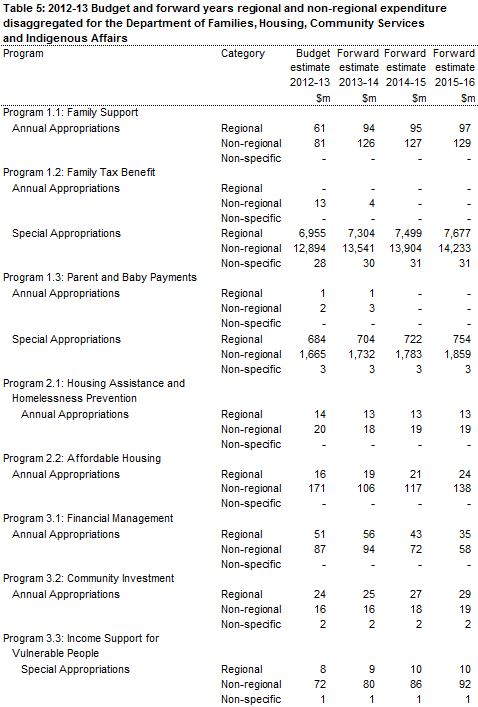
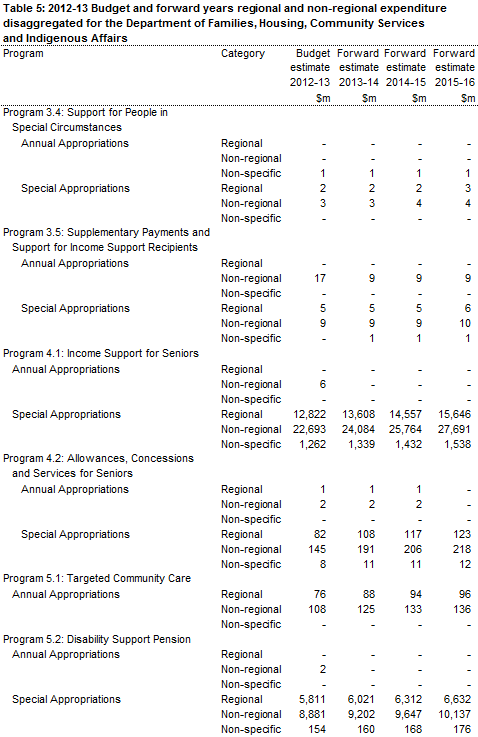
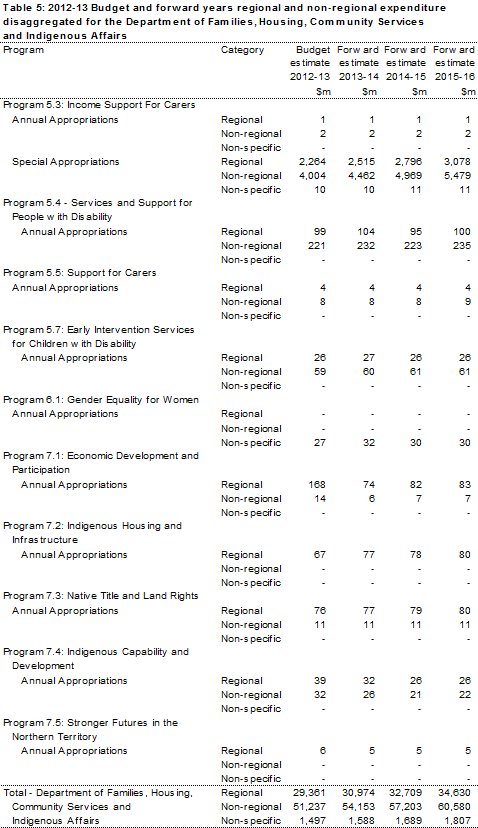
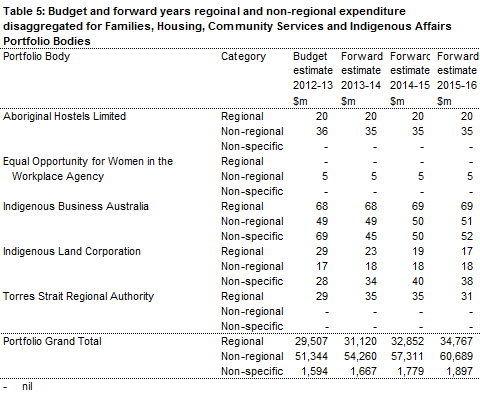
The spatial tables above set out the estimated payments and grants funding to be provided by the Department of Families, Housing, Community Services and Indigenous Affairs and portfolio bodies from 2012‑13 to 2015-16 to support individuals, families and communities.
In 2012‑13 it is estimated that $29.0 billion (or about 36 per cent) of the Department's appropriations will support people living in regional Australia. Of the Department's estimated expenditure to support regional Australia, 98 per cent is comprised of income support and family assistance payments such as the Aged Pension, Disability Support Pension, Family Tax Benefit and Paid Parental Leave.
The following parameters should be noted in relation to the data provided:
- program data is based on the Department's 2011‑12 data as not all funding commitments for future years have been finalised, and transfer payment information needs to be forecast;
- estimated non-regional and regional expenditure has been derived using the attribution of grant funding by service provider location/outlet data held by the Department. In minor instances the billing address of the grant recipient has been used;
- the Department has not applied a materiality threshold; and
- data has been included as non-specific only where it relates to funding to organisations that provide multi-region support and payments to individuals, including those overseas.
New Initiatives
National Disability Insurance Scheme
The Australian Government will provide $1.0 billion over four years for the first stage of a National Disability Insurance Scheme (NDIS). This initiative will deliver personalised care and support to up to 10,000 Australians from 2013‑14, increasing to 20,000 Australians from 2014-15. Eligible individuals will be entitled to reasonable and necessary care and support that reflects their individual circumstances.
This first stage of a NDIS will occur in up to four regions, to be announced following negotiations with State and Territory Governments. The Government will be seeking to share the costs with State and Territory Governments of individual care and support for people with a significant and permanent disability, and will bear the full remaining cost of this initiative.
The NDIS will fundamentally change the way disability care and support is provided. It will provide peace of mind for people with significant and permanent disability and those who care for them across Australia, including in regional areas.
Remote Hearing and Vision Services for Children
The Remote Hearing and Vision Services for Children program is providing $4.9 million over three years to improve access to allied health and education services to an additional 125 children with hearing and/or vision impairment in outer regional and remote Australia. This program will be delivered across Australia from 2012‑13.
Utilising the National Broadband Network where available, children and their families will have access to information, guidance, support, and skills development from qualified allied health and education services where such expertise may otherwise be scarce in regional and remote locations.
The program will be delivered via a combination of high definition videoconferencing, mailed packages with lesson plans, information sheets, multi‑media resources, telephone, fax, and email. In regions where the National Broadband Network is being rolled-out, the Government will provide for upgrades to existing videoconferencing infrastructure to ensure it is of high-definition quality.
Additional funding for Australian Disability Enterprises
Australian Disability Enterprises (ADEs) will receive an ongoing funding injection from the Australian Government of $59.6 million over four years to continue supporting more than 20,000 workers with disability across Australia.
This funding will help about 324 outlets operated by 199 organisations across Australia that provide supported employment opportunities for people with disability. ADEs provide meaningful work and training for people with a disability who need substantial ongoing support to maintain their employment. A total of 175 ADEs outlets (or 54 per cent) are located in regional areas.
Financial Counselling for Problem Gamblers
The Australian Government will provide $25.6 million over four years to implement 50 new financial counselling positions to support problem gamblers and their families. This initiative will be delivered nationally through existing Commonwealth Financial Counselling services. Currently, 61 per cent of the 95 Commonwealth Financial Counselling services are delivered to regional areas of Australia.
Under this measure, Commonwealth Financial Counsellors will undertake specialised training, and will work closely with local gambling venues and State government gambling counselling services. This measure was announced on 21 January 2012 as part of the Government's Tackling Problem Gambling Package.
Continuation of Income Management in Western Australia
Income management in Western Australia will be continued, at a cost of $13.5 million in 2012‑13, to support around 1,000 people per year in metropolitan Perth and in the Kimberley region, to participate in income management and Financial Management Program services. Income management helps families balance their household budgets and ensure their welfare payments are spent in the best interests of their children. It ensures that money is available for life essentials, and provides a tool to stabilise people's circumstances and ease immediate financial stress.
Income management is part of the Australian Government's commitment to reforming the welfare payments system and supporting people to take responsibility for themselves and their families.
Extension of the means test exemption for the Western Australia Country Fuel Card
The Australian Government is providing $25.5 million over four years to continue the social security income test exemption for the value of the Western Australia Country Fuel Card and the Cost of Living Rebate Scheme. The exemption ensures that people living in an eligible Western Australia non-metropolitan local government area receiving the Western Australia Country Fuel Card and Cost of Living Rebate maintain the full value of the Fuel Card and the Rebate to help with cost of living pressures.
Torres Strait Major Infrastructure Program Stage 5
The Australian Government is providing $21.2 million to work with the Queensland Government on a range of environmental health infrastructure projects in the Torres Strait related to water supply and reticulation, sanitation and wastewater, community roads and drainage, and serviced housing lots. Funding will also support new housing projects and help reduce overcrowding.
Previous projects have improved health outcomes in the region, with marked decreases in water and hygiene-related diseases. The program supports Indigenous economic development through local employment, training and business opportunities.
Stronger Futures in the Northern Territory
Stronger Futures in the Northern Territory is a comprehensive $3.4 billion, ten year package, to support Aboriginal people to live strong lives and drive real change over a sustained period.
The package includes:
Health
The Australian Government is investing $713.5 million over ten years to strengthen the safety and wellbeing of Aboriginal children, youth and their families in Northern Territory communities, as part of the Stronger Futures package.
The Stronger Futures in the Northern Territory through Health measure is outlined in more detail in the Health and Ageing section of this Statement.
Food security: strengthening remote stores
Independent evaluation found a large improvement in the availability, range and quality of healthy food in remote communities as a result of the Australian Government's work to licence community stores. As announced in the 2011‑12 Mid-Year Economic and Fiscal Outlook, the Government will provide $40.9 million to continue stores licensing in the Northern Territory; expand it to more stores that are an important source of food, drink and groceries for remote Aboriginal communities and improve the range of available management options to make sure stores can stay open to service local people.
In addition, the Aboriginals Benefit Account has provided $53.9 million to upgrade and construct new stores and store managers' housing in 18 communities throughout the Northern Territory. Participating stores are currently owned by, or in the process of transferring ownership to, licensed Indigenous corporations. Works will commence in 2012 and are expected to continue through to 2015.
Community Safety and Justice
The Australian Government is making a $619.3 million long-term investment in community safety in the Northern Territory.
More police
Funding will continue for 60 remote area police officers for a further ten years. The Australian Government will also continue to support the Northern Territory's Child Abuse Task Force, the National Aboriginal Violence and Child Abuse Intelligence Task Force, and the Substance Abuse Intelligence Desks, including the Dog Operations Unit. People in remote communities expressed concern about issues related to alcohol and drug abuse and these investments will continue to work on these issues.
The Australian Government is also funding an additional four remote area police stations, as well as funding to operate these stations, and the five permanent stations we have already funded in the Northern Territory, for the next ten years.
Night patrols
The Australian Government is also continuing to fund community night patrol services for the next ten years. These services operate across 80 communities to support community members, especially women and children, and defuse violent incidents before serious consequences arise to achieve community safety outcomes. This program not only provides an important safety service, but it also employs more than 350 people in Northern Territory communities.
Legal support
The Australian Government will provide additional funding for legal assistance and advice, primarily in remote communities, for a further ten years. These services ensure Aboriginal people have access to appropriate advice, support, referral and representation when in contact with the justice system.
Tackling Alcohol Abuse
To support communities to better tackle alcohol abuse, the Government provided $75.6 million over eleven years in the 2011‑12 Mid-Year Economic and Fiscal Outlook to support communities to develop alcohol management plans and provide education and skills training about alcohol, prevention programs and referral services.
Building access to quality education outcomes
To improve schooling outcomes in the Northern Territory, the Government is providing $582.6 million over ten years in the Stronger Futures in the Northern Territory Package, including:
- building a quality school workforce;
- a school nutrition program; and
- support to increase school attendance.
These measures are outlined in more detail in the Education, Employment and Workplace Relations section of this Statement.
Supporting Children, Youth and Families
The Australian Government is investing more than $ 412.6 million over ten years to strengthen the safety and wellbeing of Aboriginal children, youth and their families in the Northern Territory. This funding will support families with playgroups, home and parenting support services, youth workers and safe houses for the next decade.
Under this initiative, the number of Communities for Children sites in the Northern Territory will increase from four to 19, with a focus on remote locations. This approach encourages existing health, education and community organisations to get together to plan and deliver local parenting services, playgroups, and support to help people build healthy homes.
It also includes funding for another ten years for:
- eight existing supported and intensive playgroups to help develop children's social, emotional, physical and cognitive abilities;
- Intensive Family Support Services in up to 23 communities, for practical parenting help where children are at risk of entering the child protection system;
- continuing support for 16 women's safe houses in urban and remote areas to protect women and children through crisis accommodation and support; and
- continuing the Youth In Communities Program in more than 30 remote communities to keep young people connected with school or training and help prevent youth suicide, self-harm, and alcohol and substance abuse.
The Government is also continuing to invest in front line child protection through two mobile child protection teams. These teams provide 25 extra front line workers to support Northern Territory child protection officers so more investigations can occur in remote and regional communities to make sure more children are safe. An extra 12 part-time Aboriginal family and community workers will also be funded across 19 remote communities — on top of the current 35 full time workers, this will mean a total of 47 family and community workers in remote Northern Territory. These local workers inform and support people in communities to prevent child abuse and neglect.
In addition, a funding allocation of $30.2 million over ten years will provide for ongoing support for nine crèches in very remote Indigenous communities. These crèches will continue to play an important role in better preparing up to 225 children for school. This measure is outlined in more detail in the Education, Employment and Workplace Relations section of this Statement.
Funding for Homelands and Outstations
Approximately 9,000 people live in small, remote and dispersed communities across the Northern Territory, known as homelands or outstations.
Since 2007, the Australian Government has provided the Northern Territory Government with $20.0 million each year to support the delivery of municipal and essential services to these communities. The Australian Government has also made an unprecedented investment in facilities and services for people who choose to live in or regularly visit outstations and homelands through a range of programs and financial assistance, like health services, boarding facilities, housing maintenance and economic development.
Under the Stronger Futures in the Northern Territory package, outstations and homelands in the Northern Territory will benefit from a $206.4 million investment from the Australian Government and $15.0 million from the Northern Territory Government. This funding supports the continuation of basic essential and municipal services over ten years.
This investment will help supply outstations and homelands with access to power, water and sewerage and road maintenance. The funding will also support garbage collection, dog control programs and operational costs for organisations that provide municipal and essential services.
Jobs Package
Aboriginal people in remote communities across the Northern Territory will have greater employment and economic opportunities under the jobs package announced in the 2011‑12 Mid-Year Economic and Fiscal Outlook, including the following components.
Working on Country Indigenous Rangers Program
The Government is providing $19.1 million to create 50 new ranger positions in the Northern Territory under the Caring for our Country initiative. The program provides real employment and training for Indigenous people, many of whom live in very remote parts of regional Australia.
The Working on Country Indigenous Rangers Program measure is outlined in more detail in the Sustainability, Environment, Water, Population and Communities section of this Statement.
Improving opportunities for Aboriginal people to get access to existing jobs in their communities
Through this package the Government will provide more traineeships and job shadowing opportunities to help ensure local people fill jobs available in their communities. The new 'Local Jobs for Local People' Indigenous traineeships will ensure up to 100 Aboriginal people in the Northern Territory are supported to fill service delivery jobs in their communities as these become available. The package will also provide a jobs guarantee for Indigenous students from Northern Territory Growth Towns.
Remote Engagement and Coordination
The Australian Government is providing $427.4 million over ten years to:
- increase the numbers of Indigenous Engagement Officers in communities from 30 to 54 over the next two years, creating full and part-time job opportunities for up to another 60 local Aboriginal people;
- continue staff working and living in communities to support Indigenous Engagement Officers and become more involved in engaging with local people, including working in a more joined-up way at the regional level;
- continue support for the Northern Territory Aboriginal Interpreter Service, so local community members can get equitable access to the services they need; and
- involve communities in planning and measuring what is happening in their communities under the Stronger Futures package.
Housing
The Australian Government has now built over 600 new houses in the Northern Territory and rebuilt and refurbished some 2,100 more. The Australian Government is working with communities to agree voluntary leases over social housing and Commonwealth assets to ensure major reforms to property and tenancy management continue in remote communities. This Budget provides a further $283.5 million for two crucial elements to continue this work.
Improving existing housing and accelerating the construction of new houses
The Australian Government is investing an additional $230.4 million to improve existing housing in remote Indigenous communities in the Northern Territory. This commitment is on top of the $1.7 billion the Australian Government is already providing for housing over ten years, some of which has been brought forward so houses can be built sooner.
Healthy Homes
The Australian Government is investing a further $53.1 million on Healthy Homes in the Northern Territory. Many buildings in remote Northern Territory communities contain asbestos. The Government is providing funding to remove asbestos containing material, including in houses scheduled for demolition so that new housing can be built.
Continue investment in the Alice Springs Transformation Plan
The Australian Government has invested over $150.0 million in the Alice Springs Transformation Plan (ASTP) since 2009 and is working in partnership with the Northern Territory Government to make the town camps a better place to live.
The Australian Government is providing an additional $13.7 million to continue important family, community and intensive tenancy support projects under the ASTP for a further two years. These projects:
- tackle the devastating and harmful effects of alcohol abuse on Aboriginal people, children and families;
- improve school enrolment and attendance rates for Indigenous children;
- ensure the safety and wellbeing of women and children escaping domestic violence remains a high priority for action;
- deliver preventative measures that will overcome child neglect through strengthening parenting skills, education and support; and
- continue the Intensive Sustainable Tenancy Enabling Program to provide intensive services to people with complex social housing needs in Alice Springs town camps.
Municipal and Essential Services Program
Beyond the Northern Territory, the Government is providing $43.4 million in the Budget to support the continuation of municipal and essential services to approximately 38,000 people in around 350 remote Indigenous communities. This funding will supplement State and local governments in Western Australia, Queensland, South Australia, Victoria and Tasmania to deliver basic services including power, water and sewerage services, garbage collection and disposal, internal road maintenance, landscaping and dust control, animal and environmental health and organisational governance.
The Commonwealth and State and Territory Governments recently agreed to work together to progress genuine reform in this critical area.
Helping Indigenous families to own their own home
The Australian Government supports Indigenous people to have access to the same housing options available to other Australians, including owning a home.
The Australian Government will assist up to an additional 545 Indigenous Australians to buy their own home in established housing markets over the next four years by merging the existing funding from the Home Ownership on Indigenous Land Program — which provides home loans and additional assistance in remote areas — and the Home Ownership Program — which provides home loans mainly in urban and regional areas, into a single Indigenous Home Ownership program.
The new program, to be managed by Indigenous Business Australia (IBA), will continue the existing range of support for people who cannot obtain finance from mainstream lenders.
The new program will make best use of the significant investment the Australian Government provides for home loans to help meet home ownership demand across Australia, while prioritising access for people seeking to move into home ownership on Indigenous land. This will help to ensure demand for home ownership in remote Indigenous communities is met while the States and the Northern Territory address issues such as lack of appropriate land tenure and individually surveyed and titled housing lots.
This initiative will assist approximately 490 people who are currently on the waiting list for a home loan with IBA and cannot obtain finance from mainstream lenders.
To date the Australian Government has supported over 15,000 Indigenous households to move into home ownership through concessional home loans and support provided by IBA.
The Australian Government also provides significant support to help Indigenous people build financial literacy skills. These services are available to people wishing to move into home ownership.
Remote Jobs and Communities Program
The Australian Government is providing $1.5 billion over five years to introduce a new Remote Jobs and Communities Program (RJCP) on 1 July 2013. The new arrangements will provide better and more integrated services, with:
- a single provider of employment, participation and community development services in each of the 65 remote servicing regions — providing better services on the ground;
- services that will be delivered in partnership with the community, underpinned by an action plan agreed with the community;
- all communities and job seekers will be engaged in meaningful participation activities; and
- jobseekers receiving personalised support from the single provider, so their skill development, participation activities and training meet their needs and better match local job opportunities.
A new Remote Youth Development and Leadership Corps for people aged under 25 will provide 12,000 places over five years to support young people on a clear pathway to employment. Building on the success of the Indigenous Rangers program, the Remote Youth Development and Leadership Corps will provide a nine-month program geared towards real employment opportunities for young people.
A new flexible $508.0 million Participation Account will provide funding for participation activities that help people get ready for work and also benefit their community.
A Community Development Fund ($240.0 million over five years) will also underpin larger community-development activities and community capacity building.
About 4,000 people who are currently receiving Community Development Employment Projects (CDEP) wages will continue to be eligible to receive wages from July 2012 until 30 June 2017 while participating in the Remote Jobs and Communities Program. These people have been participating in CDEP for a long period of time, since before 2009, and many face significant barriers to employment.
This initiative is being implemented by the Departments of Education, Employment and Workplace Relations and Families, Housing, Community Services and Indigenous Affairs.
Cape York Welfare Reform Transition — Extension of Funding
The Australian Government is providing $11.8 million to continue the Cape York Welfare Reform Trial in partnership with the Queensland Government, Cape York Regional organisations and four Indigenous communities in Cape York (Aurukun, Coen, Hope Vale and Mossman Gorge). It trials an Indigenous-led approach to rebuild social norms, help participants into the real economy and support small business.
The 12 months bridging funding to 31 December 2013 will continue the income management model and other elements of the trial, including the Family Responsibilities Commission.
Current Initiatives
Helping Children with Autism Package
The Helping Children with Autism Package commenced in 2008 and aims to address the need for services for children with Autism Spectrum Disorder, their families and carers. Eligible children under seven years of age have access to up to $12,000 for early intervention services. The package includes an additional $2,000 one-off payment, available to families with eligible children living in outer-regional, rural and remote areas to help meet some of the costs of accessing services.
The package also provides access to Medicare items for allied health services, and information services to support parents, families, carers and teachers.
Better Start for Children with Disability
The Better Start for Children with Disability initiative commenced on 1 July 2011 and aims to provide access to intensive early intervention services to children with eligible disabilities (sight and hearing impairments, including deaf-blindness, cerebral palsy, Down syndrome and Fragile X syndrome). Like the Helping Children with Autism Package, families living in outer-regional, rural and remote areas can access an additional $2,000 payment to help meet some of the costs of accessing services.
Supported Accommodation Innovation Fund
The Australian Government is investing $60.0 million over three years from 2011 to 2014 to build innovative, community-based supported accommodation places for people with disability. The funding will provide 150 new supported accommodation or respite places. Of the 27 projects funded, 16 are located in regional areas.
Additional funding for community mental health
The 2011‑12 Budget included $269.3 million of new funding over five years in community based mental health support services to assist more than 35,000 Australians with mental illness and their families and carers. This funding will establish:
- 425 additional Personal Helpers and Mentors services;
- new and expanded Mental Health Respite: Carer Support services; and
- an additional 40 Family Mental Health Support Services.
This funding is in addition to over $150.0 million the Australian Government already provided in 2011‑12 for community mental health services, with 41 per cent of funding directed to regional areas.
Locations of sites for new and expanded services for 2012‑13 and beyond are currently being finalised. The Department anticipates that the proportion of funding to regional and remote areas will be maintained in future investment into community mental health services.
Family Support Program
The Family Support Program provides integrated services for families, particularly vulnerable and disadvantaged families, to improve child well being and development, safety and family functioning. There are currently family support services in more than 2,700 locations, just under half of these are in regional, rural or remote areas.
A new model of income management in the Northern Territory
The new income management scheme has been implemented across all of the Northern Territory from 1 July 2010 at a cost of $350.0 million over four years.
Income management is a key tool in protecting vulnerable people, especially children. There are around 17,500 people currently participating in the income management scheme in the Northern Territory. Income management helps ensure that more welfare payments are spent in the interests of children on life essentials, including food, clothes and housing costs, and less welfare goes to problem behaviours like gambling and alcohol abuse.
Breaking the Cycle of Alcohol and Drug Abuse in Indigenous Communities
The Aboriginal and Torres Strait Islander Substance Use in Indigenous Communities Initiative funds culturally appropriate substance-use prevention, early intervention, treatment, rehabilitation and aftercare. In addition, the Breaking the Cycle initiative provides $20.0 million over three years from 2011‑12 to 2013‑14 to support new community solutions for fighting alcohol and substance abuse in Indigenous communities, including development of alcohol and substance abuse management plans.
Improved Service Delivery for Indigenous People Living in Remote Communities
In remote areas, the Remote Service Delivery National Partnership Agreement is delivering a placed-based approach to service design and delivery in 29 priority locations. With funding of up to $291.2 million over five years from 2009‑10 to 2013‑14, the agreement involves cooperation between and across multiple government agencies and six jurisdictions to work in partnership with communities to deliver on local priorities. The Remote Service Delivery National Partnership Agreement aims to improve access to services, raise the level of services, improve governance and leadership and increase economic and social participation.
Army Aboriginal Community Assistance Program
The Army Aboriginal Community Assistance Program (AACAP) is a joint initiative between the Department of Families, Housing, Community Services and Indigenous Affairs and the Australian Army. Each year the AACAP delivers a $6.0 million project to remote communities in Queensland, South Australia, Western Australia, or the Northern Territory. The AACAP site for 2012‑13 is Fregon in Western Australia.
Each project has a construction component, a health component and a training component. The construction component focuses on the provision of environmental health infrastructure such as housing, water, sewerage and electrical services as well as improving access to primary health care facilities by constructing or upgrading roads and airfields. The health component focuses on augmenting existing community medical, dental and veterinary programs. The training component focuses on specific skills required within the community and includes courses such as construction and building maintenance, vehicle and small engine maintenance, welding, concreting and cooking.
National Partnership Agreement on Remote Indigenous Housing
The National Partnership Agreement on Remote Indigenous Housing is providing $5.5 billion over ten years from 2008‑09 to 2017—18 to tackle the very poor housing conditions in many remote areas.
Remote Indigenous Energy Program
The Remote Indigenous Energy Program (RIEP), announced in the 2011‑12 Mid-Year Economic and Fiscal Outlook, is a $40.0 million initiative and part of the Australian Government's Clean Energy Future Package.
RIEP will support smaller remote Indigenous communities reliant on diesel generators for power to transition to a Clean Energy Future by installing renewable energy systems. From July 2011 to June 2016, RIEP will install renewable energy systems in up to 50 smaller remote communities across South Australia, Western Australia, the Northern Territory and Queensland. To complement the installation of renewable energy systems, service providers will provide community members with energy efficiency education and training in basic system maintenance. RIEP will provide employment opportunities for Indigenous Australians.
Homelessness
The White Paper on Homelessness, The Road Home, released on 21 December 2008, sets out the Government's plan for addressing homelessness with a strong effort directed at improving services, turning off the tap by intervening early to prevent homelessness and supporting people with accommodation to break the cycle of homelessness.
To support this strategy, the Australian Government has committed almost $5.0 billion in new funding since 2008 to provide support services and programs to assist people who are homeless or at risk of becoming homeless. Under the National Partnership Agreement on Homelessness (NPAH), the Australian Government together with the States and Territories has committed $1.1 billion to provide new and better integrated accommodation and support services right across Australia. This Agreement will deliver over 180 new or expanded homelessness services across Australia, including our regions, as well as 600 dwellings under A Place to Call Home initiative.
Of the 180 services funded under the NPAH, 46 are in regional areas and 12 are in remote areas. There are also 82 state-wide initiatives which also provide services in regional and remote areas.
One of these initiatives funded under the NPAH is the rural interagency homelessness project for people with complex needs, operating in the Riverina Murray and New England regions of New South Wales. At each site, the project provides case management and access to supportive housing for people who are homeless or at risk.
In Western Australia, the NPAH funds an initiative which ensures Child Support Workers in rural and remote domestic violence accommodation services are supported and provided with training to improve the outcomes for children.
Building Better Regional Cities
The Australian Government has committed $100.0 million until 2014 to help build more affordable homes in regional cities to relieve pressure on our major capital cities so that Australia can grow sustainably. This program will assist participating local councils to invest in local infrastructure projects that support new housing developments, such as connecting roads, extensions to drains and sewerage pipes, and community infrastructure such as parks and community centres. Funding will be given to cities that produce robust evidence of future jobs growth projects, and can show that extra affordable homes will be created as a result of these upfront development costs being borne by the Government. Across Australia, 47 regional cities were invited to participate in the program.
Housing Affordability Fund
Through the Housing Affordability Fund, the Australian Government is investing up to $450.0 million over five years to 2012‑13 to lower the cost of building new homes across Australia. The Fund is supporting projects that improve the supply of new housing, and make housing more affordable for home buyers entering the market. It is addressing two significant barriers to the supply of housing: holding costs incurred by developers as a result of long planning and approval waiting times; and infrastructure costs such as water, sewerage, transport and open space.
The Fund targets greenfield and infill developments where high dwelling demand currently exists or is forecast. Priority is given to projects that improve the supply of new, moderately priced housing and demonstrate how cost savings are passed on to new home buyers. Some of these projects will benefit home buyers in rural and regional Australia, for example the Mackay Regional Council has received $8.5 million to reduce the price of 1,000 new housing lots and the Western Australian Land Authority has received $4.5 million for the Broome North Project that will bring forward 242 subsidised dwellings.
National Rental Affordability Scheme
The National Rental Affordability Scheme is part of the Australian Government's long-term commitment to invest in affordable rental housing. The Scheme includes support for communities in regional areas by increasing the supply of new affordable housing, reducing rental costs for low and moderate income households and encouraging large scale investment and innovative delivery of affordable housing. The Scheme offers financial incentives to the business sector and community organisations to build and rent dwellings to low and moderate income households at a below market rate, providing affordable private rental properties for Australians and their families.
Further information about this and other initiatives relating to rural and regional Australia is available at www.fahcsia.gov.au/nras.
Financial Management Program
The Australian Government's Financial Management Program help people who are struggling to balance their household budgets or in financial crisis. The program includes emergency relief, financial counselling, money management services and financial literacy programs. Around 65 per cent of the 837 financial management program services are in regional areas.
Community Investment Program
The Community Investment Program aims to strengthen communities and promote social inclusion and participation of vulnerable people in community life. The Community Investment Program is committed to delivering a fairer share of funding to regional cities and country communities with 60 per cent of funding in 2012‑13 supporting regional Australia.
Volunteer Grants
Volunteer Grants recognises the valuable work of Australia's volunteers and is part of the Australian Government's ongoing commitment to supporting volunteers and encouraging volunteering in local communities.
In 2011, 3,369 organisations in regional Australia shared in $11.0 million of $16.0 million in total volunteer grants funding. This represented 71.5 per cent of the funding provided through Volunteer Grants in 2011. Funding is available to not-for-profit organisations to purchase small equipment items, and to contribute to the reimbursement of volunteers' fuel costs and to assist with the cost of volunteers training courses and background checks.
Broadband for seniors
The Australian Government has committed $25.4 million to the Broadband for Seniors initiative since 2008. Free training is provided by community volunteers to help develop the skills and confidence of older learners and first-time computer users. At a kiosk, senior Australians can learn how to send emails and search the internet in a friendly and supportive environment.
The Broadband for Seniors initiative provides free access to computers and the internet for Australian seniors from around 2,000 kiosk sites at community centres, retirement villages, libraries and community clubs. More than half of the kiosks are located in regional Australia.
National Women's Alliances
In March 2010 the Australian Government announced funding of $3.6 million over three years for six National Women's Alliances. Each alliance will receive $600,000 in core funding until 2013.
The two alliances representing women in regional Australia are the National Rural Women's Coalition (NRWC) and the National Aboriginal and Torres Strait Islander Women's Alliance (NATSIWA). NRWC represents over 250,000 regional and remote women, their families, communities and associated networks. NATSIWA enables Aboriginal and Torres Strait Islander women from rural, regional and urban areas to share information, identify issues from their own communities and raise concerns, in their own words, with their own solutions, and bring these to government.
National Plan to Reduce Violence against Women and their Children
The National Plan to Reduce Violence against Women and their Children 2010-2022 seeks to ensure Australian women and their children live free from violence in safe communities. Women in rural and regional areas have specific issues in relation to access to services and support. Under the National Plan a number of national initiatives have been introduced which seek to prevent violence against women and to improve service responses including in regional, rural and remote parts of Australia.
The creation of the 24 hour national telephone and online counselling service for victims of domestic violence and sexual assault, 1800RESPECT, provides access to professional counselling for all Australians, irrespective of where they live. Assistance is also available to family and friends and people working in services who are working with victims of domestic violence and sexual assault. Support for frontline workers will be expanded during 2012‑13.
Training on domestic violence issues for health and allied health workers is delivered through the national DVAlert program. In addition to online courses, priority is given to holding courses in rural and regional locations. Work is underway to enhance the training available to aboriginal health workers. Financial assistance with travel costs is also available for workers from rural and remote locations.
If www.budget.gov.au responds slowly or you are having trouble downloading a document, try one of the Budget Website Mirrors
Note: Where possible, Budget documents are available in HTML and for downloading in Portable Document Format(PDF). If you require further information on any of the tables or charts on this website, please contact The Treasury.