



Infrastructure and Transport
The Australian Government recognises the vital importance of Australia's regions to our national prosperity and the unique contribution rural and regional Australians make to our national character. The Infrastructure and Transport portfolio remains committed to supporting vibrant, productive and sustainable rural and regional communities, across the length and breadth of Australia.
Through the unprecedented investment of more than $36.0 billion in the Nation Building Program, the Australian Government will continue to strengthen rural and regional road, rail, and port infrastructure. This includes significant investment to improve and renew our rural and regional roads, fix hundreds of black spots, upgrade our freight rail lines and continue the development of intermodal terminals. This investment will modernise and improve our national infrastructure and deliver concrete economic benefits. Almost two-thirds of the Nation Building Program funding will be allocated to projects in rural and regional Australia. The Australian Government's Regional Infrastructure Fund will support regional infrastructure projects by providing $6.0 billion for much-needed regional infrastructure over 11 years to 2020.
The Australian Government is also preparing for our long-term future by delivering major reforms to the way we invest in, build and regulate our infrastructure. The Government has established an independent statutory body, Infrastructure Australia, to undertake detailed planning and consultation on infrastructure funding priorities. Infrastructure Australia is also leading the development of the National Ports Strategy and the National Land Freight Strategy, which will provide blueprints for better long term planning and future investment in the nation's port, road and rail infrastructure.
Spatial Reporting
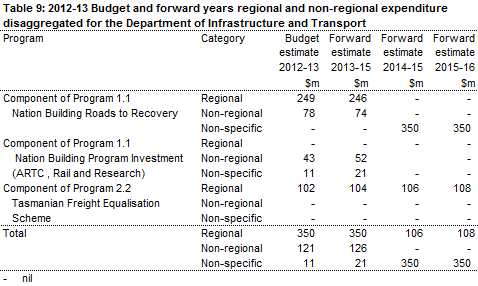
Table 9 illustrates a summary of expenditure for selected grants programs in the Infrastructure and Transport portfolio disaggregated between regional Australia, non-regional and non-specific location for the budget year and forward estimates for the Infrastructure and Transport portfolio. It does not include grants programs where payments are made to the States and Territories or for grants programs of less than $50.0 million.
The Infrastructure and Transport portfolio is making a substantial contribution to regional Australia through various grant programs including, but not limited to, the programs outlined in the below table.
- The Roads to Recovery program provides funding directly to local councils for road works chosen by the councils and to States and Territories for roads in areas where there are no councils. Each funding recipient has a set allocation of funding over the life of the program.
- The Tasmanian Freight Equalisation Scheme assists in alleviating the sea freight cost disadvantage incurred by shippers of eligible non-bulk goods moved by sea between Tasmania and mainland Australia. Its objective is to provide Tasmanian industries with equal opportunities to compete in mainland markets, recognising that, unlike their mainland counterparts, Tasmanian shippers do not have the option of transporting goods interstate by road or rail. The Government has committed approximately $102.0 million in 2012‑13 and $317.0 million in the forward years to the Scheme.
New Initiatives
The Pacific Highway Duplication
Both the Australian and New South Wales Governments have had a long-standing commitment to complete the duplication of the Pacific Highway by 2016. By the end of the current Nation Building Program in 2013‑14 (subject to the required New South Wales matching funding), it is expected that 63 per cent of the Pacific Highway will be duplicated, with a further seven per cent under construction.
Between 2012‑13 and 2016‑17, the Australian Government will make available an additional $3.6 billion under the Nation Building Program. This funding could be made available to the New South Wales Government, contingent on a dollar for dollar matching commitment up to $3.6 billion, to allow the completion of the Pacific Highway upgrade by 2016.
Completion will bring major improvements in freight efficiency, an expected reduction in road trauma and benefits to industries and regions made more accessible by the upgrade. Completion of the upgrade will fulfil an objective long held by the north coast community and governments at all levels.
Black Spot Program
The Australian Government will provide $300.0 million, $60.0 million per annum, to continue the Black Spot Program from 2014-15 to 2018-19. The program provides funding for road safety works at places where there have been serious crashes or where serious crashes are likely.
Roads to Recovery Program
The Australian Government will provide $1.75 billion, $350.0 million per annum, to continue the Roads to Recovery Program from 2014-15 to 2018-19. The program provides funding directly to local councils for road works chosen by the councils and to States and Territories for roads in areas where there are no councils.
Heavy Vehicle Safety and Productivity Program
The Australian Government is committed to improving heavy vehicle road safety and productivity in rural and regional Australia. Driver rest areas play a vital role in ensuring safe and efficient road freight movements and decoupling bays provide improved facilities and safer areas for truck drivers to consolidate and deconsolidate consignments.
An additional $140.0 million will be provided to extend the Heavy Vehicle Safety and Productivity Program - $10.0 million funded in 2012‑13, $30.0 million in 2013‑14 and then $20.0 million ongoing until 2018-19. This funding builds upon the $70.0 million previously provided under this program over the four years 2008‑09 to 2011‑12.
The program directly targets the improved safety of heavy vehicles by providing funding for new and upgraded rest areas, parking and decoupling bays and other road enhancement projects. The majority of these projects are located in rural and regional Australia. To date, the program has funded 236 projects including 95 new or upgraded rest areas and 45 new or upgraded parking/decoupling bays. The introduction of the National Heavy Vehicle Regulator will improve productivity by providing an enduring solution to the current situation where drivers must consolidate or deconsolidate consignments as a result of inconsistent load limits across States and Territories.
Seatbelts on Regional School Buses
The Australian Government will provide $4.0 million over four years from 2012‑13 to 2015-16 to continue to improve the safety of school children in regional and rural areas through the Seatbelts on Regional School Buses program. The program aims to increase the number of school buses equipped with seatbelts for students in rural and regional areas.
Rural and regional school students often travel longer distances on bus routes and on roads with higher speed limits and which can present more hazards than those travelled by students in metropolitan areas. Many of the buses operating on these rural and regional routes are not equipped with seatbelts.
The Seatbelts on Regional School Buses program provides eligible school bus operators with funding of up to $25,000 per bus to cover the cost of fitting seatbelts. Since the program commenced in 2007, the Australian Government has spent over $4.4 million to increase the number of school buses equipped with seatbelts for students. Funding has been provided to fit seatbelts in over 280 school buses throughout regional Australia, helping to improve the safety of our rural and regional school students.
National Transport Planning
The Australian Government will provide new funding of $20.0 million over four years from 2012‑13 to 2015-16 to strengthen its commitment to long term national transport planning and support vital work in areas such as high speed rail. Since 2007 the Australian Government has placed high priority on innovative, long term planning solutions on how we move people and goods within cities, between cities, between regions — and between Australia and the world.
This additional investment will progress high speed rail in Australia and help take critical research and analysis to the next level — ensuring all governments are best placed to take informed decisions on the future of transport systems and networks across the country.
Current Initiatives
Nation Building
Funding of over $36.0 billion will be provided under the current Nation Building Program, with $4.7 billion to be provided in 2012‑13 for road, rail and port initiatives across Australia, to support jobs, and to help drive Australia's long-term productivity and international competitiveness. By investing in transport infrastructure of national significance across Australia, the Government is boosting our economy's productivity. This is part of the Australian Government's continued rollout of the most significant infrastructure program in our nation's history, supporting jobs, productivity and sustainability right across the country.
This infrastructure investment is an important part of strengthening the national economy and enhancing rural and regional Australia's capacity. The Australian Government's investment in land transport infrastructure will benefit rural and regional Australia by addressing infrastructure capacity constraints, relieving traffic congestion, improving road safety, and improving connections with major cities and ports.
Our investment will increase the efficiency of freight and passenger transport, and will bring long term economic benefits to our regions.
Regional Infrastructure Fund
The Australian Government has established the Regional Infrastructure Fund (RIF), which will be funded from the proceeds of the Minerals Resource Rent Tax (MRRT), to address critical infrastructure needs in areas supporting the mining industry. In total, the RIF will invest around $6.0 billion over 2010‑11 to 2020-21 in much-needed infrastructure.
The RIF allows the Government to invest the proceeds of a resurgent resource boom to address urgent infrastructure needs, while supporting the mining industry, boosting export capacity and developing and growing regional economies.
There are three program streams under the RIF:
- Stream 1, administered by the Department of Infrastructure and Transport, represents the implementation of commitments made in 2010 worth $916.0 million;
- Stream 2 will be administered by the Department of Infrastructure and Transport, and comprises two elements: Economic Infrastructure projects and Regional Infrastructure Planning projects — worth approximately $4.5 billion; and
- Projects eligible for consideration for funding are economic infrastructure projects including rail, road, ports, airports, energy, communications and water, as well as other critical economic infrastructure (such as planning, feasibility studies and development work).
- Stream 3, administered by the Department of Regional Australia, Local Government, Arts and Sport, forms part of the Regional Development Australia Fund (RDAF), worth approximately $1.0 billion, with $573.0 million of to be funded from the RIF.
The 2011‑12 Budget provided funding for Stream 1 projects to get underway. Stream 1 project funding includes:
- up to $54.0 million for the Blacksoil Interchange (Queensland) — planning for the project is being finalised, with construction expected to commence mid-2012;
- up to $160.0 million for the Townsville Ring Road (Queensland) - planning work has commenced, with the location of interchanges identified and the majority of required land acquired;
- up to $120.0 million for Peak Downs Highway (Queensland) - preliminary planning has been undertaken to identify priority areas for funding;
- up to $40.0 million for the upgrade of the Intersection of the Bruce and Capricorn highways (Queensland) — planning is being finalised with construction expected to commence in mid-2012;
- up to $50.0 million for the Gladstone Port Access Road (Queensland) - the project is currently in the planning stage. A Steering Committee comprising key stakeholders has been formed to oversee development of the project;
- up to $10.0 million for the Mackay Ring Road Study (Queensland) — the study commenced in June 2011 and is expected to take around three years to complete;
- up to $480.0 million for the Gateway WA project (Western Australia) - RIF funding will be used for construction of the project once planning has been completed. Construction is expected to commence in 2013, with a view to completing the full package of works in 2017; and
- up to $2.0 million for the Scone Level Crossing Study (New South Wales) - a study is being undertaken which aims to display project options in mid-2012 for community comment prior to determining a preferred solution.
In regard to Stream 2 funding, Infrastructure Australia will work with State, Territory and local governments, Regional Development Australia (RDA) committees and the resources sector, in consultation with the Department of Infrastructure and Transport, the Department of Resources, Energy and Tourism and other relevant departments, to identify long term economic infrastructure priorities in regions that are likely to meet the objectives and criteria of the RIF. The Australian Government will then make decisions on funding approval for projects, including the amount of funding to be offered, based on the advice of Infrastructure Australia and the Department of Infrastructure and Transport.
The Department will soon be releasing guidelines outlining eligibility criteria, and governance and financing arrangements under the RIF.
Black Spot Program
The Black Spot Program provides funding for safety works such as roundabouts, crash barriers and street lights, in places where there have been serious crashes or where serious crashes are likely.
The investment of $502.2 million from 2008‑09 to 2013‑14, with $59.5 million to be provided in 2012‑13, is helping to make local roads safer for motorists, cyclists and pedestrians. Each State and Territory receives a share of the total funding, based on population and crash data.
State and Territory Governments, local councils, community groups and individuals can nominate a black spot for funding. Nominations are considered by Black Spot Consultative Panels, which are made up of road experts, Government advisors and local representatives. After examining each nomination, the panels make a recommendation to the Australian Government about a project's merit for funding.
Approximately 50 per cent of Black Spot funds in each State (except Tasmania, the Australian Capital Territory and the Northern Territory) are reserved for projects in non-metropolitan areas. This ensures that crash locations in rural areas are treated, and that rural and regional areas will receive the road safety enhancements they need.
Roads to Recovery Program
The Australian Government is providing a record $2.1 billion from 2008‑09 to 2013‑14, with $350.0 million in 2012‑13, to local councils through the Roads to Recovery Program. Of this, more than 70 per cent ($248.5 million) will be provided to local councils in rural and regional areas.
The Roads to Recovery program provides funding directly to local councils for road works chosen by the councils, and to States and Territories for roads in areas where there are no councils. Each funding recipient has a set allocation of funding over the life of the program. The Australian Government has increased funding for the program by $42.5 million per annum, from 2009‑10.
Western Australian Grain Rail
The Australian Government has allocated $135.0 million in the current Nation Building Program towards the upgrade of Western Australia's Grain Rail Line, with the West Australian Government committing $157.2 million.
This project is providing improvement works on the Western Australian grain freight network, in particular the upgrade of selected Tier 1 and 2 rail lines, selected rail sidings and some of the local road network where Tier 3 rail lines will cease operations. The upgrade of the Tier 1 and 2 rail lines is being delivered in three stages: the Avon to Albany line which is completed; and the Kwinana North and Albany zones, which are currently under construction.
Maldon to Dombarton Rail Link
In October 2011, the Australian Government announced $25.5 million for pre-construction work on the Maldon to Dombarton Rail Link. Pre-construction activities will include the preparation of a detailed design to complete the partially constructed 35 kilometre rail link connecting the Main North-South Line near Picton to Port Kembla, New South Wales. The alignment for the Maldon to Dombarton Rail Link is partially completed, including 70 per cent of the earthworks, tunnel portals and approach spans for the Nepean River Bridge. A Feasibility Study for the Maldon to Dombarton Rail Link completed in September 2011 found that it is technically feasible to build the Maldon to Dombarton Rail Link along the partially completed alignment at an estimated cost of between $624.0 million and $667.0 million.
Arrangements for the Design Stage are currently being finalised, with design work expected to commence in 2012‑13.
Intermodal Terminals
The Australian Government has committed $78.1 million from 2008‑09 to 2013‑14 for the development and/or enhancement of intermodal terminals in Western Australia, Victoria and Tasmania. When complete, these projects will provide benefits across the supply chain, including in rural and regional Australia, through more efficient connections to the interstate rail network and major ports. They will improve Australia's productivity and economic performance, and promote industry development and investment. The projects are intended to reduce heavy vehicle traffic, improve the competitiveness of rail freight, improve air quality and reduce greenhouse gas emissions.
These initiatives are complementary to the Australian Government's commitment to deliver the Moorebank Intermodal terminal in western Sydney, a state-of-the-art intermodal freight hub with both import-export and interstate terminal facilities.
Temporary Assistance for Tasmanian Exporters
In March 2012, the Government announced the provision of $20.0 million to assist Tasmanian exporters with access to international markets. This funding will assist in addressing the ports and shipping issues being encountered by Tasmania based exporters. The funds will be paid to the Tasmanian Government.
Tasmanian Rail Investments
The Australian Government has allocated over $193.6 million from 2008‑09 to 2013‑14 to undertake capital upgrades on the Tasmanian freight rail network. This investment is helping to keep the core of the Tasmanian network operational, whilst supporting the ongoing growth of freight movements to and from Tasmania's ports. In July 2011, the $78.0 million Tasmanian Rail Rescue Package was completed. This package involved rehabilitation and re-sleepering over the core of the Tasmanian rail network. Major works underway in 2012‑13 include upgrades of the Melba Flats to Burnie line and the Burnie to Hobart line. The investment also includes upgrade works on two off network lines, Fingal and Boyer, providing support for Tasmania's economically significant cement, paper and coal mining industries.
Investment in the Australian Rail Track Corporation
The Australian Government is continuing its investment in the Government-owned Australian Rail Track Corporation (ARTC) through its equity investments of $2.2 billion to support the ARTC's extensive capital upgrade program across regional Australia. This investment will modernise and improve the capacity of the interstate and Hunter Valley rail networks, helping to reduce heavy vehicle traffic on rural and regional roads. These projects will help create some 1,500 jobs, mostly in regional Australia.
In a boost for regional economies, the required material — new concrete sleepers and steel rail — are being sourced from factories in Whyalla, Grafton, Geelong, Mittagong and Wagga Wagga.
Equity for these capital upgrades is being been provided through two packages. The Australian Government is providing $996.0 million under the Rail Productivity Improvements Package, having already made two equity injections in 2010‑11 and 2011‑12, totalling $784.3 million towards this commitment. The remaining equity injection of $211.7 million is due to be provided in July 2012.
Funding of $79.2 from the productivity package has recently been allocated to the $134.0 million Ballast Rehabilitation Program being undertaken by the ARTC to further enhance the interstate rail line between Sydney and Melbourne.
The Rail Productivity Improvements Package includes:
- $99.2 million to straighten the line between Maitland and the Queensland border at 58 locations;
- $24.0 million to build three double track passing loops near the New South Wales towns of Picton, Glenlee and Menagle Park;
- $304.0 million to re-rail the lines between Whyalla and Broken Hill and between Parkes and Broken Hill;
- $253.0 million to replace the existing old wooden sleepers on the line between Parkes and Broken Hill with one million new concrete sleepers;
- $109.6 million to re-rail the line between Albury to Melbourne to Geelong;
- $32.0 million to build four new passing loops between Gheringhap and Maroona in Victoria; and
- $95.0 million to improve capacity of the East-West rail corridor between Koolyanobbing and Kalgoorlie.
In addition, the Government has provided a $1.1 billion equity injection to the ARTC through the Economic Stimulus Plan to support 17 major rail projects, of which 13 have been completed. Completed projects include:
- the Wodonga Rail Bypass Duplication ($50.0 million);
- the Western Victoria Track Upgrade ($105.7 million);
- the Queensland Border — Acacia Ridge upgrade ($55.8 million);
- the Melbourne to Junee Passing Loops ($29.7 million); and
- the Adelaide — Kalgoorlie New and Extended Loops ($23.0 million).
Work on the Hunter Valley Rail package ($580.0 million provided through the Economic Stimulus Plan) is also progressing, with four of the six projects now complete.
The ARTC is also improving the reliability on the main North-South rail line connecting Sydney and Melbourne as a priority, by accelerating its ballast rehabilitation program through the reallocation of funds from the re-scoped North Coast Curve Easing Program and other project savings. The $134.0 million ballast rehabilitation program is being implemented following the wet weather events that have affected this line since mid-2010, allowing the ARTC to capitalise on the substantial investment being made on the Melbourne - Sydney - Brisbane corridor.
All of these projects are supporting significant rural and regional construction and economic activity, and boosting the cost competitiveness of freight rail along the North-South and East-West rail corridors.
High Speed Rail
Work is progressing on a $20.0 million strategic study commissioned by the Australian Government to determine the economic benefits and financial viability of a high speed rail network along Australia's east coast.
The study is being undertaken in two phases. The report of the first phase, released in August 2011, considered initial corridor and station options, patronage and indicative high-level costs.
The second phase, which builds on the first phase of the study, is scheduled for completion in late 2012. It will determine the recommended route alignment; refine capital cost estimates, passenger and revenue forecasts; assess financial and economic viability; and provide options for staging, financing and governance. It will also consider the environmental, social and regional development impacts of high speed rail.
The study will form the basis of Government considerations on the future of high speed rail in Australia.
Strengthening aviation security — regional and domestic aviation security
Between 2010‑11 and 2013‑14 the Australian Government will invest $32.1 million in initiatives to strengthen aviation security. Measures funded across these four years include:
- increasing explosive trace detection capability for passenger screening at existing domestic airports from 1 July 2012;
- implementing passenger screening for all regular public transport and open charter air services utilising aircraft with a maximum takeoff weight greater than 20,000 kilograms; and
- extending the requirement for hardened cockpit doors to be fitted to all aircraft with a maximum takeoff weight greater than 10,750 kilograms.
The Government will assist with the cost of additional explosive trace detection machines at domestic screened airports, screening equipment at unscreened regional airports, and installation of hardened cockpit doors.
Benefits to regional Australia will be an improved travel experience with an enhanced security outcome for passengers passing through regional airports. Additionally, upgraded aviation security measures will remove any aviation security related disincentives from operating large aircraft in regional ports.
Regional Aviation Access Program
The Regional Aviation Access Program (RAAP) provides funding for regular subsidised passenger and freight services, remote aerodrome safety and access projects as well as remote aerodrome advisory services.
RAAP has a 2012‑13 Budget allocation of $24.6 million, including $11.0 million for aerodrome upgrades at remote and isolated airstrips across Australia. This funding will be used for works at identified Indigenous community airstrips to improve safety and accessibility and to fund grants to a broad range of aerodrome owners for projects on a co-funding basis.
The airstrips support flights essential to remote communities such as those delivering fresh food, mail, transporting residents and emergency personnel, as well as the Royal Flying Doctor Service.
Funding Components under RAAP include:
- the Remote Air Services Subsidy Scheme (RASS);
- the Remote Aviation Infrastructure Fund (RAIF);
- the Remote Airstrip Upgrade Grants (RAUG); and
- the Remote Aerodrome Inspection (RAI) Program.
Remote Air Services Subsidy Scheme
The RASS subsidises regular (typically weekly) passenger and freight air transportation to communities which would otherwise have no regular access to transport. From January 2011 to December 2011, the RASS carried over 7,247 passengers and over 285,000 kilograms in freight and mail to 253 remote communities (including 83 Indigenous communities) in ten remote geographical locations across the Northern Territory, Western Australia, South Australia, Queensland and Tasmania.
Remote Aviation Infrastructure Fund
The RAIF provides funding to upgrade airstrips at remote Indigenous communities that received a RASS service and were also identified as requiring priority works. These upgrades will make the airstrips safer and more accessible. The airstrips present a vital lifeline to people living in remote Indigenous communities across Australia. They allow these areas access to essential items such as medical and business supplies, fresh food and long-distance educational materials.
Remote Airstrip Upgrade Funding Component
Australian Government funded RAUGs are also available for communities to improve the safety and accessibility of airstrips and facilitate the provision of non-commercial essential community air services including delivery of food supplies, community mail, passenger transport services, medical supplies and medical care.
Remote Aerodrome Inspection Funding Component
The Australian Government's RAI Program provides an aerodrome inspection service for 59 designated Indigenous communities.
This Australian Government funded service provides practical assistance to remote communities heavily reliant on air services. The RAI program facilitates training of aerodrome reporting officers, as required for compliance with aviation safety regulations. Normally, aerodrome inspections of this type would be the responsibility of the aerodrome owner/operator. However, they require specialised technical expertise not readily available in many remote communities.
The Airservices Australia Enroute Charges Payment Scheme
Under the Australian Government's Airservices Australia Enroute Charges Payment Scheme (the Enroute Scheme), eligible aeromedical service providers are reimbursed for enroute air navigation charges, as levied by Airservices Australia.
Funding of $1.0 million per annum will continue to be available for the Enroute Scheme.
Further Information:
Further information about these and other infrastructure and transport initiatives relating to rural and regional Australia is available at www.infrastructure.gov.au.
If www.budget.gov.au responds slowly or you are having trouble downloading a document, try one of the Budget Website Mirrors
Note: Where possible, Budget documents are available in HTML and for downloading in Portable Document Format(PDF). If you require further information on any of the tables or charts on this website, please contact The Treasury.