



Regional Australia, Local Government, Arts and Sport
The Regional Australia, Local Government, Arts and Sport portfolio supports the Government's commitment to improve the social, economic and environmental outcomes for Australia's regions and to provide oversight and management of the sport and recreation, and arts and culture functions.
The portfolio is strengthening communities and regions by improving local opportunities, creativity, productivity and wellbeing, and by supporting participation and excellence in cultural and sporting activities.
A key focus of the Department is to work with communities, industry stakeholders, State and local governments to better understand the needs and priorities of regional Australia, and to work across government to shape and influence policy outcomes to maximise the benefits for regional Australia. The Department also administers the delivery of almost $1.0 billion in Australian Government funding for the Regional Development Australia Fund (RDAF) for infrastructure projects that meet the identified priorities of regional communities.
Spatial Reporting
Table 10 illustrates a summary of expenditure by program disaggregated between regional Australia, non-regional and non-specific location for the budget year and forward estimates for the Regional Australia, Local Government, Arts and Sports portfolio.
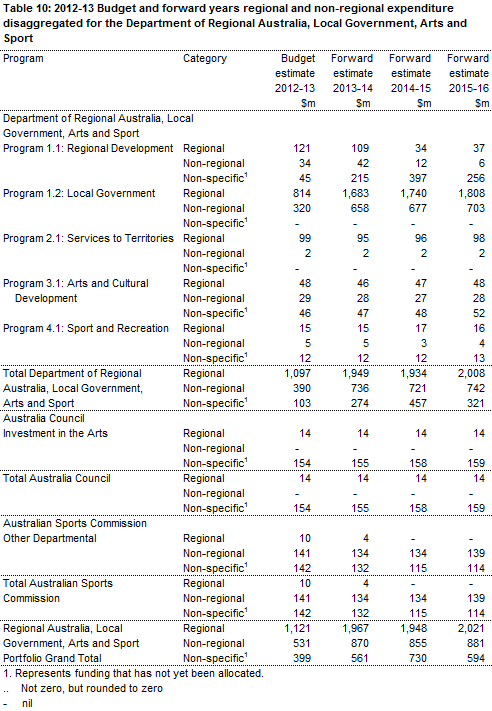
In the 2012‑13 Budget and over the forward estimates the Department will continue to focus on policy development and implementing the Australian Government's reform initiatives for regional Australia.
A number of portfolio agencies also deliver programs that benefit regional Australia, as outlined below.
- The Australia Council supports a number of programs in regional Australia to enrich our nation by supporting the practice and enjoyment of the arts.
- The Australian Sports Commission plays a central leadership role in the development and operation of the Australian sports system, administering and funding innovative sport programs and providing leadership, coordination and support for the sports sector, a number of these programs benefit regional Australia.
New Initiatives
Active After-School Communities Program — continuation
An additional $39.2 million will be provided from 2012‑13 to 2013‑14 to continue the Active After-School Communities (AASC) program. AASC is a nationally coordinated initiative that encourages primary school-aged children to participate in sport and other structured physical activity. The AASC program has three main outcomes:
- to engage traditionally inactive children in sport;
- to deliver a quality program which is safe fun and inclusive; and
- to provide pathway opportunities to promote transitions into community sport.
The program contributes to the Government's social inclusion agenda. It currently has 52 per cent of sites in regional and remote communities. In many of these communities there are no established community sporting clubs and the AASC program is the only co-ordinated vehicle to deliver a variety of sports to primary school children. The cornerstone of the AASC program is the involvement of the local regional community in the delivery of the program. This involvement will offer opportunities to support and strengthen community cohesion and development. In 2010, 64 per cent of coaches and 79 per cent of teachers were trained in the Community Coach Training Program in regional Australia.
Norfolk Island — further reforms
During the 2010 election, the Government committed to "ensure the standards of living of residents of Norfolk Island are comparable with mainland Australia, without sacrificing the benefits to the community of self-government and continue to work with the Norfolk Island Government and local community to improve standards of accountability and transparency within the Government and associated enterprises."
The $2.9 million second stage of the Norfolk Island Reform Package includes a rolling series of reforms to reduce the Norfolk Island community's dependency on Commonwealth emergency funding, empower the community to lift services on the Island and provide a further step towards economic diversity. The reforms are focused on four key areas of economic development, public sector governance, community wellbeing and environmental management. The reforms will provide for capacity building within essential services, implementing recommendations from the Economic Development Strategy and Action Plan (completed in early 2012), revitalising the tourism industry and developing a strategic community plan for the Island.
This measure will foster a robust economy and promote good governance by the Norfolk Island Government. It will also ensure that the Commonwealth Capacity Building Team agreed in 2011 advances implementation planning and policy development for future reform proposals.
The costs of this measure will be met from within existing resources.
Community Street Soccer and RecLink
Participating in sport and recreation activities promotes social inclusion and is good for people's health and wellbeing. Funding of $2.6 million will be provided to use sport and recreation to help break the cycle of entrenched social disadvantage by providing financial support to eligible community sporting organisations that help people in need. This initiative will focus on two existing programs that are successfully achieving social inclusion outcomes through the use of sport and recreation activities:
- the Community Street Soccer program assists homeless, recently homeless and unemployed people to reconnect with the community and regain self esteem and independence through participating in sport; and
- the RecLink program is a national program that links more than 200 community agencies through a non profit organisation that runs sport and cultural programs to improve the lives of Australians suffering from drug and alcohol abuse, mental illness, social disconnection and homelessness.
Jim Stynes Achievement Scholarships
The Government has allocated $3.0 million in the 2012‑13 Budget as a one-off grant in 2011‑12 to establish a sporting scholarships scheme in partnership with the Australian Football League. It is expected that under the scheme, scholarships of up to $20,000 will be provided to around 37 recipients annually to provide both a pathway to employment and a pathway to develop skills and/or talents unique in youth (15 to 19 years of age) from multicultural backgrounds, indigenous communities and socially disadvantaged communities.
Nominees for the scholarship will come from community sporting clubs and not‑for‑profit community organisations across Australia. Successful applicants will be offered a minimum 12-month scholarship which will provide a range of opportunities including education and travel grants, coaching and talent development, work experience and engagement in The Reach Foundation's inspiring youth-led programs and workshops.
National Disaster Recovery Task Force — extension
An additional $1.6 million has been allocated in the 2012‑13 Budget to the Department to continue the work of the National Disaster Recovery Task Force until June 2013. The National Disaster Recovery Taskforce is continuing to assist Queensland and Victoria recover from an unprecedented level of damage following flooding and Tropical Cyclone Yasi in 2010‑11.
The reconstruction task includes repairing over $7.0 billion damage to State and local infrastructure, such as roads, government buildings, utilities and marine infrastructure.
In 2010‑11, the Commonwealth advanced $2.3 billion to the Queensland Government and $500.0 million to the Victorian Government to ensure rebuilding could commence as soon as possible. A further $1.9 billion was advanced to the Queensland Government in 2011‑12.
As the task of rebuilding continues in communities around Queensland, the reconstruction program now exceeds $5.7 billion in projects underway, being prepared for market or already completed. Similarly, in Victoria around half of the funding estimated for reconstruction work has been committed.
The Australian Government Reconstruction Inspectorate is examining reconstruction work in both Queensland and Victoria to ensure Commonwealth funding is achieving value-for-money. Inspectorate members have travelled to regional locations including Toowoomba, Cardwell and Mildura, to meet local authorities and review reconstruction projects first hand. Project reviews are expected to continue throughout 2012‑13 as the remainder of reconstruction work gets underway.
Other new initiatives
The Government has committed additional funding of $61.9 million in 2011‑12, announced in the 2012‑13 Budget, for a number of smaller measures across the Regional Australia, Local Government, Arts and Sport portfolio. Some of these measures have regional impacts, including:
- $1.8 million for upgrades to the Wayne Richards Park Sports Complex, including resurfacing the Port Macquarie Hockey Field;
- a $182,510 contribution to the Gunnedah Rural Museum in New South Wales;
- a $50,000 contribution to Tamworth community facilities for children;
- $1.0 million for Port Macquarie foreshore works;
- $1.2 million for the development of the Taree foreshore;
- a $30,000 contribution towards a statue to pay tribute to Slim Dusty and Joy McKean, to be placed in the centre of Tamworth;
- $8.7 million for the King George V sports precinct in Glenorchy, Tasmania; and
- $8.2 million to remove the wreckage of the MV Tycoon from Christmas Island and remediation work at the site.
Current Initiatives
Regional Development
Regional Development Australia
The Government has created a national network of 55 Regional Development Australia (RDA) committees to engage with regional communities and provide advice to Government. The key functions that underpin the role of this network include:
- providing support for informed regional planning;
- consulting and engaging with regional communities on economic, social and environmental issues, solutions and priorities;
- liaison with all levels of government and local communities about government programs, services, grants and initiatives for regional development; and
- contributing to business growth plans and investment strategies, environmental solutions and social inclusion strategies in the region.
The Government is working with the RDA network and regional partners to enhance their role in prioritising investment in infrastructure and services for regional communities to make sure that it meets their needs and matches their growth. Guidelines for the recently announced Regional Development Australia Fund provide for a major role for RDA committees in identifying projects to be supported. Around $78.9 million will be provided to support RDA committees over the forward estimates period.
Regional Development Australia Fund
The Australian Government has allocated almost $1.0 billion, which includes $573.0 million from the passage of the MRRT legislation, to the RDAF for projects intended to address the infrastructure needs of Australia's regions and promote economic and social development. The RDAF supports the economic, environmental and community needs of Australia's regions by providing funding for projects that meet the identified priorities of regional communities, as articulated in RDA Regional Plans. It is designed to ensure that new investments build on strengths and reflect the characteristics, opportunities and challenges of our diverse regions.
A total of 553 applications were submitted for the $150.0 million Round One of the RDAF. Grants of between $500,000 and $25.0 million were allocated to support 35 projects across the country.
New South Wales
- Ballina Byron Gateway Airport Apron Extension Project - Ballina
- Refurbishment of the Coast Community Centre - Gosford
- Four Winds: Building Nature's Concert Hall - Bega Valley
- Upgrade to Griffith Airport (Terminal and Main Apron) - Griffith
- Expanding the capacity of the Hunter Valley Research Foundation - Newcastle
- Lismore City Hall Upgrade - Lismore
- Newcastle Region Art Gallery Redevelopment - Newcastle
- Freeman House - Rebuild for Regional Health, Education and Communities Project - Armidale
- Youth Off The Streets - Project Cordeaux — Cordeaux Heights
Victoria
- Sandhurst (Bendigo) Community Theatre Complex - Bendigo
- The new Geelong Library and Heritage Centre - Geelong
- Skilled Stadium Redevelopment - Stage 3 (Southern Stand) - Geelong
- Lake Hamilton Regional All Abilities Playground and Foreshore Redevelopment - Hamilton
- Clunes Community and Interpretive Centre - Clunes
Queensland
- Bundaberg Recreational Precinct - Bundaberg
- Upper Coomera Community and Youth Hub — Upper Coomera
- Lifeline Youth, Community Counselling, Education and Training Facilities - Fraser Coast
- Maleny Community Centre Social Enterprise Capacity Building Renovation Stage 1B - Maleny
- Somerset Civic Centre - Esk
- Rockhampton Southside Memorial Pool Redevelopment - Rockhampton
- Magnetic Island Walkway Project - Nelly Bay to Arcadia - Magnetic Island
South Australia
- APY Art Centres 2030 - APY Lands
- The Tanunda to Gawler Shared Bicycle/Walking Path - Barossa Valley
- Energizing The Flinders - A green energy infrastructure project for The Flinders - Flinders Ranges
- Port Lincoln Airport Upgrade - Port Lincoln
- Development of the Streaky Bay Oval Precinct - Streaky Bay
- Port Pirie Men's Shed and Community Centre Complex Rebuild Project - Port Pirie
Western Australia
- Katanning Regional Sheep Saleyards - Katanning
- Kimberley Land Council Office Project - Broome
- Baldivis Library and Community Centre - Rockingham
- Karratha Leisure Complex - Karratha
Northern Territory
- Alice Springs Regional Waste Management Centre - Alice Springs
- HIA Multi Purpose Building Industry Training Centre - Darwin
Tasmania
- Glenorchy Art & Sculpture Park - Stage 2 - Glenorchy
- Meeting Regional Needs: Delivering a Paediatric Regional Centre of Excellence - Hobart
A further $200.0 million in funding is available under Round Two of the RDAF for grants up to a maximum of $15.0 million. An announcement on recipients of Round Two funding is expected in the near future.
Community Infrastructure Grants
During the 2010 election, the Australian Government made a commitment to fund projects that were identified by local communities across regional Australia as priority investments for their region. Projects include the construction and upgrade of local sport, recreation and community infrastructure, significantly enhancing the liveability of Australia's regions. Funding of $188.4 million over the forward estimates period ($66.9 million in 2012‑13) will be available to fund eligible community infrastructure projects.
Clean Energy Future — Regional Structural Adjustment Assistance - supporting communities and regions
The Government has set aside $200.0 million, if needed, to provide structural adjustment assistance to support workers, regions, and communities that remain strongly impacted by carbon pricing, after other forms of assistance have been provided. This assistance could include: support for displaced workers and their families; community development programs; and economic diversification projects. Where assistance may be required, the Government will work in close consultation with communities through a coordinated government approach to develop and deliver appropriate assistance. Funding for any region under this program will be determined on a case by case basis.
Tasmanian Forests Intergovernmental Agreement
As part of the Tasmanian Forests Intergovernmental Agreement, the Australian Government is providing funding to support the diversification of the Tasmanian economy. In 2011‑12, the Government provided initial funding of $20.0 million. Subject to the passage of legislation in the Tasmanian Parliament, a further $100.0 million will support economic diversification across the following 14 years.
Office of Northern Australia
The Office of Northern Australia provides policy advice to the Government on sustainable development issues in, or affecting, northern Australia. It enables better coordination across the Government and between all levels of government, businesses and communities on issues affecting northern Australia.
The Office of Northern Australia coordinates the Northern Australian Sustainable Futures Program. The implementation of this program will strengthen the capacity of the Office of Northern Australia to lead policy development, facilitate collaboration with the northern jurisdictions and to provide timely and strategic advice to Government on a range of priority issues.
Northern Australia Sustainable Futures Program
The Government provided $6.0 million in funding over 2010‑11 to 2012‑13 for the delivery of the Northern Australia Sustainable Futures Program, a 2010 federal election commitment, developed to promote and encourage the sustainable development of northern Australia.
The Program is being led by the Northern Australia Ministerial Forum, chaired by the Minister for Regional Australia, Regional Development and Local Government, the Hon Simon Crean MP, with membership including ministers responsible for regional development from the Queensland, Northern Territory and Western Australian Governments.
The program addresses the need for:
- enhanced Indigenous and community engagement in policy and planning;
- development of sustainable careers and business opportunities for Indigenous people in northern and remote communities;
- improved understanding of regional infrastructure investment priorities;
- opportunities to improve service delivery;
- improved water management in remote communities; and
- improved understanding of opportunities and risks to sustainable development in the northern beef industry.
North Queensland Irrigated Agriculture Strategy
The North Queensland Irrigated Agriculture Strategy will deliver a comprehensive assessment of sustainable water resource development and the potential for new irrigated agriculture in northern Australia.
The $6.9 million Commonwealth investment, which includes a $800,000 in-kind contribution from CSIRO, is a collaborative initiative with the Queensland Government that will examine surface water storage options in the Flinders and Gilbert River catchments; identify and demonstrate the viability of new irrigated agriculture opportunities; and thoroughly assess potential environmental, economic and cultural impacts and risks, to ensure development paths are genuinely sustainable.
Building on the work of the Northern Australia Ministerial Forum and the Northern Australia Beef Industry Strategy, the project will deepen the Australian Government's understanding of how new and sustainable irrigation industries might be developed in northern Australia and also inform a broader assessment of the potential for meat processing in northern Australia.
Regional Australia Institute
A one-off Commonwealth grant of $8.0 million has been provided to the Regional Australia Institute (RAI), formerly the Regional Development Policy Centre, to facilitate company establishment and deliver a forward research agenda. A key component of the Government's Commitment to Regional Australia, RAI operates independently of government and is expected to become a trusted source of independent advice for communities, industries and governments by undertaking rigorous research and debate that will inform approaches to regional economic development.
Local Government
Local Government Financial Assistance Grants
The Local Government Financial Assistance Grants, established under the Local Government (Financial Assistance) Act 1995, provide financial assistance to Local Governments across Australia to enable them to meet local priorities. The funding is untied and consists of two components:
- a general purpose component which is distributed between the States and Territories according to population; and
- an identified local road component which is distributed between the States and Territories according to fixed historical shares.
Supplementary funding to South Australian councils for local roads
The Australian Government will provide supplementary funding of $16.9 million in 2012‑13 and $17.5 million in 2013‑14 for South Australian local roads, to address anomalies in the distribution of the local road component of the Financial Assistance Grants.
Services to Territories
The Department administers the Territories of the Ashmore and Cartier Islands, Christmas Island, the Cocos (Keeling) Islands, the Coral Sea Islands and Jervis Bay; and manages national interests in the Australian Capital Territory, the Northern Territory and Norfolk Island.
The objective of the Department's work is to assist the Territories to establish and maintain good governance and manage their own futures by providing services and advice on ongoing administration. It also provides funding support and undertakes capital works with the objective of ensuring that Territory communities enjoy the same level of services as equivalent State communities.
Sport and Recreation
The Indigenous Sport and Active Recreation Program (ISARP) is administered by the Office for Sport as part of the Australian Government's whole-of-government approach to assisting Indigenous Australians. The ISARP is a new name for the merger of the following two former programs:
- Indigenous Sport and Recreation Program; and
- Jobs Creation Package — Sport and Recreation.
The ISARP supports community participation in sport and active recreation activities that help to improve the health and physical wellbeing of Indigenous Australians and those that contribute to broader social benefits for participants and their communities.
The ISARP provides funding to a whole range of activities from high participation sports such as; cricket, football, netball, basketball, athletics through to Traditional Indigenous Games and various sporting events. In addition, subsidies for employment are also provided for positions that directly support and or deliver ISARP funded activities.
Arts and Cultural Development
The Australian Government supports a number of initiatives which assist the touring of performing artists and exhibitions to increase access to and participation in the arts by people living outside major metropolitan areas. This recognises that culturally vibrant regions are vitally important to our national cultural identity.
Contemporary Touring Initiative
The Contemporary Touring Initiative assists collecting institutions and other organisations with the costs of developing and touring major exhibitions of contemporary Australian visual arts and craft across Australia. In 2012‑13 the Government has allocated $0.6 million to support its ongoing commitment to contemporary Australian visual arts and craft with the objective of encouraging wider audience access to Australian visual arts and craft through quality publications, education and public programs that are a part of touring exhibitions.
Regional Arts Fund
The Government has allocated $3.1 million for 2012‑13 to support sustainable cultural development in regional and remote Australia. The Regional Arts Fund is a devolved fund which is delivered on behalf of the Government by regional arts organisations in the States and arts agencies in the Territories.
Festivals Australia
The Government has allocated $1.2 million for 2012‑13 to the Festivals Australia program, which assists in the presentation of new arts and cultural activities at Australian regional and remote community festivals. Since the program's inception in 1995, the program has supported over 1,260 new arts and cultural projects with funding totalling over $17.6 million. Projects funded include a range of disciplines such as dance, music, theatre, literature, comedy, circus, parades, instrument making, film and video, animation, puppetry, visual arts and crafts, and multimedia.
Playing Australia
For 2012‑13, the Australian Government has allocated $6.8 million to the Playing Australia program, the Australian Government's national touring program for the performing arts. Since its inception in 1992, funding of $92.0 million has assisted over 880 tours to take performing arts across Australia, particularly to regional and remote communities. The program supports projects ranging the disciplines of theatre, music, opera, dance, puppetry and circus performance to tour regionally where it would otherwise not be commercially viable and there is a demonstrated public demand.
Contemporary Music Touring Program
The Contemporary Music Touring Program assists emerging and established musicians take their music on tour to Australia's regional and remote areas. The program provides assistance with touring costs such as transport, accommodation, insurance, production and marketing and supports all types of genres including jazz, fusion, blues, hip hop, world, new classical, pop, funk, country, folk, electronic, alternative and rock.
Visions of Australia
For 2012‑13 the Australian Government has allocated $2.3 million to the Visions of Australia program. The Visions of Australia program supports access to exhibitions of Australian cultural material by providing funding to eligible organisations to develop and tour exhibitions. Through this, the program provides more Australians in regional and remote areas access to Australian cultural material.
National Collecting Institutions Touring and Outreach Program
The National Collecting Institutions Touring and Outreach Program is an initiative announced by the Government in 2009‑10 Budget and provides $4.0 million over four years to assist the National Collecting Institutions in the development and touring of their collections both nationally and internationally. The aim of the program is to:
- improve access for all Australians to the national collections, with a particular emphasis on providing access for audiences in regional Australia;
- promote Australia by supporting works from Australian national collections to tour overseas; and
- attract smaller international collections to tour to multiple venues, particularly in regional Australia.
Community Heritage Grants Program
The Community Heritage Grants Program, administered by the National Library of Australia, aims to preserve and provide access to nationally significant Australian cultural heritage material such as objects, artefacts, letters, diaries, maps, photographs, film/video and oral history recordings held by community groups across the country. Grants of up to $15,000 are available for preservation projects and collection management training for staff and volunteers.
Indigenous Arts and Culture Programs
The Australian Government, through the Office for the Arts supports Indigenous culture, languages and visual arts through a number of initiatives.
Indigenous Repatriation
This program returns Aboriginal and Torres Strait Islander ancestral remains and secret sacred objects held in major government funded museums and in overseas collections to their communities of origin where possible and when requested.
Indigenous Languages Support Program
The Indigenous Languages Support Program (formerly Maintenance of Indigenous Languages and Records) addresses the steady erosion and loss of Australia's estimated 250 original Indigenous languages by providing support for the maintenance and revival of these languages to community organisations throughout Australia.
Indigenous Culture Support Program
The Indigenous Culture Support program supports the maintenance and continued development of Indigenous culture at the community level. The program supports activities that maintain Indigenous culture through community involvement; support new forms of Indigenous cultural expression; increase public awareness of Indigenous culture, including through the presentation and exchange of culture; and support the sustainable development of community organisations involved in cultural activities.
Cape York Welfare Reform Trials
The Government will support the employment of Aboriginal and Torres Strait Islander peoples in entry level positions supporting the arts and broadcasting sectors. The jobs are being funded as part of Australian Government Cape York Welfare Reform Trials which aim to promote engagement in the real economy, reduce passive welfare and rebuild social norms.
Torres Strait Island Jobs Creation
The Government has allocated $2.8 million in 2012‑13 to support the employment of Aboriginal and Torres Strait Islander peoples in the visual arts industry in the Torres Strait Islands. These jobs are being funded as part of Australian Government reforms to the Community Development Employment Program.
Support for Indigenous Visual Art
Since 2007, the Government has increased funding to the Indigenous visual arts sector by over $17.0 million. This includes $2.0 million over four years from 2009‑10 to support professional development in the sector, including a national training package that will provide workforce skills to Indigenous arts workers.
Support to the sector is delivered through the National Arts and Crafts Industry Support program that will provide funding of approximately $5.4 million in 2012‑13 to over 80 Indigenous owned art centres, mostly in remote and very remote locations, and a number of allied industry support organisations.
The Government has allocated $0.5 million over three years from 2009‑10 to assist the Indigenous visual arts industry to implement the Indigenous Australian Art Commercial Code of Conduct. The Code sets out a minimum standard for commercial galleries and dealers, supports the rights of Indigenous artists to negotiate fair terms of trade for their work and gives buyers greater certainty of an artwork's origin.
Visual Arts and Craft Strategy — Indigenous Visual Arts Component
The Visual Arts and Craft Strategy is a joint initiative of the Australian, State and Territory Governments to support a strong, sustainable and dynamic contemporary visual arts and craft sector. A component of the funding is provided to the Indigenous visual arts sector.
Australia Council Programs
The Australia Council is the Australian Government's arts funding and advisory body. It supports Australia's arts through:
- investing in artistic production and the development of artistic practice;
- supporting the presentation of distinctive Australian cultural work, nationally and internationally;
- promoting understanding, enjoyment, participation and appreciation of the Arts;
- developing the capacity of Australia's creative arts sector; and
- providing policy development, research, promotional and advisory services.
The Government will provide funding of $179.0 million to the Australia Council in 2012‑13 to continue to fund artistic endeavours across Australia. Australia Council funding provides rural and regional areas with enhanced access to the arts and the opportunity to be involved in the production or experience of various art forms.
Australian National Maritime Museum
Maritime Museums of Australia Project Support Scheme
The Australian National Maritime Museum offers grants to regional not-for-profit museums and organisations to help preserve Australia's rich maritime heritage. The museum supports and encourages their efforts to conserve and display unique local objects for this and future generations. The grants are provided for managing the collection, conservation and presentation. Ninety per cent of beneficiaries are located in regional Australia.
Australian Sports Commission
Elite Indigenous Travel and Accommodation Assistance Program
The Elite Indigenous Travel and Accommodation Assistance Program (EITAPP) program supports Indigenous sports people who are involved in mainstream official national championships and international sporting competitions apply for financial assistance for travel and accommodation expenses. Grants are provided nationally on an applications basis. In 2011‑12 around 60 per cent of EITAPP recipients were from regional areas.
Local Sporting Champions
This program provides financial assistance for young people, on an application basis, towards the cost of attending an official national sporting organisation endorsed State, national or international sporting championships or a school sport Australia state or national championships. In 2011‑12 it is estimated that 39 per cent of the recipients supported by the Local Sporting Champions initiative were young sportspeople in regional areas.
Sport Leadership Grants for Women
This program provides grants on an application basis to applicants across Australia offering development opportunities and training for women to reach their leadership potential within the sports industry. In 2011‑12 it is estimated that 18 per cent of recipients of the Sport Leadership Grants for Women initiative were from regional areas.
Northern Territory Australian Football League and Australian Netball League
The Australian Government has agreed to support the involvement of a Northern Territory team in the North East Australian Football League, and provide support to assist a Northern Territory netball team to compete in the Australian Netball League.
If www.budget.gov.au responds slowly or you are having trouble downloading a document, try one of the Budget Website Mirrors
Note: Where possible, Budget documents are available in HTML and for downloading in Portable Document Format(PDF). If you require further information on any of the tables or charts on this website, please contact The Treasury.