




Part 2: Economic Outlook (Continued)
International economic outlook
The global financial crisis continues to cast a shadow over the international economy, with economic activity remaining weak in the major advanced economies and global financial conditions still highly volatile. An already subdued global outlook has weakened further since Budget, with the recession in Europe and soft recovery in the United States impinging on growth outcomes and prospects for emerging market economies. The European crisis continues to weigh on global confidence, despite a number of welcome policy announcements recently that have led to an easing in financial market turbulence.
Conditions in the major advanced economies have weakened further since Budget. While the contraction in the euro area is expected to be slightly less severe in 2012 than forecast at Budget, a weaker recovery in euro area growth is now forecast in 2013 as financial stress, ongoing fiscal consolidation, and bank deleveraging drag on growth. Although broadly in line with expectations, growth in the United States remains weak, amid concerns over the impending fiscal cliff. If new legislation to avert the fiscal cliff is not passed, the United States could fall back into recession in early 2013.
Since the end of the global recession, growth across emerging market economies, particularly in Asia, has been relatively robust on the back of strong domestic demand. While still strong, a number of major emerging market economies, including China and India, have recently experienced a slowing in their growth rates. This reflects the effect of previous policy tightening in some economies, particularly in China, as well as a reduction in export demand as growth in advanced economies has weakened.
The further weakening in the global economic outlook means that world GDP is now expected to grow 3¼ per cent in 2012 and 3¾ per cent in 2013, compared with Budget forecasts of 3½ per cent and 4 per cent respectively.
| Actuals | Forecasts | ||||
|---|---|---|---|---|---|
| 2011 | 2012 | 2013 | 2014 | ||
| United States | 1.8 | 2 | 2 1/4 | 2 1/2 | |
| Euro area | 1.5 | - 1/2 | 1/4 | 1 1/4 | |
| Japan | -0.8 | 2 1/2 | 1 3/4 | 1 1/4 | |
| China(b) | 9.3 | 7 3/4 | 8 | 7 3/4 | |
| India(b) | 7.1 | 5 1/2 | 7 | 7 1/2 | |
| Other East Asia(c) | 4.3 | 3 3/4 | 4 1/2 | 4 3/4 | |
| Major trading partners | 4.4 | 4 1/4 | 4 3/4 | 4 3/4 | |
| World | 3.8 | 3 1/4 | 3 3/4 | 4 | |
(a) World, euro area and other East Asia growth rates are calculated using GDP weights based on purchasing power parity (PPP), while growth rates for major trading partners are calculated using export trade weights.
(b) Production‑based measure of GDP.
(c) Other East Asia comprises the newly industrialised economies (NIEs) of Hong Kong, South Korea, Singapore and Taiwan and the Association of Southeast Asian Nations group of five (ASEAN‑5), which comprises Indonesia, Malaysia, the Philippines, Thailand and Vietnam.
Source: National statistical agencies, IMF World Economic Outlook October 2012, Thomson Reuters and Treasury.
The global recovery remains vulnerable to shocks, most notably stemming from Europe, but also the threat of the fiscal cliff occurring in the United States. Growth in emerging market economies, while slowing, has the potential to be boosted by policy action, although the policy response in China to date has been modest. A sharper‑than‑expected deterioration in Europe or the United States would have spillover effects on emerging market economies, including through lower export demand, disruption in financial markets, and lower confidence.
Although growth in Australia's major trading partners (MTPs) is forecast to be lower than at Budget, it is nonetheless expected to remain solid. MTP growth is expected to be 4¼ per cent in 2012 and then forecast to be 4¾ per cent in both 2013 and 2014, as conditions in Europe and the United States gradually improve. This is expected to lead to an increase in external demand flowing through to China's growth, and to the global economy more broadly. The more robust growth prospects for Australia's MTPs compared with the global economy overall reflects the composition of our MTPs, which is increasingly weighted towards the fast‑growing Asian emerging market economies.
Conditions in the euro area have continued to deteriorate, with output declining in the June quarter, credit markets remaining impaired, business and consumer confidence continuing to weaken, and the unemployment rate rising to new euro‑era highs. Following recession in 2012, the euro area is assumed to make incremental progress towards resolving the crisis and gradually recover over the forecast horizon. However, growth over this period is expected to be anaemic, with remaining fiscal consolidation requirements and bank deleveraging expected to continue to drag on growth.
Uncertainty persists over Greece's European Union/IMF bailout program and its planned path to fiscal sustainability, notwithstanding the significant debt write‑down negotiated with private creditors in early 2012. Throughout the year, Spain has come under increasing pressure as a result of its troubled banking sector and more recently from the fiscal difficulties of both its central and regional governments. Markets are also concerned about Italy, the third largest economy in the euro area, given its significantly larger sovereign debt and poor growth prospects.
The recent European Central Bank (ECB) announcement that it is prepared to purchase short‑term sovereign debt of troubled euro area economies through Outright Monetary Transactions as long as governments commit to fiscal and structural reforms has, at least for now, eased financial market turbulence and appears to have bought the region much needed time. However, the ECB can only relieve the immediate funding pressures facing the troubled euro area sovereigns. A lasting resolution to the European sovereign debt crisis will only be achieved through a firm political commitment to a closer fiscal and banking union in the euro area. It will also require the euro area's economies to continue to implement structural reforms in order to boost their competitiveness and growth potential.
The forecasts for the euro area assume a gradual and partial adoption of policies sufficient to stem any further escalation in the crisis, but without enabling any significant improvement in economic growth in the near term. A more substantial and comprehensive policy response would be expected to impact on the region's growth prospects beyond the forecast horizon. However, the risk that progress toward a resolution fails to occur remains significant.
Unlike Europe, the United States economy continues to grow, albeit at a subdued rate by historical standards, with persistent underlying weaknesses in labour and housing markets constraining growth. Notwithstanding recent signs of improvement in the United States housing market, persistent oversupply and the impact of lower house prices on household wealth will continue to weigh on growth prospects. The United States continues to be dependent on very accommodative monetary policy, and is still yet to achieve a self‑sustaining recovery. Consequently, it remains vulnerable to further negative shocks.
While the United States is assumed to avoid the fiscal cliff, it remains a key risk to the outlook. A variety of tax provisions, including the 'Bush' tax cuts, expire at the end of 2012, while discretionary spending cuts are currently legislated to commence at the end of 2012. If Congress is unable to come to an agreement to avoid the fiscal cliff, this would have a severely detrimental impact on the United States economy in 2013. Even if the fiscal cliff is avoided, the longer it takes for Congress to reach any agreement, the more likely businesses and households will defer investment and consumption decisions. It also remains crucial that the United States craft a credible medium‑term fiscal consolidation plan.
Growth in economic activity in China has eased in recent months due to a weakening external sector and the effects of previous policy tightening. The larger‑than‑expected moderation in growth has led to a cautious shift in Government policy towards supporting growth. Chinese authorities have eased monetary policy, accelerated the approval of infrastructure projects, provided consumption incentives to households, and lowered taxes for small and medium‑sized enterprises.
The magnitude of any policy stimulus is likely to be smaller than that undertaken in 2008‑09, with Chinese officials mindful of avoiding the asset quality issues and substantial inflationary pressures that resulted from that round of stimulus. The more supportive policy settings being implemented this year are expected to see growth pick up later in the year and into early 2013.
Over the forecast horizon, China's growth is expected to remain relatively robust, albeit lower than anticipated at Budget. While the projected growth rates are more modest compared with those recorded over much of the past 30 years, the Chinese economy is now around 40 per cent larger than in 2008, and its growth is still making a very substantial contribution to global growth. Furthermore, the more moderate outlook is also more consistent with a maturing economy on a sustainable and balanced growth path and with the growth target under the 12th Five‑Year Plan (as discussed in Box 2.2).
A further deterioration in economic conditions in Europe or a more significant slowing in growth in the United States poses the main risk to China's growth outlook. If global conditions were to deteriorate further, the Chinese authorities retain significant capacity to adopt further measures to support growth.
Elsewhere in the region, the boost to Japan's growth from earthquake reconstruction activity peaked in the first half of 2012, with Japan's growth in the medium term likely to return to very subdued rates with a reliance on exports. The weakening in external demand has adversely affected the highly trade‑exposed newly industrialised economies (NIEs), particularly Taiwan and Hong Kong.
In contrast, the economies in the ASEAN‑5 such as Indonesia, Thailand and the Philippines have generally continued to record more robust growth rates due to healthy domestic demand. A key risk across a number of East Asian economies is their vulnerability to the threat of a sharp outflow of capital if global conditions deteriorate.
In India, economic growth is forecast to be lower than expected at Budget, particularly for 2012, reflecting a slowing in investment and a delay in monsoon conditions. Over the remainder of the forecast horizon, India's growth is expected to improve, reflecting a gradual recovery in private investment and a return to normal seasonal conditions.
A lingering additional risk to the global outlook is the potential for a spike in global oil prices as political tensions in the Middle East remain unresolved. While global oil prices fell in the three months to June, they have since risen noticeably despite the softening in global economic conditions, suggesting that market concerns over geopolitical risks are a major factor. While the possibility of an oil price spike persists, if conditions in the euro area were to deteriorate and global growth was to slow sharply, then conversely oil prices could decline substantially.
Box 2.2: China's medium‑term outlook
The slowdown in the Chinese economy has been more pronounced than expected at Budget, although growth remains relatively robust. In the September quarter, through‑the‑year (tty) growth decelerated for the seventh consecutive quarter to 7.4 per cent, reflecting a policy‑induced slowdown in the property sector and deteriorating external demand. In response, the Chinese Government has enacted policies intended to stabilise growth.
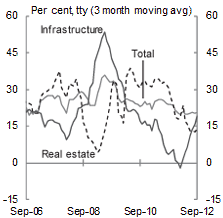
Measures include the bringing forward of infrastructure projects and modest monetary policy easing. The percentage of Chinese bank deposits that must be held in reserve has been cut by 150 basis points since December and, since June, one‑year benchmark lending rates have been cut by 56 basis points. In the short term, investment activity may receive a mild policy‑induced boost from a pickup in construction, providing some support to broader economic activity (Chart A).
Chart A: Fixed asset investment
Source: CEIC China database and Treasury.
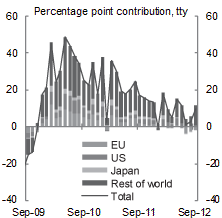
The recent shift towards policy easing is yet to gain traction and stimulus has not been as large as first anticipated by many analysts. China also remains vulnerable to further weakness in advanced economies (Chart B) and softness in the domestic property sector. Nevertheless, with inflation under control (and likely to remain subdued in the short term) and the Government's solid fiscal position, China retains the capacity to use macroeconomic policy to further support growth should conditions deteriorate markedly.
Chart B: Export growth
Source: CEIC China database and Treasury.
Over the medium term, a more moderate growth path is in line with the Chinese Government's target for sustainable and better quality growth. China is targeting an annual average growth rate of 7 per cent during the 12th Five‑Year Plan (FYP) (2011‑2015), down ½ a percentage point from the 11th FYP (2006‑2010).
This lower target provides China with greater space to take a more measured approach to supporting growth while addressing longer‑term challenges associated with the structural biases of its export‑ and investment‑reliant growth model.
Australia is not immune to slower growth in China due to our strong trade links. The recent slowing in Chinese growth has been accompanied by a weakening in the Chinese steel market, which has led to sharper‑than‑expected declines in prices for Australian exports of iron ore and metallurgical coal.
However, Australia's sensitivity to economic conditions in our major trading partners is not new. The Australian economy has a track record of coping with slowing growth in key export markets (such as Japan) and other external shocks (such as the global financial crisis).
Notwithstanding short‑term cyclical developments, China's economic expansion will continue to make an important contribution to the Australian economy. Rapid urbanisation and continuing efforts to promote economic and industrial development outside the relatively wealthy coastal regions will raise China's energy consumption and require ongoing investment in metals‑intensive projects, supporting demand for Australian coal and iron ore.
Furthermore, as Chinese consumers grow wealthier they will also demand increased levels of goods and services, with opportunities extending well beyond the resources sector. This will open up new markets for Australian producers and service providers across a broad range of sectors, including in the tourism, education, agriculture and food industries.
If www.budget.gov.au responds slowly or you are having trouble downloading a document, try one of the Budget Website Mirrors
Note: Where possible, Budget documents are available in HTML and for downloading in Portable Document Format(PDF). If you require further information on any of the tables or charts on this website, please contact The Treasury.