




Statement 1: Budget Overview (Continued)
Fiscal strategy and outlook
Significant write‑downs in revenue have caused the Government to recalibrate the pace of fiscal consolidation. This Budget sets out a responsible path to return to surplus on a timetable that supports jobs and growth. In the current environment, making significant cuts to offset revenue write downs in a short period of time would have come at a significant cost to jobs and growth.
Fiscal strategy
The Government's fiscal strategy is designed to ensure fiscal sustainability, while providing the necessary flexibility for the budget position to vary in line with economic conditions.
The medium‑term fiscal strategy, which has remained unchanged since the Government's first budget in 2008‑09, is to:
- achieve budget surpluses, on average, over the medium term;
- keep taxation as a share of GDP, on average, below the level for 2007‑08 (23.7 per cent); and
- improve the Government's net financial worth over the medium term.
To ensure a timely return to surplus and recovery in the fiscal position, since the beginning of the GFC the Government has further committed to:
- allow the level of tax receipts to recover naturally as the economy improves, while maintaining the Government's commitment to keep taxation as a share of GDP below the 2007‑08 level on average; and
- build growing surpluses by holding real growth in spending to 2 per cent a year, on average, until the budget surplus is at least 1 per cent of GDP, and while the economy is growing at or above trend.
Striking the right fiscal balance
The Government is charting a sensible pathway to surplus over the forward estimates, consistent with maintaining solid growth and low unemployment. A more gradual return to surplus is appropriate given the significant downgrades to revenue and the transition underway in the economy.
Responding to changing economic and fiscal circumstances is a central element of the Government's fiscal approach. This allows the near‑term fiscal settings to reflect economic circumstances and to maintain a medium‑term path that ensures ongoing fiscal sustainability. While the changing revenue outlook has inevitably changed the budget outlook, the Government's approach to supporting jobs and growth remains the same. At the height of the GFC the Government stepped in to keep the economy out of recession and protect jobs. The Government has since delivered a sensible fiscal consolidation that is consistent with maintaining solid growth and low unemployment (Box 1).
Returning to surplus too quickly by making drastic spending cuts in the near term could have only been achieved at a significant risk to jobs and growth in the economy, which is inconsistent with the Government's fiscal strategy. For this reason, the Government has chosen not to offset substantial revenue downgrades in the near term. Strong public finances require a strong economy. The Government's fiscal consolidation has therefore been targeted to limit any adverse impact on economic growth and employment, with the expected overall impact of the Government's policy decisions on economic growth and employment in 2012‑13 and 2013‑14 largely unchanged since MYEFO.
Box 1: Managing the pace of fiscal consolidation
Between the height of the GFC in 2009‑10 and the return to balance in 2015‑16 the fiscal position is expected to consolidate by 4.2 per cent of GDP. This consolidation combines the impact of the natural recovery in tax receipts following the GFC, the savings decisions that the Government has made, and the expiry of temporary stimulus measures.
The timing of the consolidation has been designed to manage its impact on growth and jobs. The fiscal consolidation in 2012‑13 is now expected to be 1.6 per cent of GDP, with the change since MYEFO largely due to the write‑down in tax receipts of 0.8 per cent of GDP.
This Budget will deliver an average annual fiscal consolidation of around ½ of a percentage point of GDP per annum from 2013‑14 to 2016‑17. This rate of consolidation is consistent with returning the budget to surplus while supporting jobs and growth and making room for nation building investments.
From 2014‑15 the contribution of the natural recovery of tax receipts is expected to slow, and policy is expected to have a more significant role in the fiscal consolidation than in 2013‑14. All new payments measures within the forward estimates have been more than offset by reductions in payments. From 2014‑15 onwards the consolidation is driven by the measures Government is taking to shore up the integrity of the tax system, and the increase to the Medicare levy to provide a strong and stable funding source for DisabilityCare Australia.
Despite the more gradual return to surplus, the Government's fiscal consolidation provides ongoing scope for monetary policy to respond to economic developments as needed. Just as the Government's fiscal settings are consistent with solid growth and low unemployment, they are also consistent with contained inflation. The Government's fiscal consolidation has already given the RBA scope to ease monetary policy, with policy interest rates reduced by 200 basis points since late 2011. Lower interest rates are already providing support to many sectors, assisting the transition towards non‑mining sources of growth over the forecast period.
The Government is maintaining its record of fiscal discipline and is taking important steps to improve the sustainability of Australia's public finances. Already, real growth in spending between 2009‑10 and 2012‑13 is less than in any equivalent period of time since the late 1980s. The discipline imposed on real spending growth means that the average payment to GDP ratio over the five years from 2012‑13 is lower than the average payment to GDP ratio over the previous thirty years. This Budget contains savings that total $43 billion across the forward estimates. The Government's sensible fiscal consolidation and clear and credible pathway to surplus support Australia's AAA credit rating, which underscores confidence in the Australian economy. The Government is expected to return to surplus before most advanced economies.
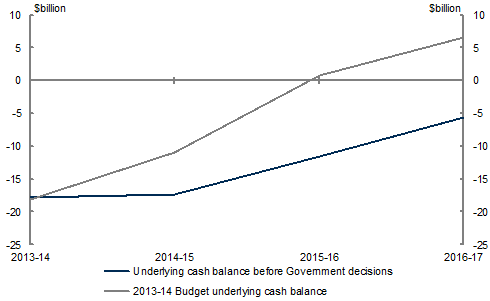
The Government's fiscal discipline is also necessary to make room for the significant investments this Budget makes in education, infrastructure, and a fairer go for Australians with a disability. These reforms have the potential to improve the long‑term growth prospects of the economy, lifting productivity growth and enhancing participation. The impact of these reforms will improve fiscal sustainability in the long run. Without the net impact of policy decisions in this Budget the underlying cash balance would have remained in deficit through the forward estimates (Chart 2).
Chart 2: Government decisions improve the underlying cash balance
Source: Treasury.
An important foundation of sound public finances is transparency. The Government has taken measures that will add to the transparency of the debate over the budget position through the creation of the Parliamentary Budget Office (Box 2).
Fiscal outlook
Consistent with the fiscal strategy, the fiscal consolidation is being achieved through a combination of responsible savings and allowing the natural increase in tax receipts associated with a growing economy to flow through to the budget.
An underlying cash deficit of $19.4 billion (1.3 per cent of GDP) is expected in 2012‑13, with a deficit of $18.0 billion (1.1 per cent of GDP) expected in 2013‑14.
Box 2: Fiscal transparency — The Parliamentary Budget Office
Transparency of fiscal policy is a fundamental element of the Australian budgetary and political landscape. Since 1998, the Charter of Budget Honesty has provided a detailed framework for the conduct of Government fiscal policy, including regular reporting on the Government's fiscal strategy and the economic and fiscal outlook. The Charter also includes a mechanism for costing the election commitments of the Government, the Opposition, and (since 2011) minority parties.
The Government has supported fiscal transparency by establishing the Parliamentary Budget Office (PBO), with the first Parliamentary Budget Officer — Mr Phil Bowen PSM — appointed on 30 May 2012. The PBO provides independent and non‑partisan analysis of the budget cycle, fiscal policy and the financial implications of proposals. The availability of the PBO's services means all Parliamentarians have access to high quality advice about the fiscal implications of their policies, which enables them to be more transparent to the Australian public about those implications.
The Government has taken further steps to improve fiscal transparency, by introducing legislation to require the PBO to publish a post‑election report on the cost of the election commitments of each party with five or more members of Parliament. If passed, this legislation will mean there is a non‑partisan and independent analysis of the fiscal implications of each party's election commitments. The Government has also provided additional funding to the PBO to support its functions, particularly during election years. These measures will ensure that political debate on questions of fiscal policy is informed by rigorous independent analysis.
Weaker tax revenue as profits slow
Tax receipts (abstracting from policy measures) have been revised down by around $60 billion over the four years to 2015‑16 since MYEFO.
Tax receipts have been significantly affected by weaker than expected nominal GDP growth. Weaker commodity prices and the persistently high Australian dollar have hit company profits across most of the economy, including the resources sector. This has had a significant impact on the level of company tax receipts expected in 2012‑13 and over the forward estimates. Lower than expected capital gains tax and resource rent taxes have compounded the fall in company tax receipts.
Income tax withholding and consumption taxes have been revised down to a lesser extent, reflecting the forecast for modest wages growth and solid consumption growth. The fall in tax receipts has been partly offset by policy measures including measures designed to ensure the integrity of the tax base.
Corporate profitability has been unexpectedly weak. The persistently high Australian dollar is having an acute and widespread effect on profits and prices. Over the past year and a half, private non-financial corporate gross operating surplus, the National Accounts measure of private corporate profitability, has fallen by almost the same amount as during the early 1990s recession and the GFC, albeit over a longer period of time. This is highly unusual in what has otherwise been a period of solid economic growth.
Company taxes have been revised down by around $5.2 billion in 2012‑13 and $7.2 billion in 2013‑14. In comparison, the outcome for 2008‑09 company tax receipts was $11.3 billion lower than forecast at the 2008‑09 Budget, the last budget before the GFC. Resource rent taxes have been revised down by around $3.6 billion in 2012‑13 and $3.2 billion in 2013‑14.
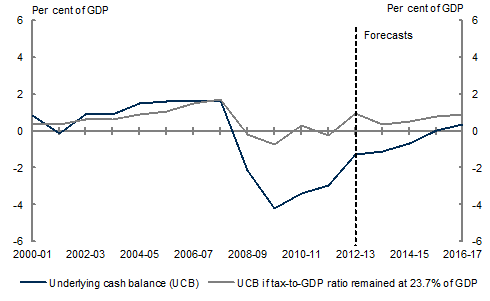
Across the forward estimates, tax receipts as a share of GDP are expected to remain well below pre‑GFC levels. Over the five years to 2012‑13, the average tax to GDP ratio is expected to be 20.9 per cent, lower than any period since the five years ending in 1995‑96. Had tax receipts stayed at the share of 2007‑08, the Budget would have been in surplus from 2012‑13 onwards (Chart 3).
Chart 3: Underlying cash balance if tax receipts were 23.7 per cent of GDP
Source: Treasury.
Responsible savings
The responsible savings in this Budget ensure investments in priorities for future growth are fully funded including in education, disability and nation building infrastructure.
This Budget makes $43.0 billion in savings that improve the budget position, continuing the Government's record of offsetting all new spending since mid‑2009. This includes $16.4 billion in savings in MYEFO and more than $130 billion of savings identified in the five budgets since 2008‑09. Over the past six Budgets the Government has identified savings of over $180 billion.
These savings decisions improve the position of the budget, and help to pay for critical new investments. In making these decisions the Government has paid careful attention to the impact on growth and jobs, delivering greater fairness in existing expenditure and concessions and taking the responsible decisions to keep our public finances on a sustainable footing.
In the fiscal environment Australia currently faces any new policy requires reprioritisation. In some areas some slowing in the growth in expenditure is necessary to pay for significant new reforms. And in other areas the Government has retargeted spending to those who need it most.
The Government continues to work to protect the tax base, and, in particular in this Budget, will protect the corporate tax base from erosion and loopholes. By improving the integrity and fairness of the corporate tax system in this year's Budget, the Government is ensuring that other firms are not forced to contribute more to make up for the reduced revenues from those able to exploit loopholes. Protecting the corporate tax base in this way contributes to a sustainable fiscal position, which is essential to Australia's future prosperity.
The Government will also increase the Medicare levy by half a percentage point from 1.5 to 2 per cent of taxable income, to provide a strong and enduring funding source for DisabilityCare Australia — the most fundamental social policy reform since Medicare. This will provide Australians with significant and permanent disability and their families with the support they need, when they need it. The money raised by the increase in the Medicare levy will be placed into the DisabilityCare Australia Fund, which will only be drawn upon to fund the additional costs of delivering DisabilityCare Australia. Virtually all taxpayers will still be paying less income tax than they would have under the 2007‑08 tax scales, due to the Government's three rounds of tax cuts and the tripling of the tax‑free threshold.
The Government introduced a carbon price from 1 July 2012 as part of the Clean Energy Future Plan. From 1 July 2015, the carbon price links with the European Union emissions trading scheme, the largest trading scheme in the world, with the European price expected to set the Australian price. The price of carbon in Europe has fallen due in large part to ongoing economic weakness. Carbon price estimates have been revised down in this Budget, with carbon price revenue now estimated to be lower, particularly from 2015‑16 onwards.
The 2015‑16 personal income tax cuts were designed to assist households on the expectation of an increase in the carbon price to $29 in 2015‑16 from the fixed price of $25.40 in 2014‑15. As the carbon price is now projected to be around $12 in 2015‑16, these tax cuts will be deferred until the carbon price in the Budget is estimated to rise above $25.40. All existing household assistance will remain in place.
Key elements of the Clean Energy Future plan were designed to adjust automatically with changes in the carbon price, including permit‑based assistance through the Jobs and Competitiveness Program and the Energy Security Fund. Further targeted savings will be made to specific programs, including through adjustments to extend the life of programs and better match spending with the collection of revenue from the carbon price. Further information on these changes is provided in Box 2 in Budget Statement 3.
The Government is also extending the requirement to make monthly Pay As You Go (PAYG) income tax instalments announced in MYEFO to all large entities in the PAYG system, including trusts, superannuation funds, sole traders and large investors. This change will better match tax collections with the economic conditions faced by business and ensure neutral treatment across business structures.
The Government is better targeting support for research and development (R&D) by limiting access to the R&D tax incentive so that it only applies to companies with annual aggregate Australian turnover of less than $20 billion from 1 July 2013. This is estimated to increase tax receipts by $1.1 billion over the forward estimates period. This change will ensure that the incentive is targeted to companies that are more responsive to the incentive, delivering value for money for the community.
The Government will phase out the poorly targeted Net Medical Expenses Tax Offset. All existing claimants will be grandfathered for two years, and claims for aged care, disability aids and attendant care will be allowed through until 30 June 2019, as reforms to aged care are implemented and DisabilityCare Australia is rolled out across the country. This will provide savings of $963.5 million over four years.
The Government will restructure the Import Processing Charge to recover the costs of all import related cargo and trade functions undertaken by the Australian Customs and Border Protection Service. The new charges will come into effect from 1 January 2014 and apply to consignments valued over $10,000, generating additional revenue of $674 million over four years.
In this Budget the Government will reform the family payments system to improve its sustainability, and better target assistance now Australia has a national Paid Parental Leave (PPL) scheme. From 1 March 2014, the Baby Bonus will be replaced with an increase to Family Tax Benefit Part A (FTB‑A). For those families not claiming PPL, FTB‑A will be increased by $2,000 following the birth or adoption of a first child and by $1,000 following the birth or adoption of a second or subsequent child.
The Government is also improving the PPL scheme by extending the work test so that parents will be able to count periods of Government PPL as 'work', just like employer‑funded PPL. Currently, some parents who have children close together are unable to meet the work test in time to claim PPL for the subsequent birth, and this measure will particularly assist these families.
In addition, the indexation pauses on the FTB end‑of‑year supplements, the Child Care Rebate annual per child cap, the higher income tests for family payments and the income threshold for the dependency tax offsets will be extended for a further three years.
These family payments reforms will save a total of $2.5 billion over the forward estimates.
Further, in light of revenue write downs across the forward estimates, the Government will not proceed with the increase to FTB‑A announced in the 2012‑13 Budget.
The Government has announced a package of reforms to improve the fairness, sustainability and efficiency of the superannuation system. These reforms will save around $0.9 billion over the forward estimates period and build on previous reforms to make the superannuation system stronger and fairer.
In order to have the best universities we need to have the best schools. The Government's substantial investment in universities will continue, with some adjustments to help make room for the National Plan for School Improvement. The Government is introducing an efficiency dividend of 2 per cent in 2014 and 1.25 per cent in 2015 on most grants programs under the Higher Education Support Act 2003. The Government will also replace the Student Start‑up Scholarships program with an equivalent income contingent loan program for new students, abolish the 10 per cent HECS‑HELP up‑front payment discount and 5 per cent voluntary HELP repayment bonus, and introduce a $2,000 cap on the tax deduction for work‑related self‑education expenses. Higher education funding is expected to be 17 per cent higher in real terms by 2016‑17 (the end of the forward estimates) than it was in 2007‑08, when the Government came to office.
The Government will also index tobacco excise and excise equivalent customs duty to average weekly ordinary time earnings (AWOTE), replacing the current Consumer Price Index (CPI) indexation. This will ensure tobacco excise keeps pace with income growth.
The Government will continue to increase its official development assistance program to 0.5 per cent of gross national income, but will defer the target date by one year from 2016‑17 to 2017‑18. This decision will result in $1.9 billion in savings over the forward estimates while still growing annual aid spending by 42.4 per cent over this period.
Savings for the longer term
Since its first Budget in 2008‑09 the Government has consistently made savings decisions that continue to benefit the budget beyond the forward estimates. These savings have allowed the Government to make room for new priorities such as establishing DisabilityCare Australia, and the National Plan for School Improvement. These enduring savings have also helped improve the budget bottom line, helping to achieve the goals of the Government's medium‑term fiscal strategy.
Long‑term savings made prior to this Budget include gradually increasing the pension age to 67, reforms to the private health insurance rebate and to the family payments system, changes to the concessional contribution arrangements for superannuation, means testing for aged care recipients, and reforms to personal tax offsets and fringe benefits tax concessions to make the tax system fairer. Significant long‑term savings in this Budget build on this record, and include the changes to education funding, reforms to business taxation, the increase to the Medicare levy, reforms to family payments, and the phasing out of the poorly targeted net medical expenses tax offset. The long‑term savings made in this budget total $77 billion by 2020‑21. These savings fully offset the expenditure needed for DisabilityCare Australia and the National Plan for School Improvement (Chart 4). Between 2013‑14 and 2023‑24 the long‑term savings provide $121 billion.
Chart 4: Making Room for the National Plan for School Improvement
and DisabilityCare Australia
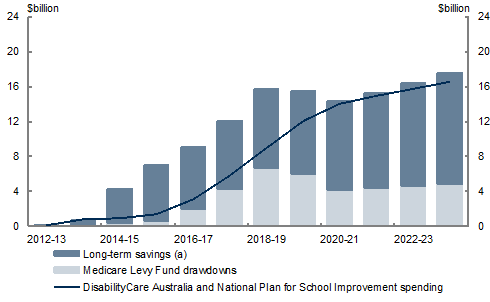
(a) Long‑term savings from 2013‑14 Budget and 2012‑13 MYEFO, excluding Medicare Levy and net of Dental Care Reform expenditure.
Without the savings made since the 2008‑09 Budget the outlook would be much poorer. The long‑term savings the Government has made in this Budget and previously, mean that the budget is cumulatively better off by over $300 billion by 2020‑21.
These savings also help to deal with the longer‑term budget pressures that were identified in the Intergenerational Report. The Intergenerational Report showed that without changes to future policy the expenditure pressures from ageing and other factors would create a significant fiscal gap by 2050. Changes to health expenditure, such as adjustments to the indexation of the Medicare benefits schedule, have helped to reduce one of the most significant contributors to the projected fiscal gap.
A strong and sustainable budget position
The Government's fiscal strategy will ensure that Australia's financial position remains one of the strongest in the developed world.
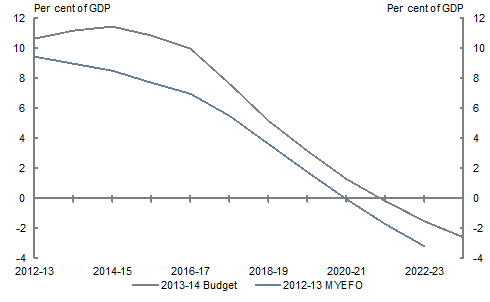
Net debt is expected to peak at 11.4 per cent of GDP in 2014‑15, and decline over the remainder of the forward estimates. Net debt is projected to reach zero in 2021‑22, only one year slower than projected at MYEFO despite the substantial reduction in expected tax revenue.
Net debt remains very low by international standards, with the average net debt position of the major advanced economies expected to be around 93 per cent of GDP in 2014 (Chart 5). Despite the delay in the return to surplus, Australia will return to surplus ahead of most other advanced economies (Chart 6).
Chart 5: Comparison of Government net debt for selected economies, 2012‑2018
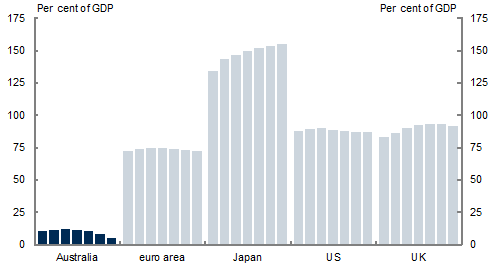
Note: Australian data are for the Australian Government general government sector and refer to financial years beginning 2012‑13. Data for all other economies are total government and refer to calendar years beginning 2012.
Source: IMF Fiscal Monitor April 2013 and Treasury.
Chart 6: Comparison of Budget balances for selected economies, 2012‑2018
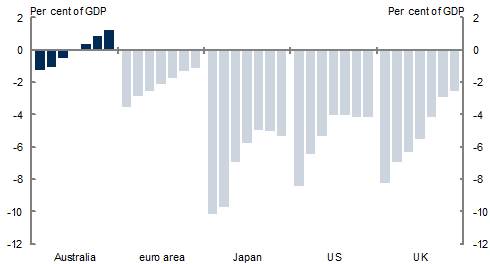
Note: Australian data are for the Australian Government general government sector underlying cash balance and refer to financial years beginning 2012‑13. Data for all other economies are total government and refer to calendar years beginning 2012.
Source: IMF Fiscal Monitor April 2013 and Treasury.
The medium‑term projections show Australia's net debt continuing to fall, reaching zero by 2021‑22 (Chart 7).
Chart 7: Net debt projected to 2023‑24
Source: Treasury.
Note: Where possible, Budget documents are available in HTML and for downloading in Portable Document Format(PDF). If you require further information on any of the tables or charts on this website, please contact The Treasury.