




Statement 4: Fiscal policy in the current economic environment (Continued)
Fiscal policy in challenging times
The Australian economy has come through an extraordinary decade in good shape: the terms of trade boom starting in the early 2000s and the GFC starting in 2008 are amongst the biggest positive and negative economic shocks Australia has faced since the 1930s depression. These challenges have underscored the importance of a fiscal strategy that is flexible enough to assist macroeconomic stabilisation in the short term, while also maintaining a strong focus on medium‑to‑longer term sustainability in an environment in which the budget is subject to large temporary influences.
Strong global growth and rising demand for Australia's commodity exports from China and other emerging market economies drove a boom in Australia's terms of trade from around 2003‑04, with the terms of trade hitting a 150 year high in the September quarter of 2011. The associated boost to national income and resources investment starting in the middle of the decade led to strong growth in demand in an economy that was already close to full capacity. This delivered a massive surge in tax revenues up until the GFC: parameter and other variations increased revenue for 2007‑08 by $79 billion (equivalent to around 7 per cent of GDP) between the 2003‑04 and 2008‑09 Budgets.
In this environment the appropriate role of fiscal policy is twofold:
- to complement monetary policy in containing inflationary pressures, at least by allowing the automatic fiscal stabilisers to increase budget surpluses; and
- to maintain the structural budget position in light of a surge in revenue that could be expected to be at least partly temporary, given that supply responses could be expected to push down commodity prices over time.
Budget surpluses did increase from 0.9 per cent of GDP in 2003‑04 to 1.7 per cent of GDP in 2007‑08. However, this increase was only a fraction of the surge in revenues, which was largely channelled back into the economy, through increased government spending and tax cuts. From the 2004‑05 Budget to the 2007 Pre‑Election Economic and Fiscal Outlook, parameter and other variations added $391 billion to expected budget surpluses over the period 2004‑05 to 2010‑11, while policy decisions reduced surpluses by $314 billion over the same period (Laurie and McDonald 2008).2
In hindsight, while Australia's fiscal position in 2007‑08 was clearly strong by international standards, the structural position was less robust than the headline numbers implied as these were based on economic, commodity and financial market conditions that were not sustained and are unlikely to be repeated in the foreseeable future. Tax cuts and new spending, funded by temporary increases in the terms of trade and capital gains, led to deterioration in the structural budget position in the lead‑up to the GFC. Moreover, by not allowing budget surpluses to increase significantly as revenues surged, government decisions prior to the GFC meant that interest rates had to be higher than otherwise to control inflation in an economy that was showing signs of over‑heating.
Against this background, the environment for fiscal policy was dramatically transformed from late 2008 by the GFC, which had a significant and immediate impact on tax receipts. The automatic revenue impact of weaker domestic and global growth, combined with weaker asset prices, is estimated to have reduced the budget balance, relative to expectations at the time of the 2008‑09 Budget, by $23 billion in 2008‑09, $49 billion in 2009‑10 and $55 billion in 2010‑11 (Budget Statement 4 2009‑10). The direct impact of stimulus measures deployed to support demand also detracted from the fiscal position, albeit only temporarily.
The combination of the Government's discretionary fiscal stimulus and automatic fiscal stabilisers — together with a considerable easing of monetary policy, a large fall in the exchange rate, the resilience of our emerging Asian trading partners and measures to support the financial sector — was able to limit the adverse effects of the GFC on Australia. Treasury estimates indicate that, without the stimulus, the Australian economy would have fallen into recession in this period, resulting in a much larger rise in unemployment (Budget Statement 2 2010‑11).
The direct fiscal impacts of the stimulus measures in the short‑term, therefore, need to be set against the substantial fiscal impacts of the deeper economic downturn that would otherwise have occurred — as well as the broader social impacts of recession and higher unemployment. Such an outcome would have affected the fiscal position not only in the short term, but also in the medium‑to‑long term because deep recessions have lasting impacts on the economy's supply potential, in particular through increased long‑term unemployment and the associated loss of skills.
As the economy has recovered, the key task for fiscal policy has been to return the budget to surplus, consistent with the medium‑term fiscal strategy. The temporary stimulus measures have been unwound and spending discipline imposed, with the average payment to GDP ratio over the five years from 2012‑13 lower than the average payment to GDP ratio over the previous thirty years. However, this has been occurring in an economic and revenue environment far less favourable than in the period before the GFC, and also less favourable than in some previous fiscal consolidation cycles.
Chart 1 shows that nominal GDP since the GFC has so far grown more slowly than in comparable periods in the 1980s and the 2000s, with only the 1990s cycle exhibiting weaker nominal growth. This gap is expected to widen further over the forward estimates period. By 2016‑17, nominal GDP growth in the current cycle is expected to be around 75 percentage points less than over the equivalent period in the 1980s and 30 percentage points less than in the 2000s.3 As will be detailed in the next section, weaker nominal GDP growth has been reflected in weaker growth in government revenue.
Chart 1: Nominal GDP from previous economic cycle peak
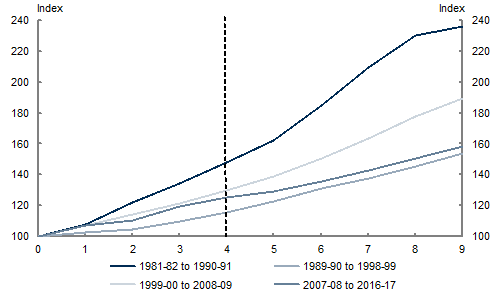
Note: Cyclical peaks (year 0) are based on real GDP relative to a HP filter trend. Current period figures are forecasts/projections from 2012‑13 (year 5) onward.
Source: ABS Cat. No. 5206.0 and Treasury.
Importantly, while periods of below‑trend real GDP growth can be expected to be offset over time by above‑trend periods as the economy returns to full employment, the same cannot be assumed for nominal GDP as there is no mechanism to return prices to any given level following a period of weak price growth.
Weak nominal GDP growth and a reduction in the tax take per dollar of income have resulted in significantly less revenue growth in the post‑GFC period than in the 1980s and 2000s, similar to what occurred in the 1990s; a period that saw a marked step‑down in inflation relative to prior decades (Chart 2). Less automatic improvement to the budget from revenue has made fiscal consolidation more challenging because larger policy adjustments are needed to achieve the same budget outcome.
Fiscal consolidation in the 1980s, in particular, was made much easier by high inflation, which meant that the budget gained considerably from fiscal drag — the additional tax revenue that results from growth in nominal incomes and the progressivity of the personal income tax scales. In the low inflation environment of the 1990s and now, fiscal drag is much reduced. The fact that weak revenue growth has made fiscal consolidation more challenging is a notable point of commonality between the current period and the 1990s. While current economic circumstances are in many ways very different to the early 1990s, when the economy experienced a deep recession, that period also saw a decline in the terms of trade and weak growth in domestic prices, as well as a significant fall in the tax‑to‑GDP ratio; factors that have affected revenues recently (as will be shown in the next section).
Chart 2: Receipts from previous economic cycle peak
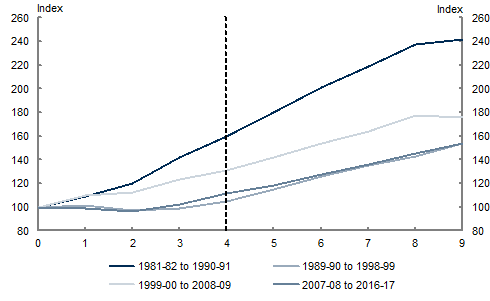
Note: Cyclical peaks (year 0) are based on real GDP relative to a HP filter trend. Current period figures are forecasts/projections from 2012‑13 (year 5) onward.
Source: Treasury.
While weaker revenue growth has increased the fiscal adjustment required to return to surplus, other developments have meant that the economy also faces more challenges in absorbing such an adjustment. In normal circumstances, the contractionary impacts of fiscal consolidation can be absorbed because the economy emerges from the preceding downturn with considerable momentum. Previous cyclical downturns have been followed by an extended period of above‑trend real GDP growth.
While the Australian economy has performed impressively in the post‑GFC period, in marked contrast to most other advanced economies, it is not expected to grow as strongly as in previous fiscal consolidation episodes in Australia in the 1980s and 1990s. This reflects in part the relatively moderate slowdown in the Australian economy during the global downturn, with Australia virtually alone among the advanced economies in avoiding recession. This meant that we did not come out of the GFC with substantial spare capacity, in contrast to the 1980s and 1990s episodes.
Further, the extraordinary nature of the GFC has meant that the economy has faced significant post‑GFC headwinds arising from less buoyant global growth, the high Australian dollar and deleveraging by companies and households — a combination of factors that was not present in previous episodes. Chart 3 shows that growth in real GDP from the previous cyclical peak (which takes into account the depth of the downturn) is expected to be lower over the current period than in the previous episodes.
Chart 3: Real GDP from previous economic cycle peak
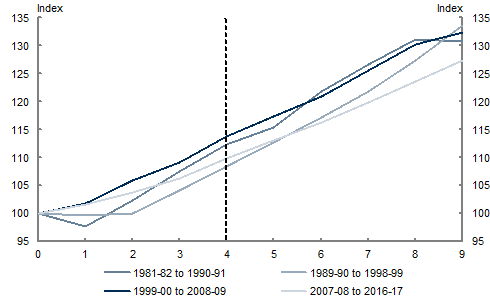
Note: Cyclical peaks (year 0) are based on real GDP relative to a HP filter trend. Current period figures are forecasts/projections from 2012‑13 (year 5) onward.
Source: ABS Cat. No. 5206.0 and Treasury.
2 Some of this estimated gain from parameter and other revisions was not realised because of the impacts of the global financial crisis from 2008‑09.
3 Nominal GDP growth was particularly strong in the 1980s, which preceded the establishment of the current low inflation regime, consistent with the 2 to 3 per cent inflation target.
Note: Where possible, Budget documents are available in HTML and for downloading in Portable Document Format(PDF). If you require further information on any of the tables or charts on this website, please contact The Treasury.