




Statement 7: Asset and Liability Management (Continued)
Overview of the Australian Government's balance sheet
The Government's balance sheet shows the stocks of all government assets and liabilities. Measures such as net debt, net financial worth and net worth are aggregates drawn from the balance sheet that provide an indication of the Government's financial strength at a point in time (see Box 1).
The outlook for the Government's stocks of assets and liabilities — or the Government's balance sheet — over the forward estimates is based on a range of estimates and assumptions about those assets and liabilities. If the estimates or assumptions change, this is likely to affect the projected value of assets and liabilities, and hence change the projected path of the balance sheet measures outlined above.
Since the 2012‑13 Budget several factors, including the large further write‑down in tax receipts and lower yields on Commonwealth Government Securities, have resulted in an increase in the expected value of liabilities over the forward estimates. This increase in liabilities has been partly offset by increases in expected value of assets, in particular increases in expected holdings of financial assets. This has led to higher estimates for net debt, and lower estimated net financial worth and net worth than was expected at the 2012‑13 Budget.
However, Australia's net debt position remains very low by international standards, with Australia one of only eight countries to have a AAA credit rating with a stable outlook from all three major credit rating agencies.
The Government's ongoing commitment to fiscal discipline and the enduring savings announced in this Budget will sustain confidence in the strength of Australia's public finances.
Statement 3: Fiscal Strategy and Outlook examines the impact of altering key economic assumptions on payments and receipts. Since the budget position is one of the main drivers of the movement in the Government's asset and liability position, changes in the economic assumptions will also affect the Government's financial stocks.
The Government reports on a range of other fiscal risks in Statement 8: Statement of Risks. These risks comprise general developments or specific events that may affect the fiscal outlook. Fiscal risks may affect expenses or revenue and, as a result, may contribute to variability in the Government's projected net debt, net financial worth and net worth position.
Measurement of the Government's financial position
Box 1: Net debt, net financial worth and net worth
Net debt is a commonly quoted measure of a government's financial strength. Historically, this was the only available stock measure for governments that were recording financial information in a cash‑based accounting system. Net debt provides the most useful measure for international comparisons, given most OECD countries report on it.
Net financial worth is used by the Government as the primary indicator of balance sheet sustainability because it provides a more effective and intuitive indicator of the sustainability of the Government's finances. It is a broader measure than net debt as it includes government borrowing, superannuation and all financial assets, but is narrower than net worth since it excludes non‑financial assets. There are advantages to excluding non‑financial assets since they are often illiquid and cannot easily be drawn upon to meet the Government's financing needs.
Net worth is the broadest measure of the Government's financial position. It is the net position of total assets and liabilities recorded on the balance sheet.
Net debt, net financial worth and net worth
Several factors, including the large further write‑down in tax receipts and lower yields on Commonwealth Government Securities, have resulted in an increase in the value of expected liabilities. This increase in liabilities has been partly offset by the assets set aside in the DisabilityCare Australia Fund as well as increases in the value of HELP assets and investments of the Future Fund. This has led to higher estimates for net debt, and lower estimated net financial worth and net worth than was expected at the 2012‑13 Budget.
Net debt is now expected to peak at $191.6 billion in 2014‑15 (11.4 per cent of GDP), falling to $185.7 billion (10.0 per cent of GDP) by the end of the forward estimates.
In 2013‑14, net financial worth is estimated to be ‑$286.1 billion, compared with the 2012‑13 Budget estimate of ‑$244.3 billion. Net financial worth is estimated to be ‑$275.1 billion by the end of the forward estimates.
Chart 1 shows the projected movements in net financial worth since the 2011‑12 Budget.
Chart 1: Net financial worth comparison
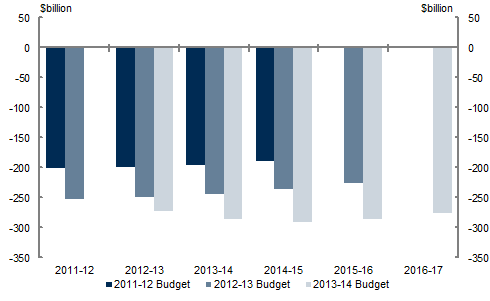
Note: Net financial worth for 2015‑16 and 2016‑17 was not projected in the 2011‑12 Budget; net financial worth for 2016‑17 was not projected in the 2012‑13 Budget. At the 2013‑14 Budget, prepayments have been reclassified as financial assets to align with ABS GFS, affecting the measure of net financial worth (see Statement 9: Budget Financial Statements for further details).
Net worth is currently estimated to be ‑$173.5 billion in 2013‑14, compared with ‑$132.8 billion estimated at the time of the 2012‑13 Budget.
The Australian Government's financial position remains amongst the strongest in the developed world (Box 2) and is a key reason behind Australia receiving a AAA credit rating from all three major credit rating agencies. Indeed, Australia is now one of only eight countries to have a AAA rating with a stable outlook from all three agencies.
In addition to the Government's adherence to a credible medium‑term fiscal framework, other key factors underpinning Australia's credit rating are the resilience of the economy, the ongoing stability of the financial system and the quality of policy and institutional arrangements, including independent monetary policy and strong financial regulation.
The Australian Government has a strong history of prudent balance sheet management, and is well placed to manage its liabilities. A recently published IMF paper on global demand for advanced economy sovereign debt noted that Australia has a particularly safe investor base, with a high share of foreign central bank and domestic investors, which are generally seen as more stable investors.
The weighted average term to maturity of Australia's Treasury Bond portfolio has been increased from 4.64 years as at 31 March 2011 to 5.22 years as at 31 March 2013. In the same period, the Australian Office of Financial Management (AOFM) has increased the rolling one year average tenor of new issuance of Treasury Bonds from 5.96 years to 8.58 years. All else being equal, increasing the term to maturity of debt reduces both refinancing risk and the variability of public debt interest costs.
Yields on Commonwealth Government Securities remain at historically low levels (see Box 3). In addition to this, all Commonwealth Government Securities are issued in Australian dollars. This means that the Australian Government faces almost no exchange rate risk on its debt and does not need to engage in foreign exchange hedging to manage its liabilities.
The Australian Government has also accumulated $85.2 billion of financial assets within the Future Fund to enhance the Government's ability to offset its unfunded superannuation liabilities.
Box 2: The strength of the Australian Government's financial position
During 2012‑13, many other advanced economies faced financial and fiscal challenges as a result of the accumulation of large budget deficits and high levels of sovereign debt. Several governments have continued to implement severe austerity measures to support more sustainable trajectories for government debt at a time when they also face the significant task of generating growth and reducing unacceptably high unemployment. Other governments such as those in the United States and Japan, while not currently facing market pressures, nonetheless face their own considerable medium‑term fiscal consolidation challenges.
This stands in sharp contrast to the strength and resilience of the Australian Government's financial position and the resilience of the domestic economy, which is forecast to record solid growth.
Australia's level of net debt remains very low by international standards (Chart A). Australian Government net debt is expected to peak at 11.4 per cent of GDP in 2014‑15, compared with the expected peak in the average net debt position of the major advanced (G7) economies of 92.6 per cent of GDP in 2014.
Chart A: Comparison of government net debt for selected economies, 2012‑2018
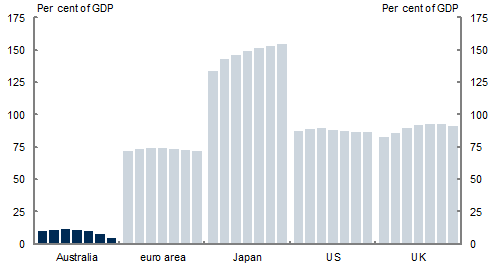
Note: Australian data are for the Australian Government general government sector and refer to financial years beginning 2012‑13. Data for all other economies are total government and refer to calendar years beginning 2012.
Source: IMF Fiscal Monitor April 2013 and Treasury.
Similarly, Australia's net interest payments are very low by international standards (Chart B).
Chart B: Net interest payments for Australia, the US and the euro area
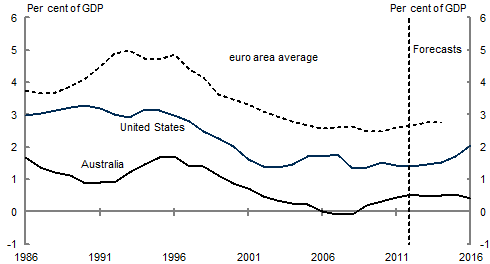
Note: Net interest payments are equal to the difference between interest paid and interest receipts on government assets and liabilities. Australian and US data are federal government data. Australian data refer to financial years beginning 1986‑87 and is for the general government sector. US data refer to US fiscal years beginning October 1986. Euro area data are total government and refer to calendar years beginning 1986.
Source: United States Congressional Budget Office The Budget and Economic Outlook February 2013, OECD Economic Outlook 92 November 2012, Thomson Reuters and Treasury.
Not only are the Government's debt levels very low by international standards, the responsible fiscal consolidation and the return to surplus within the forward estimates means that the Government is well placed to reduce net debt from its already modest level.
Returning the budget to surplus will strengthen the balance sheet further and will ensure Australia continues to have the flexibility to respond to any unanticipated adverse future events and to other longer‑term challenges.
Note: Where possible, Budget documents are available in HTML and for downloading in Portable Document Format(PDF). If you require further information on any of the tables or charts on this website, please contact The Treasury.