




Statement 7: Asset and Liability Management (Continued)
The Australian Government's major assets and liabilities
Assets
The Government's total stock of assets is estimated to be around $352.5 billion at 30 June 2013, increasing to $376.6 billion in 2013‑14 and $462.2 billion by the end of the forward estimates.
The Government's financial assets are estimated to be $242.2 billion at 30 June 2013, increasing to $264.0 billion in 2013‑14 and $343.0 billion by the end of the forward estimates.
The Government's non‑financial assets are estimated to be $110.3 billion at 30 June 2013, increasing to $112.6 billion in 2013‑14 and $119.1 billion by the end of the forward estimates.
Future Fund
The Future Fund was established in 2006 to accumulate financial assets and invest them on behalf of the Australian Government to address the Government's unfunded superannuation liability.
The Treasurer and the Minister for Finance and Deregulation set the Investment Mandate for the Future Fund which, since the Fund's establishment, has set a benchmark return of at least the Consumer Price Index (CPI) plus 4.5 per cent to 5.5 per cent per annum over the long term. The Investment Mandate gives guidance to the Future Fund Board of Guardians (the Board) in relation to its investment strategy. The Board is independently responsible for the investment decisions of the Fund. The Investment Mandate also requires the Board to take an acceptable but not excessive level of risk for the Fund, measured in terms such as the probability of losses in a particular year.
The portfolio of assets has performed well, given the extent of uncertainty and volatility in financial markets over the past five years. Since the effective start of the investment program on 1 July 2007, the Future Fund has generated a nominal return of 5.6 per cent. Since the first contribution to the Future Fund on 5 May 2006, the return has been 5.7 per cent per annum.
At 31 March 2013, the Future Fund's return for the financial year to date was 10.6 per cent.
The Future Fund was valued at $85.2 billion at 31 March 2013.
The Future Fund's portfolio has now been substantially invested but will continue to evolve as the Board manages the portfolio in line with its mandate and strategy. Table 1 shows changes in the asset allocation of the Future Fund over 2012‑13.
| Asset class | 30 June 2012 $m |
31 March 2013 $m |
|---|---|---|
| Australian equities | 7,980 | 9,890 |
| Global equities | 17,343 | 20,262 |
| Private equity | 4,895 | 5,764 |
| Property | 4,948 | 5,473 |
| Infrastructure | 4,912 | 5,547 |
| Debt securities | 14,119 | 14,174 |
| Alternative assets | 14,653 | 13,060 |
| Cash | 8,163 | 10,996 |
| Total Future Fund assets | 77,012 | 85,166 |
Nation‑building Funds
The Building Australia Fund (BAF), the Education Investment Fund (EIF) and the Health and Hospitals Fund (HHF) were established on 1 January 2009. These Nation‑building Funds were established to finance investment in transport, communications, broadband, energy, water, higher education, research, vocational education and training, and health infrastructure.
The Investment Mandates for the Nation‑building Funds, which are set by the Treasurer and the Minister for Finance and Deregulation, give guidance to the Future Fund Board of Guardians (the Board), which has responsibility for managing the investments of the BAF, EIF and HHF. The Board is responsible for the investment decisions of the funds.
The Investment Mandates set a benchmark return on the Nation‑building Funds of the Australian three month bank bill swap rate plus 0.3 per cent per annum calculated on a rolling 12 month basis (3.9 per cent for the year to 31 March 2013). The Investment Mandates require that investments minimise the probability of capital losses over a 12‑month horizon. Consistent with these requirements, the assets of the three funds are invested in combinations of short‑term and medium‑term debt instruments.
Over the 12 months to 31 March 2013, the BAF, EIF and HHF each returned 4.6 per cent, exceeding the mandated benchmark return of 3.9 per cent.
At the end of the March quarter 2013, the value of the BAF was $5.0 billion, the EIF was $4.1 billion and the HHF stood at $3.1 billion.
The estimated uncommitted balance of funds at 31 March 2013 was $2.2 billion for the BAF, $3.1 billion for the EIF and $0.9 billion for the HHF. These figures are the amounts available for new eligible projects and include net investment earnings up to 31 March 2013.
The Nation‑building Funds are financial asset funds, consisting of cash and investments in debt instruments. When cash is drawn down from the Funds to fund projects, this reduces the size of the Funds on the balance sheet. In addition, decisions which commit to future spending from the uncommitted balances of the Funds will impact on the underlying cash balance estimates at the time those decisions are taken.
DisabilityCare Australia Fund
The Government is establishing the DisabilityCare Australia Fund (DCAF) to provide strong and stable funding for DisabilityCare Australia, the national disability insurance scheme. Revenue raised from increasing the Medicare levy by half a percentage point from 1.5 to 2 per cent will be placed into the DCAF for a fixed 10 year period from 1 July 2014 to 30 June 2024, which will only be drawn upon to fund the additional costs of delivering DisabilityCare Australia.
A fixed amount of the money flowing into the DCAF each year will be set aside for the States and Territories. In 2014‑15, this fixed amount will be $825 million (which is 25 per cent of the revenue estimated to be raised in that year). Thereafter, the amount to be set aside for the States and Territories will be indexed annually by 3.5 per cent.
The balance of the DCAF will be available to the Commonwealth to meet additional expenditure during the launch and transition to full scheme of DisabilityCare Australia.
The States and Territories will be able to draw down from the DCAF when they meet key conditions, including agreement to fully implement DisabilityCare Australia and once at least 50 per cent of their eligible population is covered by the scheme. In addition, once eligible States and Territories have clients participating in DisabilityCare Australia, they will be able to access 10 per cent of their annual allocation in 2015‑16 and 20 per cent of their annual allocation in 2016‑17 and 2017‑18 to support early establishment costs related to DisabilityCare Australia.
The DCAF will be established on 1 July 2014 and will be managed by the Future Fund Board of Guardians. The Treasurer and Minister for Finance and Deregulation will set an Investment Mandate for the DCAF which will provide guidance to the Board in relation to its investment strategy for the Fund.
Residential mortgage‑backed securities
The global financial crisis led to the profound dislocation of the securitisation market globally, including the Australian residential mortgage‑backed securities (RMBS) market. In view of these developments, in October 2008 the Government directed the AOFM to invest in high quality, AAA‑rated Australian securities to support competition from smaller lenders in the residential mortgage and small business lending markets.
During the life of the program, the AOFM program supported 67 securitisation deals, which raised over $45 billion, assisting 20 smaller mortgage lenders to continue lending to the retail market. In total, AOFM directly invested $15.5 billion in high‑quality RMBS issued by smaller lenders. It is estimated that the program assisted smaller lenders fund the equivalent of 245,000 home loans and more than $3.2 billion worth of loans to small businesses. The program also helped preserve critical market infrastructure that has allowed the market to quickly rebound after the financial crisis, which has helped smaller lenders continue to raise more economic funding to exert competitive pressure on the major banks. The AOFM program has made an important contribution to boosting competition in the banking sector.
Conditions in the Australian securitisation market have improved substantially since the introduction of the AOFM program. Since September 2012, private demand for securitisation had increased to the extent that the AOFM was not required to provide any direct investment in new RMBS deals.
Given the improvement in the market, the Deputy Prime Minister and Treasurer announced on 10 April 2013 that the program would close for new investment. The AOFM may continue to hold previously purchased RMBS until their maturity. However, where the sale of RMBS held by the AOFM can occur at a price the AOFM considers acceptable and continues to support market recovery, the AOFM is empowered to undertake such a sale.
The AOFM and the Treasury will continue to monitor conditions in the RMBS market closely.
National Broadband Network
NBN Co Limited (NBN Co) was established on 9 April 2009 to design, build and operate the National Broadband Network (NBN), the single largest nation building infrastructure project in Australian history. NBN Co is a Government Business Enterprise, wholly owned by the Australian Government and represented by two Shareholder Ministers — the Minister for Finance and Deregulation and the Minister for Broadband, Communications and the Digital Economy.
The finalisation of the NBN Co‑Telstra Definitive Agreements in March 2012 has enabled NBN Co to commence the full scale rollout of the NBN and continue expanding construction activity across Australia. Fibre rollout to over 4.8 million Australian premises is scheduled to be underway or completed by the middle of 2016.
Recently, NBN Co has identified some delays to the rollout associated with the physical mobilisation of some of its construction partners. NBN Co is working to resolve these issues and does not expect to revise the forecast 2021 completion date or overall cost of the NBN.
As a consequence of delay, NBN Co's equity requirement from Government in 2012‑13 has reduced from $4.7 billion to $2.6 billion. Over the four years from 2013‑14, the Government will provide $21.4 billion in equity to NBN Co.
Higher Education Loan Program
The Higher Education Loan Program (HELP) comprises concessional loans to students that enable them to defer payment of fees for diploma level and above courses, which are paid back once earning an income above a certain level.
The value of HELP is estimated to be around $22.3 billion at 30 June 2013, which is $2.1 billion higher than projected in the 2012‑13 Budget. The value of HELP is projected to grow to around $26.2 billion in 2013‑14 and $42.1 billion by the end of the forward estimates.
This growth is largely a result of the estimated increase in university commencements over the forward estimates, principally the result of the uncapping of Commonwealth Support Places for Undergraduate courses from 1 January 2012 and the expansion of access to the Vocational Education and Training FEE‑HELP scheme.
Clean Energy Finance Corporation
The Clean Energy Finance Corporation (CEFC) was established as a Commonwealth Authority in August 2012 through the Clean Energy Finance Corporation Act 2012 (CEFC Act). Investment decisions are made by an independent board consistent with the CEFC Act and the high level investment mandate set by the Government. The CEFC's Special Account will be credited with $2 billion per annum for five years from 1 July 2013 to allow the CEFC to invest, directly and indirectly, in clean energy technologies.
The CEFC was established to finance Australia's clean energy sector using financial products and structures to address the barriers inhibiting investment. The CEFC is a mechanism to help mobilise investment in renewable energy, low‑emissions and energy efficiency projects and technologies in Australia, as well as manufacturing businesses and services that produce the required inputs. It will invest at the demonstration, commercialisation and deployment stages of innovation using a range of financial instruments to make these investments, including loans on commercial and concessional terms, loan guarantees and equity. The CEFC will apply commercial rigour when making its investment decisions and have regard to its potential effect on other market participants when considering investment proposals.
Further information can be found in the measure: Clean Energy Finance Corporation detailed in the Mid‑Year Economic and Fiscal Outlook 2011‑12.
Liabilities
The Government's total liabilities are estimated to be $513.6 billion at 30 June 2013, increasing to $550.1 billion in 2013‑14 and $618.1 billion by the end of the forward estimates.
Public sector employee superannuation liabilities
Public sector employee superannuation entitlements relating to past and present civilian employees and military personnel are a financial liability on the Government's balance sheet. The Government's superannuation liability is estimated to be around $143.5 billion at 30 June 2013.
The Australian Government has never fully funded its superannuation liabilities. The Commonwealth Sector Superannuation (CSS) Scheme and the Public Sector Superannuation (PSS) Scheme were closed to new members in 1990 and 2005 respectively. The Public Sector Superannuation Accumulation Plan was introduced from 1 July 2005 and provides fully funded accumulation benefits for new civilian employees.
Despite these reforms, the value of the Government's existing superannuation liability is projected to continue growing (in nominal terms) into the future, reaching $164.8 billion by the end of the forward estimates. This is the result of growth in the membership of the Military Superannuation and Benefits Scheme (MSBS), which remains open to new military personnel, and continued growth of entitlements accruing to existing members of the closed civilian and military schemes.
An actuarially determined discount rate is used to estimate the present value of future unfunded superannuation benefits. The long‑term nature of the unfunded superannuation liability requires the use of a discount rate that best matches the duration of the liability. The value recorded on the balance sheet is highly sensitive to the discount rate used. The use of a long‑term discount rate for budget purposes avoids introducing volatility that would occur by using a discount rate based on yields on government bonds that varies periodically. Consistent with the latest Long Term Cost Reports for the civilian and military schemes, the discount rate currently applied is 6.0 per cent per annum.
As the superannuation liability is included in the Government's net worth and net financial worth aggregates, revaluations of the liability have an impact on these aggregates (see Note 1 in Budget Statement 9).
The Unfunded Superannuation Liability and the Future Fund Balance
The Future Fund was established by the Future Fund Act 2006 (the Act) to enhance the ability of the Commonwealth to discharge unfunded superannuation liabilities expected after 2020. The Future Fund and the unfunded superannuation liability represent significant items on the Commonwealth's balance sheet.
Primarily as a result of changes in member behaviour, for example, members increasingly taking more of their benefit as a lifetime pension rather than as a lump sum, and members living longer after retirement, the unfunded liability has increased compared to previous projections. No government decision has materially contributed to the increase in the liability.
The open Military Superannuation and Benefits Scheme (MSBS) is the main driver of the increase in the unfunded superannuation liability into the future. Other material Government defined benefit schemes are no longer open to new members.
The size of the Future Fund depends upon its investment performance. The Future Fund has performed well, given the extent of uncertainty and volatility in financial markets over the past five years including the adverse effects of the global financial crisis. Over five years to 31 March 2013, the Fund has generated annualised returns of 6.4 per cent. This compares favourably to the 3.2 per cent returns achieved by balanced superannuation funds over the same period (Source: SuperRatings).
As at 30 June 2013, the Future Fund balance is estimated to be $87 billion and the unfunded superannuation liability is valued at $143 billion, with a difference projected to continue over the medium term. The increase in the unfunded liability compared to projections when the Future Fund was established is $19 billion.
The Government continues to support the goal of the Future Fund having sufficient resources to fund the Commonwealth's future superannuation liability and would consider further contributions to the Fund as fiscal circumstances allow.
Commonwealth Government Securities
The face value of the total stock of Commonwealth Government Securities (CGS) on issue at 30 June 2013 is expected to be $256 billion. The face value of Treasury Bonds and Notes represents the amount that the Government pays back at maturity. The face value of Treasury Indexed Bonds represents the capital value unadjusted for inflation. Face value is independent of fluctuations in market value.
CGS are reported on the balance sheet in market value terms, consistent with relevant accounting standards. The market value of CGS reflects bond prices in the secondary market, which are constantly changing with market conditions.
The AOFM's approach in recent years has been to lengthen both the nominal and real yield curves gradually. The current yield curves extend to April 2029 for (nominal) Treasury Bonds and September 2030 for (real) Treasury Indexed Bonds. Incremental extensions to the yield curve have facilitated efficient pricing of new bond lines.
Treasury Bonds
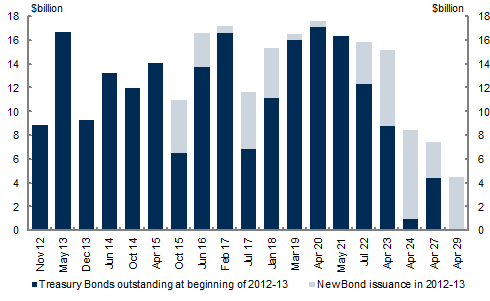
Chart 2 shows the face value of Treasury Bonds outstanding at 30 June 2012 and new issuance in 2012‑13. One new Treasury Bond line was launched in 2012‑13. This was an April 2029 maturity.
Chart 2: Treasury Bonds on issue
Note: New issuance in 2012‑13 is to 14 May 2013.
The face value of Treasury Bonds on issue at 30 June 2013 is projected to be around $233 billion, and around $260 billion at 30 June 2014.
Treasury Indexed Bonds
Treasury Indexed Bonds (TIBs) are medium‑term to long‑term securities that have a capital value which is adjusted for movements in the CPI. Interest is paid quarterly, at a fixed rate, on the adjusted capital value. At maturity, investors receive the adjusted capital value of the security. The Australian Government recommenced the issuance of TIBs in 2009‑10.
TIBs contribute to the management of Australian Government debt by widening the range of available debt instruments, diversifying risk and tapping additional sources of investor demand.
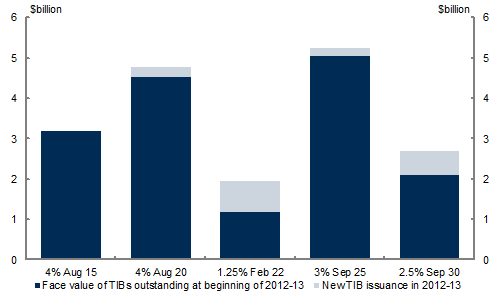
Chart 3 shows TIBs outstanding at 30 June 2012 and new issuance in 2012‑13.
Chart 3: Treasury Indexed Bonds on issue
Note: New issuance in 2012‑13 is to 14 May 2013.
The face value of TIBs on issue at 30 June 2013 is projected to be around $18 billion, and around $22 billion at 30 June 2014.
Interest payments made on TIBs are reflected in the Government's cash flow statements, with the adjusted capital value paid in the year which the bond matures. In 2015‑16 there is an increase in interest paid as a result of the August 2015 TIB maturing.
Treasury Notes
Treasury Notes are short‑term debt securities used primarily to meet within‑year financing requirements resulting from differences in the timing of receipts and payments. The volume of Treasury Notes on issue will vary over the course of the year, depending on the size and profile of the within‑year funding flows. In October 2012, the AOFM announced that the 'floor' of $10 billion of Treasury Notes on issue will no longer be maintained and there are expected to be times when there will be no Treasury Notes on issue.
Aussie Infrastructure Bonds
In April 2009, the Government announced that its investment in NBN Co would be partly funded through the issuance of Aussie Infrastructure Bonds (AIBs).
AIBs were not required prior to 2011‑12, as the Government's equity contributions were met in full with funds from the Building Australia Fund (BAF).
In 2011‑12, all of the Government's $1.5 billion equity investment in NBN Co was financed through AIBs, through the wholesale issuance of Commonwealth Government Securities as part of the AOFM's overall debt program. In 2012‑13, it is expected that $2.3 billion of the Government's $2.6 billion equity investment in NBN Co will be financed through AIBs in the same manner, with the remainder coming from the BAF. From 2013‑14, all of the Government's equity contributions to NBN Co will be financed through AIBs.
Legislative framework
The Commonwealth Inscribed Stock Act 1911 places a limit on the outstanding stock of Commonwealth Government Securities. The Government will legislate to increase the limit as it becomes necessary.
Note: Where possible, Budget documents are available in HTML and for downloading in Portable Document Format(PDF). If you require further information on any of the tables or charts on this website, please contact The Treasury.