




Statement 7: Asset and Liability Management (Continued)
The Commonwealth Government Securities Market
In the 2011‑12 Budget, the Government reaffirmed that its primary objective for the future of the Commonwealth Government Securities (CGS) market is to maintain liquidity to support the three‑ and ten‑year bond futures market. The Government is maintaining this objective in the 2013‑14 Budget. The experience of the global financial crisis underscored the value of maintaining a liquid and efficient CGS market of sufficient size to support the long‑term stability of the financial markets.
In considering the future of the CGS market, including the size needed to ensure liquidity, the Government's deliberations were informed by discussion with a panel of financial market participants and financial regulators. The panel considered the impact of the global financial crisis, the new global liquidity standards and the changing composition of the CGS investor base on the CGS market.
Since the 2011‑12 Budget there have been significant developments in world financial markets that have had implications for the CGS market, in particular the growing demand from international investors for Australian dollar denominated securities, including CGS, against a backdrop of global economic volatility and persistently weak sovereign balance sheets in many other advanced economies.
The strength of Australia's public finances and its continued economic resilience stand in stark contrast to many other sovereigns, which are facing a significant task of placing public finances on a sustainable footing, while supporting growth and jobs.
A number of factors have influenced the fall in yields on Treasury Bonds. The benchmark borrowing rate for the ten‑year Treasury Bond has fallen to some of the lowest levels in Australia's history (see Box 3).
Box 3: Increased demand for Australia's sovereign debt
CGS yields have fallen across the yield curve since the 2012‑13 Budget (Chart A), resulting in lower borrowing rates for the Government. Following the 2012‑13 Budget, CGS yields fell to some of the lowest levels on record owing to the uncertain global economic environment. Although yields have risen since then, they remain at historically low levels (Chart B).
These historically low yields are a result of a range of factors including Australia's strong public finances and economic resilience, strong foreign demand for a dwindling pool of AAA rated securities like Australia's, the overall subdued global growth outlook which is placing downward pressure on global long‑term bond yields, increasing diversity in the buyers of government debt and the attractiveness of the deep and liquid CGS market.
Chart A: Yield curve for Treasury Bonds
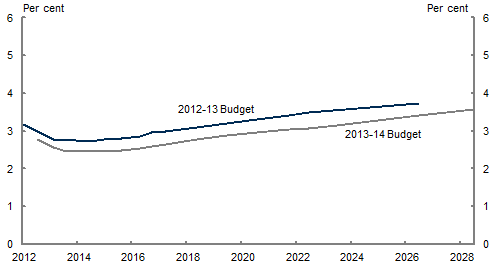
Note: Yields are indicative mid‑rates of CGS. Data for the 2012‑13 Budget and 2013‑14 Budget refer to yields on 8 May 2012 and on 7 May 2013 respectively.
Source: RBA.
Chart B: Historical ten‑year Treasury Bond yields
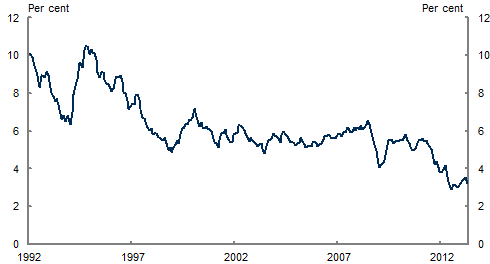
Source: RBA.
Note: Where possible, Budget documents are available in HTML and for downloading in Portable Document Format(PDF). If you require further information on any of the tables or charts on this website, please contact The Treasury.