
The budget aggregates for 1996-97 to 2000-01 are shown in Table 1 below.
Table 1: Summary of Budget Aggregates
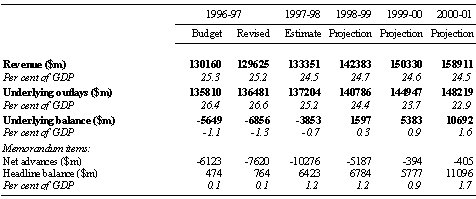
Measures taken in the Budget build on the already substantial fiscal consolidation implemented in the 1996-97 Budget and contribute to the improvement in the underlying balance of around 3¾ per cent of GDP between 1995-96 and 2000-01. This improvement accords with the Government's commitment to achieving underlying budget balance within the term of this Parliament and is consistent with attainment of its medium-term objective of underlying budget balance, on average, over the course of the economic cycle.
The improvement in the Commonwealth's underlying budget balance, together with the forward projections of State/local government fiscal positions contained in Statement 7, can be expected to provide a substantial boost to public sector saving and thus to reducing the structural national saving-investment imbalance. Together with receipts from sizeable equity asset sales over the next few years, it should also result in a decline in Commonwealth general government net debt from around 19 per cent of GDP in 1995-96 to just under 10½ per cent by 2000-01.
The Government's fiscal consolidation efforts to date have focussed primarily on outlays restraint. Together with favourable movements in outlays resulting from revisions to the economic parameters, this restraint provides for a decline in underlying outlays from 27 per cent of GDP in 1995-96 to just under 23 per cent of GDP in 2000-01. Revenue is expected to fall marginally as a proportion of GDP over the same period.
The headline budget balance is expected to improve by more than the underlying budget balance in 1996-97 and 1997-98. In 1996-97, this is primarily due to receipts from the recapitalisation of Telstra. In 1997-98, it reflects the sale of leases of the Federal Airports Corporation (FAC) and the sale of the Australian Industry Development Corporation (AIDC), the National Rail Corporation (NR) and the partial sale of Telstra. Movements in the headline budget balance in the outyears generally reflect improvements in the underlying balance and reductions in proceeds from asset sales.
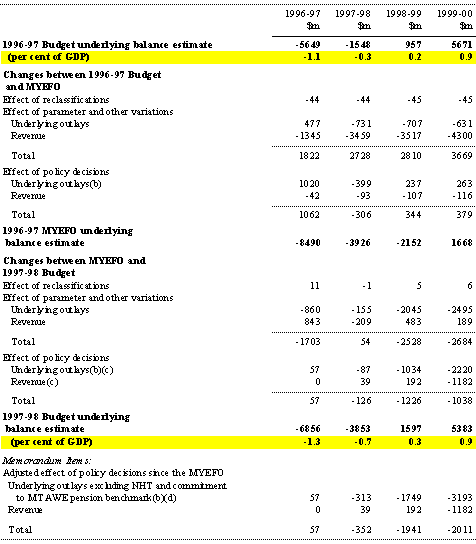
Table 2 provides a reconciliation of budget estimates between those at the time of the 1996-97 Budget, the MYEFO and the 1997-98 Budget in terms of policy decisions and parameter and other variations.
Estimates published in the MYEFO showed a deterioration in the fiscal outlook from the 1996-97 Budget, largely reflecting parameter and other variations. The MYEFO estimates incorporated downward revisions to company tax estimates for 1996-97 as well as 1997-98 and the outyears. The beneficial impact on outlays from lower estimates for inflation and lower interest rates, from 1997-98 onwards, was more than offset by lower company tax estimates together with downward revisions to revenue associated with favourable movements in prices and wages.
Table 2: Reconciliation of 1996-97 Budget, MYEFO and 1997-98 Budget Estimates(a)
(b) Includes public debt interest savings from measures affecting the headline balance. A separate breakdown of policy measures and their impact on public debt interest can be found in Table 6 in Statement 2.
(c) Includes recostings of pre-MYEFO decisions.
(d) Abstracts from those Government spending decisions for which an allowance was already set aside in the Contingency Reserve in the 1996-97 Budget. See the following page for explanation.
Since the MYEFO, there has been a slight deterioration in the starting point [2] for 1997-98 but a significant improvement in the starting point for the outyears. [3] The deterioration in 1997-98 largely reflects the influence of one-off factors, notably a lower than expected Reserve Bank of Australia (RBA) dividend. The improvement in the starting point for the outyears reflects the influence of more favourable economic parameters and also revisions to estimated company tax revenues from those in the MYEFO. The latter revisions have been made in the light of further information on how company tax payments are evolving.
Policy decisions since the MYEFO (including measures in the 1997-98 Budget) [4] provide for a small net improvement in the underlying balance in 1997-98, and an improvement of $1.2 billion in 1998-99. However, these estimates count as 'new' spending decisions some commitments already made and budgeted in the 1996-97 Budget Contingency Reserve.
In total, net outlays measures [4] since the MYEFO reduce the underlying deficit by $87 million in 1997-98 and $1 billion in 1998-99, rising to $2.2 billion in 2000-01. The significant increase in net outlays savings measures in the outyears reflects the Government's decision to introduce a new savings rebate in place of the 'LAW' tax cuts previously allowed for as matching Government superannuation contributions. The cost of the savings rebate, to be implemented through the tax system, is accounted for as reduced revenue. Further details on the expected cost of this scheme and on the net fiscal impact of introducing this rebate are in Part II of Statement 2.
Most of the revenue measures in the Budget focus primarily on protecting the existing revenue base from further erosion, rather than on raising additional revenue. Consequently, revenue measures since the MYEFO make only a small contribution to improving the underlying budget balance in 1997-98 and 1998-99. The decline in revenues in 1998-99 associated with the introduction of the Government's savings rebate is more than offset by other revenue measures, so that, in total, revenue measures in the post-MYEFO period are expected to contribute $192 million towards the improvement in the underlying budget balance in that year.
A more detailed discussion of the implications of changes in the economic parameters, policy decisions and other estimates variations affecting outlays and revenues can be found in Part II of Statement 2.


