Table 5: Summary of Budget Sector Outlays
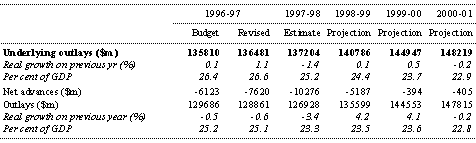
Over the period 1997-98 to 2000-01, underlying outlays are expected to fall:
Net outlays measures taken since the 1996-97 Budget contribute to the fiscal consolidation task in 1997-98 and over the forward estimates period.
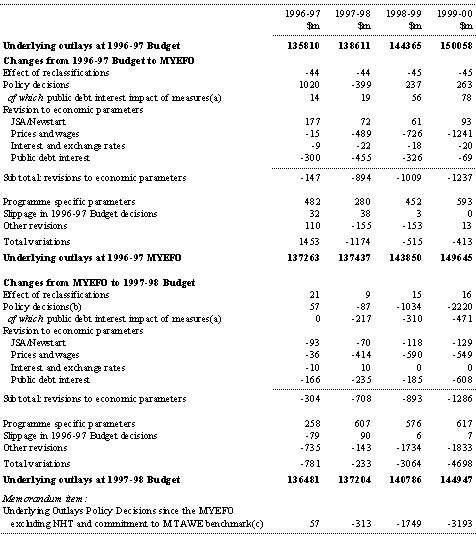
Table 6 reconciles the outlays estimates between the 1996-97 Budget, the MYEFO and the 1997-98 Budget in terms of policy decisions and parameter and other variations.
Between the 1996-97 Budget and the MYEFO, underlying outlays increased by $1.5 billion in 1996-97 but decreased in 1997-98 and the outyears. This pattern largely reflected a number of policy decisions taken by the Government which impacted primarily in 1996-97 and did not have a major effect in the outyears. Revisions to economic parameters in particular, lower expected inflation and wages growth * reduced outlays in all years, with the expected impact larger in the outyears. Lower interest rates reduced public debt interest outlays in all years. From 1997-98 these positive effects more than outweighed some increase in outlays associated with higher unemployment beneficiary numbers and higher average rates payable on pensions and other benefits.
Table 6: Reconciliation of Changes to Budget Sector Underlying Outlays since the 1996-97 Budget
(b) Includes recostings of pre-MYEFO decisions.
(c) Abstracts from Government spending decisions for which an allowance was already set aside in the Contingency Reserve in the 1996-97 Budget.
Downward movements in outlays have been limited by further increases in programme specific parameters, primarily reflecting changes in client numbers and/or higher average rates payable on family payments, family tax payments and disability support pension programmes. As new data have become available, projections of client numbers and average rates payable on a number of payments have been revised. The major revisions have been to pensions, family tax payments and disability support pension programmes. Programme specific parameters are difficult to forecast because of the need to interpret recent trends in an environment in which programmes and eligibility criteria are changing.
It should be noted, however, that these estimates include the effect of spending decisions for which provision had already been included in the 1996-97 Budget in the Contingency Reserve.
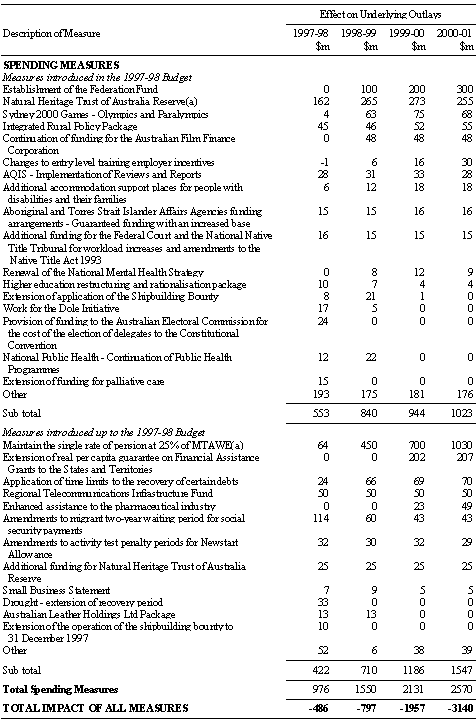
Table 7 provides a summary of the major savings measures affecting underlying outlays, while Table 8 outlines the major spending measures.
In total, net outlays savings measures in the period since the 1996-97 Budget, after providing funding for new spending measures of $1 billion in 1997-98 and $1.6 billion in 1998-99, reduce underlying outlays by $486 million in 1997-98, and $797 million in 1998-99.
The most significant saving measure reflects the Government's decision on the 'LAW' tax cuts (shown as outlays when they were proposed as matching Government superannuation contributions) which will not be paid as outlays but part of which will be redirected to a new savings rebate implemented through the tax system. This measure reduces outlays by $1.1 billion in 1998-99, $2.4 billion in 1999-2000 and $4 billion in 2000-01.
Other key savings decisions include:
Table 7: Major Savings Measures Introduced Since the 1996-97 Budget
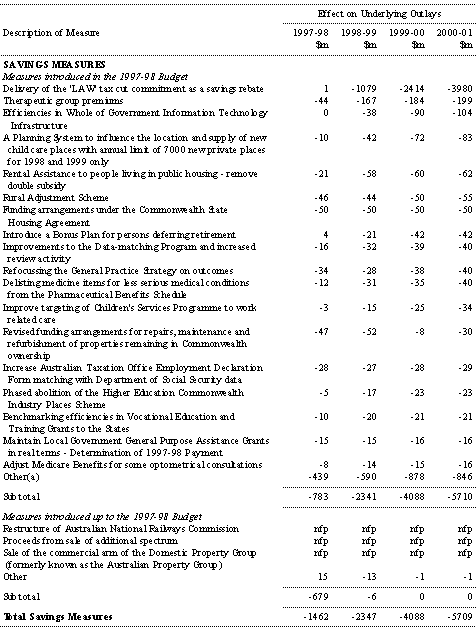
Table 8: Major Spending Measures Introduced Since the 1996-97 Budget