
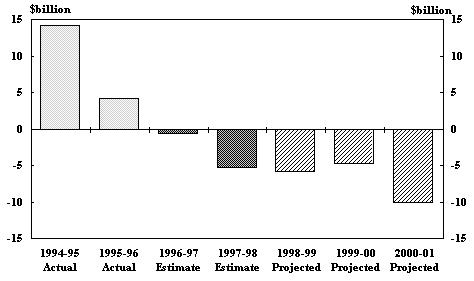
Chart 1 depicts the net borrowing requirement in recent years and that projected for each year out to 2000-01. The net borrowing requirement is projected to remain negative for each of the out-years. The negative net borrowing requirements for 1998-99, 1999-00 and 2000-01 are projected to be $5.8 billion, $4.8 billion and $10.1 billion respectively.
CHART 1: NET BORROWING REQUIREMENT
The Commonwealth's gross borrowing requirement in 1997-98 is estimated to be $5.5 billion after allowing for the refinancing of scheduled domestic debt maturities (excluding Treasury Notes) of $10.5 billion and foreign currency debt repayments of $0.2 billion.
Within the aggregate programme of around $6½ billion to $7½ billion, Treasury Fixed Coupon Bond issuance is expected to be of the order of $5 billion to $6 billion, with Treasury Adjustable Rate Bond issuance around $1 billion and Treasury Indexed Bond issuance around $500 million to $1 billion. No net change in the Treasury Note stock or in cash balances is planned for 1997-98. Consistent with portfolio management objectives, a new $US exposure requirement of around $3 billion is indicated. Relative cost will be an important consideration in choosing between domestic or offshore sourcing of $US requirements. Any direct offshore issue would, of course, reduce the domestic issue programme.
A detailed announcement covering the Commonwealth's debt management operations in 1997-98 will be made in the new financial year. This will cover planned issuance strategies across each debt instrument, including indications as to possible new benchmark lines and early repurchase operations, and details of the broad risk management framework guiding the composition and conduct of the issuance programme.
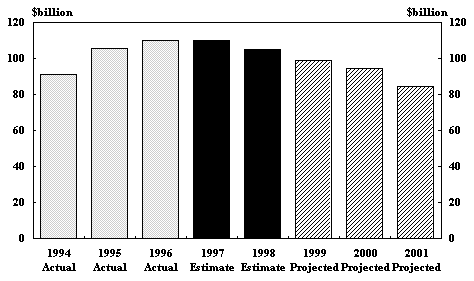
CHART 2: COMMONWEALTH GOVERNMENT SECURITIES ON ISSUE AT END-JUNE(a)(b)(c)
(b) Based on the face value of securities.
(c) Excludes Commonwealth holdings of CGS.
The estimated negative net borrowing requirement for 1997-98 implies a reduction in the stock of CGS on issue over 1997-98. At end-June 1998, the face value of CGS on issue is estimated to be around $105 billion, or around 19 per cent of GDP, compared with an estimated $110 billion and 21 per cent of GDP at end-June 1997.
Further reductions in the stock of CGS on issue are projected in the out-years. Between end-June 1998 and end-June 2001, the volume of CGS on issue is projected to fall more than $20 billion to around $84 billion, or to about 13 per cent of GDP.
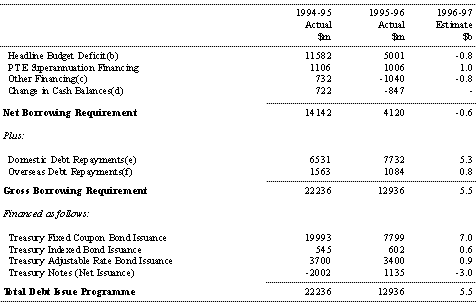
Table 1: Borrowing Requirement and Debt Issue Programme(a)
(b) Deficits increase the borrowing requirement; surpluses reduce the requirement.
(c) Includes difference between face value of securities and proceeds, net subscriptions to the IMF, proceeds and payments relating to swap transactions classified as financing transactions and other financing transactions not elsewhere identified.
(d) Change in cash balances held by the Commonwealth at the Reserve Bank. A reduction in cash balances reduces the borrowing requirement.
(e) Excludes the refinancing of Treasury Notes.
(f) $A equivalent at exchange rate at time of transaction.
The Commonwealth is expected to have a negative net borrowing requirement of $0.6 billion for 1996-97, $1.3 billion less than estimated at budget time, reflecting:
Treasury Fixed Coupon Bonds have been the main funding instrument employed by the Commonwealth in 1996-97. Ten tenders have been held, raising $7.0 billion. A new benchmark stock, a September 2009 line, was introduced in 1996-97, consistent with the objective of maintaining the length of the Commonwealth yield curve at around twelve to thirteen years.
Four tenders of Treasury Indexed Bonds have been conducted in 1996-97, raising an aggregate $622 million. In line with the Commonwealth's continuing commitment to assist the development of the domestic market for indexed securities, issuance timing and volume through the course of the year have been tailored to meet identified market demand. In October 1996, a new 2020 capital indexed stock was launched via a $250 million tender. In subsequent tenders, priority has been given to building up liquidity in the new 2020 line. However, it is planned to continue to issue also the 2015 line as demand and circumstances permit.
Consistent with the programme announced at budget time last year, a total of $900 million of Treasury Adjustable Rate Bonds (TABs) has been issued in 1996-97. Three tenders have been conducted, with all issuance being into the October 2000 line. The TABs market continued to develop steadily through the year, with investor support underpinned by the Commonwealth's practice of managing issuance in line with identified demand.
Treasury Note issuance in 1996-97, as in prior years, has been directed primarily towards meeting the within-year funding task that arises from day-to-day mismatches in the timing of outlays and revenue. The volume of Treasury Notes outstanding at end-June 1997 is expected to be around $13 billion, around $3 billion lower than at end-June 1996.
Full details of the Commonwealth's debt and portfolio management operations in 1996-97, as well as historical data on debt issuance and portfolio composition in previous years, will be presented in the Commonwealth Debt Management Report for 1996-97, which is expected to be published in September 1997.


