| |
This appendix:
In presenting budget statistics, the standards established by the Australian Bureau of Statistics (ABS) in its Government Finance Statistics: Concepts, Sources and Methods (Cat. No. 5514.0) are generally adopted. This standard draws on features of the 1968 United Nations publication A System of National Accounts (SNA) and the 1986 IMF publication A Manual on Government Finance Statistics. A revised version of the SNA standard was issued in 1993, but this has not yet been incorporated into ABS Government Finance or National Accounts statistics. The IMF standard is currently being revised.
The Commonwealth, States and Territories have an agreed framework — the Uniform Presentation Framework (UPF) — for the consistent presentation of government financial information on a GFS basis. The data provided in Appendix F are consistent with this framework.
Sectoral Classifications
As shown in Diagram 1, the Commonwealth non-financial public sector may be viewed in two ways:
Commonwealth financial enterprises, such as the Reserve Bank, are currently excluded from Commonwealth government statistics in line with ABS practice.
The term government business enterprise (GBE) is not an ABS concept but is used by the Commonwealth to describe a group of companies and authorities, located mainly in the PTE and public financial enterprise (PFE) sectors, which trade goods and/or services in the market with a prime objective of earning a commercial return. Government trading enterprises is a term used in the Council of Australian Governments context and refers to the commercial activities of the Commonwealth, States and Territories.
Diagram 1: Commonwealth Non-financial Public Sector
|
|
BUDGET CLASSIFICATION |
GFS CLASSIFICATION |
|
Commonwealth Non-financial Public Sector |
Budget Sector (eg DEETYA, DSS) |
General Government Sector (includes budget sector and non-budget general government entities) |
|
|
Non-budget Sector — Non-budget General Government Sector (eg ABC, CSIRO) |
|
|
|
— PTE Sector(eg Australia Post) |
PTE Sector (eg Australia Post) |
Commonwealth Budget Sector
Traditionally, the budget and mid-year statements have mainly presented transactions between the Commonwealth budget sector and other sectors of the economy, including transactions with non-budget Commonwealth entities. The Commonwealth budget sector consists of those departments and agencies whose day-to-day transactions are recorded in the Official Commonwealth Public Account (CPA), whether via the Consolidated Revenue Fund, Loan Fund, Commercial Activities Fund or the Reserved Money Fund.
Transactions between budget sector agencies — such as payments of fringe benefits tax, customs duty and interdepartmental charges — are identified but netted out when calculating total budget outlays or revenue. Only transactions into and out of the CPA impact on budget outlays and revenue.
Excluded from the budget sector are many Commonwealth government authorities, such as CSIRO and the ABC, that operate outside the CPA through their own bank accounts. Although they may depend on appropriations from the Commonwealth budget in some cases, they are classified as part of the non-budget sector. Budget payments to them are classified as transfers to the non-budget sector. The ABS refers to this budget/non-budget distinction as the administrative sector classification.
ABS Government Sectors
The ABS GFS provides an alternative classification which allocates government units according to their role in providing market or non-market services. This approach recognises the different organisational focus of market oriented units by separating general government units that supply mainly non-market services from PTEs and PFEs, which provide market goods and services.
This standardised classification system facilitates direct comparisons between governments in Australia and allows the impact of total government activity to be measured relative to other sectors of the economy.
PFEs are currently regarded as outside the scope of ABS GFS. However, under the UPF, historical financial enterprise statistics will be phased in by all jurisdictions once the ABS has included PFE information in the GFS (currently proposed from 1998-99). This will provide a more complete coverage of the public sector. Associated with this change is the reclassification of State central borrowing authorities to the PFE sector.
The ABS has reclassified universities from the general government sector of the relevant jurisdiction to a new multi-jurisdictional general government category. This change was introduced in the 1997-98 Government Financial Estimates (Cat. No. 5501.0) published in November 1997. The data in Appendix F and Statement 7 reflect the new classification.
Since 1989-90, effectively all budget sector activity has been classified to general government. The general government sector also includes non-commercial government agencies that operate through private sector bank accounts, such as the ABC and CSIRO (referred to as the general government non-budget sector).
Outlays, Revenue and Financing Transactions
Government sector transactions can be viewed from an economic perspective and categorised into underlying outlays, revenue, net advances and financing transactions.
Underlying outlays exclude net advances (ie net policy lending and net equity transactions) from headline outlays. Except in relation to PTEs, underlying outlays measure the net cost of providing goods and services generally allocated through collective political choice rather than through the operation of the market.
User charges are offset against relevant payments in calculating underlying outlays. The alternative treatment of classifying user charges as revenue would increase both underlying outlays and revenue and inflate the reported cost of providing public goods and services.
Revenue is the primary means of funding government activities, with any shortfall funded through borrowings or a rundown of financial assets (financing transactions). It comprises tax receipts (net of refunds) and non-tax receipts (interest, dividends etc) but excludes receipts from user charging, sale of assets and repayments of advances (loans and equity). Revenue therefore measures the value of the resources, other than borrowings, raised by a government to fund outlays.
The difference between total underlying outlays and revenue is the level of the reported underlying balance. The difference between headline outlays and revenue is the headline balance. The rationale for focussing on underlying outlays and balance measures is included in 1997-98 Budget Paper No. 1.
Financing transactions do not affect the balance and are referred to as below-the-line transactions. (Underlying outlays and revenue transactions are referred to as above-the-line transactions.) Financing transactions are undertaken to finance the deficit or invest the surplus. They consist of borrowings and changes in holdings of financial assets such as cash or investments (excluding advances).
Other Classifications
Information in the Budget Papers is also classified in the following three ways:
Consistency With External Reporting Standards
The Budget Papers have been developed to accord with public sector accounting standards and GFS concepts and methodology. The Charter of Budget Honesty requires that departures from these external reporting standards be identified.
Data consistent with GFS are provided in tables contained in Appendix F. However, the recent ABS reclassification of net advances from capital outlays to financing transactions has not been incorporated in these tables. Consequently, these tables show a separate adjustment for net advances to derive outlays and deficit estimates comparable to those provided in the ABS GFS.
The Budget Papers focus mainly on budget sector data which depart from GFS or public sector accounting standards in the following respects.
Budget sector data have been adjusted for these differences to derive the general government sector data presented in Appendix F.
Safety Net Revenues
The ABS has decided that the Commonwealth taxes introduced to replace the State franchise fees invalidated by the High Court decision on 5 August 1997 should be treated as State and Territory taxes for the purposes of GFS. This reflects the fact that the safety net arrangements represent a State and Territory tax imposed and collected by the Commonwealth at the request, and on behalf of, the States and Territories. This classification has been used in the Budget Papers. These taxes are netted out of the Commonwealth sector and attributed to the relevant State and Territory sectors. The safety net arrangements have no net impact on budget revenue apart from administrative costs. Any refunds by the States and Territories to producers or wholesalers are treated as corrective (negative tax) transactions.
Classification Changes for the 1998-99 Budget
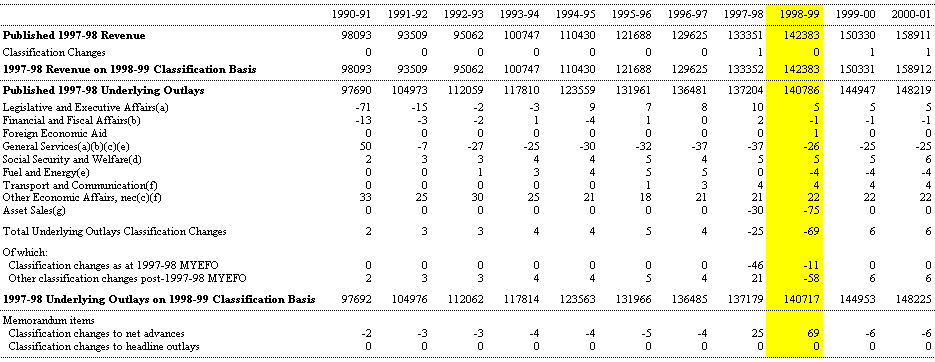
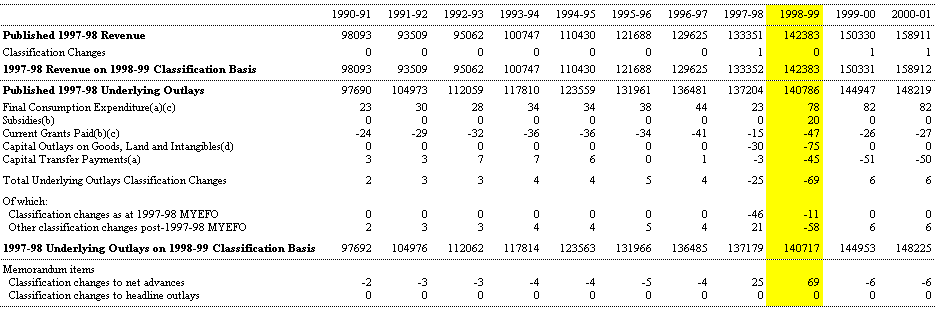
Budget classification changes can affect historical reporting. Consequently, comparisons between budget publications from different years can be misleading, and these data need to be treated with caution. All changes to the application of the functional and economic type classifications for the 1997-98 Budget are outlined in Table E1 and Table E2. As can be seen from these tables, historical data published in this document is broadly consistent with previous publications. The major changes are listed in the footnotes.
From 1 July 1998, it is proposed that payments under the AUSTUDY programme will be replaced by the Youth Allowance (for students aged under 25 years). This involves a transfer, rather than a reclassification, of outlays estimates from the Education function to the Social Security and Welfare function and therefore this transfer is not reflected in Table E1.
Table E1: Effect of Reclassification by Function since the 1997-98 Budget ($m)
(a) Comcar operations reclassified from General Services to Legislative and Executive Affairs.
(b) Australian Valuation Office operations reclassified from General Services to Financial and Fiscal Affairs.
(c) AUSLIG operations reclassified from General Services to Other Economic Affairs, nec.
(d) Refugee-assisted passage costs reclassified from Net Advances within the same function.
(e) Receipts for electricity generation on the Indian Ocean Territories reclassified from Fuel and Energy to General Services.
(f) Petroleum Products Freight Subsidy reclassified from Other Economic Affairs, nec to Transport and Communication.
(g) Asset sales reclassified from Net Advances within the same function.
Table E2: Effect of Reclassification by Economic Type since the 1997-98 Budget ($m)
(a) Payment to National System of Reserves and National Rivercare reclassified from Capital Transfer Payments to Final Consumption Expenditure, and refugee-assisted passage costs reclassified from Net Advances to Final Consumption Expenditure.
(b) Payment to Sydney Organising Committee for the Olympic Games reclassified from Current Grants Paid to Subsidies.
(c) National Vegetation Initiative reclassified from Final Consumption Expenditure to Current Grants Paid.
(d) Asset Sales reclassified from Net Advances to Capital Outlays on Goods, Land and Intangibles.
 |
 |