




Statement 4: Fiscal policy in the current economic environment (Continued)
The Government's fiscal strategy in response to medium‑term challenges
The combination of flexibility and sustainability embodied in the medium‑term fiscal strategy has helped underpin Australia's strong economic performance. Consistent with the principles underlying the strategy, the guiding imperative for this Budget is to reinforce fiscal sustainability over the medium term while limiting adverse impacts on economic growth and jobs in the near term.
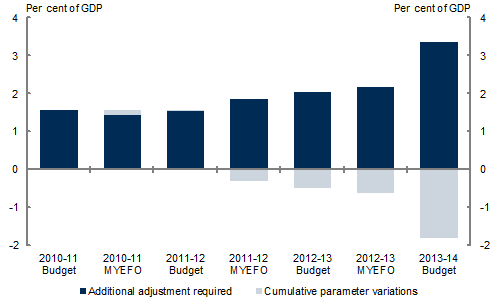
Revenue write‑downs have increased the fiscal adjustment needed to return to surplus
This task has been made harder by the revenue write‑downs outlined above. Returning to surplus by 2012‑13, as previously intended, would have required an improvement in the budget balance of at least 4.2 percentage points of GDP, relative to the deficit outcome in 2009‑10. At the time of the 2010‑11 Budget, when a surplus was first projected for 2012‑13 following the GFC, 2.2 percentage points (around half of the required adjustment) was to be achieved from the expiration of temporary stimulus measures and around 0.5 percentage points was anticipated from the unwinding of automatic stabilisers as the economy returned to full capacity.8 The implied fiscal adjustment to return to surplus, over and above the automatic impacts of the economic cycle and the unwinding of the temporary stimulus, was therefore around 1.6 per cent of GDP at the time of the 2010‑11 Budget (Chart 8).
Since the 2010‑11 Budget, parameter variations have worsened the budget balance, requiring the Government to do more to achieve the same fiscal consolidation. By the time of last year's Mid‑Year Economic and Fiscal Outlook (MYEFO), cumulative parameter variations since the 2010‑11 Budget had detracted 0.6 per cent of GDP from the budget balance for 2012‑13, with revenue write‑downs being partially offset by parameter variations to payments. This increased the fiscal adjustment required to achieve surplus in 2012‑13 from 1.6 to 2.2 per cent of GDP, with the increase representing the cumulative discretionary savings required to offset parameter variations between the 2010‑11 Budget and the 2012‑13 MYEFO. Parameter variations since MYEFO have detracted a further 1.2 per cent of GDP, increasing the adjustment required to return to budget surplus by 2012‑13 (over and above the impact of automatic stabilisers and the unwinding of temporary stimulus) to 3.4 per cent of GDP; more than double the adjustment originally anticipated.
Chart 8: Fiscal adjustment from 2009‑10 required to return to surplus in 2012‑13
Source: Treasury.
As recent parameter variations, primarily affecting the fiscal position through receipts downgrades, have increased the adjustment required to return to surplus in 2012‑13 to a size that would have a significant adverse impact on the economy, the Government has decided to defer its planned return to surplus. This decision is consistent with the Government's medium‑term fiscal strategy.
Balancing the pace of adjustment with jobs and economic growth
While the Australian economy remains strong, uneven conditions across the economy and the dampening effect of the persistently high Australian dollar have seen the unemployment rate rise moderately since mid‑2011. Although GDP growth is expected to be close to trend in 2013‑14, the transition under way in the economy is expected to see the unemployment rate rise slightly to 5¾ per cent by the June quarter of 2014. The outlook is also subject to downside risks relating to global uncertainties and the transition domestically to other sources of growth as the resources investment boom recedes.
Tax receipts write‑downs and other parameter variations since MYEFO would have required the Government to find further savings of at least 1.2 per cent of GDP to return the budget to surplus in 2012‑13. While the savings measures the Government has implemented to date have been designed to minimise adverse impacts on the economy, this becomes harder as the savings task becomes larger and the timeframe to implement becomes shorter. In the current environment, offsetting the revenue write‑downs since MYEFO for 2012‑13 would risk depressing economic growth, undermine jobs growth and place upward pressure on the unemployment rate. This could lead, in turn, to even lower revenue and increased spending on unemployment benefits, which would work against the planned improvement in the budget. In contrast, the savings measures announced in the Budget will be implemented over a timeframe that limits any drag on the economy.
Monetary policy has provided support for the economy as the Government has consolidated its fiscal position. However, as monetary policy operates with considerable lags it would not be able to offset the effects of a sharp fiscal tightening undertaken over a very short time frame. Monetary policy may also be less effective in an environment in which households and businesses have been reluctant to take on more debt and in which the exchange rate has not been responding as it normally does to reductions in domestic interest rates and the declining terms of trade.
Low debt gives us the flexibility to smooth fiscal adjustment
Australia's low level of government debt means that we retain considerable fiscal flexibility.
Although a later return to surplus means debt will be paid down more slowly than previously expected, when combined with a credible medium‑term commitment this should not have significant adverse impacts. Net debt remains low and is expected to peak at 11.4 per cent of GDP in 2014‑15. The cost of servicing new debt is also low, with bond yields currently around historically low levels.
Australia is one of only eight countries rated AAA with a stable outlook by all three major rating agencies (Chart 9). Australia's AAA rating means that the Government is assessed as having an extremely strong capacity to meet its financial commitments. Financial markets continue to view Australian government debt as very safe. Credit default swap rates on Australian government debt, which measure the cost of insuring against default, are currently close to those of major advanced economies such as the United States and Germany.
Chart 9: Sovereign debt ratings for advanced economies (Standard & Poor's)
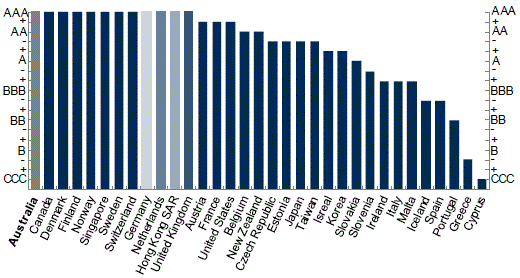
Note: Germany's rating is on negative outlook with Moody's. The Netherlands is on negative outlook with S&P, Moody's and Fitch. The UK is on negative outlook with S&P, and is rated AA+ by Fitch and AA1 by Moody's. Hong Kong is rated AA+ by Fitch and AA1 by Moody's.
Source: Bloomberg.
The relative health of Australia's fiscal position has also increased demand for Australian government securities. Foreign investors hold around 70 per cent of securities outstanding, and the partial information available suggests that a significant proportion is held by official investors, who are more likely to be stable long‑term investors.
But fiscal consolidation is still needed over the medium term
The case for phasing in fiscal adjustment in no way diminishes the importance of fiscal consolidation over the medium term.
The need for fiscal consolidation involves more than just returning the budget to surplus, although this is an important first step. The medium‑term fiscal strategy requires that sufficiently large surpluses be achieved when economic conditions are favourable to more than offset deficits that inevitably occur in adverse economic circumstances, thereby recharging fiscal buffers to allow for future fiscal stimulus if circumstances require.
When the economy is hit by adverse shocks it is appropriate for the budget to go into deficit to help moderate the impact. But this is only sustainable if fiscal policy operates symmetrically over the economic cycle. Such shocks are inherently unpredictable, but it is prudent to plan on the basis that they will occur periodically, particularly in a more volatile global environment. If we are to retain the flexibility to respond to future shocks, the government's balance sheet needs to be strengthened during good times, as the Government is doing through steps taken in this Budget.
Structural improvement to the budget over time is also important because of the longer‑term fiscal challenges arising from population ageing and growth in health costs. The Intergenerational Report 2010 highlighted that these challenges are no longer far off in the future. Ageing and health pressures have already begun to detract from the fiscal position, while Australia's potential growth rate will soon slow as a result of declining aggregate labour force participation rates. These impacts will only grow steadily over time, as a result of:
- growth in spending on age‑related pensions and aged care services owing to the ageing of the population; and
- growth in spending on health, partly reflecting pressures from ageing, but mainly owing to increasing demand for health services and the cost of new technologies.
To that end, the Budget announces a number of measures that improve the fiscal position over the medium and longer term, including measures to protect the corporate tax base from erosion and loopholes, and reforms to family payments. These measures complement long‑term savings measures already implemented over recent years to address longer‑term fiscal pressures, while making fiscal space for investments in key areas such as education and disability insurance that will deliver long lasting economic and social benefits (Box 3).
In order to shed light on the further fiscal adjustments that might be required in future, the following section presents analysis of the medium‑term outlook for fiscal sustainability under the policy settings in this Budget.
Box 3: Savings that endure
The Government's fiscal strategy includes a strong focus on the medium‑term sustainability of the budget. When making decisions, the Government considers not only the impact on the forward estimates period, but also the longer‑term budgetary effects. This Government was the first to introduce regular reporting on the medium‑term outlook in each Budget and MYEFO, reporting on the outlook for the underlying cash balance and net debt beyond the forward estimates.
Since its first budget in 2008‑09, the Government has made savings decisions that will continue to improve the budget position well beyond the end of the forward estimates. These include increasing the pension age to 67 and reforms to the private health insurance rebate and to the family payments system. These decisions help to improve the structural position of the budget and provide space for significant new priorities, including the National Plan for School Improvement and establishing DisabilityCare Australia, which will deliver long‑term economic and social benefits.
Significant new long‑term savings in this Budget include:
- the increase in the Medicare Levy to fund DisabilityCare;
- measures to protect the corporate tax base from erosion and loopholes;
- reforms to family payments to improve the sustainability of the system;
- better targeting of the research and development tax incentive;
- ensuring that tobacco excise rates keep pace with income growth;
- phasing out the poorly‑targeted net medical expenses tax offset; and
- reforms to improve the fairness, sustainability and efficiency of the superannuation system.
Without the savings made since the 2008‑09 Budget the fiscal outlook would not be as strong. The long‑term savings the Government has made in this Budget and previously mean that the budget is cumulatively better off by over $300 billion by around 2020 (Chart A).
Chart A: Long‑term savings and net debt
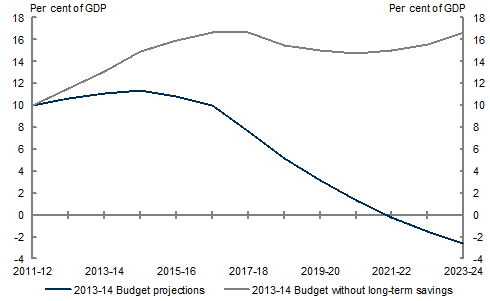
Note: To allow comparison with this Budget's medium‑term projections, only the part of the savings from 2012‑13 onwards is included (for instance, a measure from the 2008‑09 Budget only contributes to the savings projection from 2012‑13 onwards).
Source: Treasury.
Long‑term fiscal sustainability is also assisted by policies that increase long‑term growth in the economy. In this Budget the Government has funded the National Plan for School Improvement, which will help to lift productivity and participation by investing in our people. The Budget also provides funding for high‑quality infrastructure projects to improve productivity, building on previous investments such as the National Broadband Network. And this Budget funds DisabilityCare Australia that, in addition to providing a fairer system for Australians with disability, will enhance their opportunities for social and economic participation.
8 The 2009‑10 budget deficit was forecast at the 2010‑11 Budget to be 4.4 per cent of GDP. However, as the required adjustment depends on the outcome for 2009‑10, the difference between the forecast and the outcome is ignored for the purpose of this analysis.
Note: Where possible, Budget documents are available in HTML and for downloading in Portable Document Format(PDF). If you require further information on any of the tables or charts on this website, please contact The Treasury.