




Appendix B: Australian Government Financial Statements (Continued)
Financial reporting standards and budget concepts
The Charter of Budget Honesty Act 1998 (the Charter) requires the Mid‑Year Economic and Fiscal Outlook (MYEFO) to be based on external reporting standards.
The Government has produced a single set of financial statements that comply with both ABS GFS and AAS, meeting the requirement of the Charter, with departures disclosed. The financial statements for the Mid‑Year Economic and Fiscal Outlook 2013‑14 have been prepared on a basis consistent with the 2013‑14 Budget. The statements reflect the Government's accounting policy that ABS GFS remains the basis of budget accounting policy, except where the Government applies AAS because it provides a better conceptual basis for presenting information of relevance to users of public sector financial reports.
AASB 1049 and the Uniform Presentation Framework (UPF) also provide a basis for reporting of the public non‑financial corporations (PNFC) and public financial corporations (PFC) sectors and the total non‑financial public sector (NFPS).
General Government Sector Financial Reporting (AASB 1049)
The MYEFO primarily focuses on the financial performance and position of the general government sector (GGS). The ABS defines the GGS as providing public services which are mainly non‑market in nature, mainly for the collective consumption of the community, involving the transfer or redistribution of income and financed mainly through taxes and other compulsory levies. AASB 1049 recognises the GGS as a reporting entity.
AASB 1049 history and conceptual framework
The Australian Accounting Standards Board (AASB) released AASB 1049 for application from the 2008‑09 financial year. AASB 1049 seeks to 'harmonise' ABS GFS and AAS.
The reporting framework for AASB 1049 requires the preparation of accrual‑based general purpose financial reports, showing government assets, liabilities, revenue, expenses and cash flows. GGS reporting under AASB 1049 aims to provide users with information about the stewardship of each government in relation to its GGS and accountability for the resources entrusted to it; information about the financial position, performance and cash flows of each government's GGS; and information that facilitates assessments of the macroeconomic impact. While AASB 1049 provides a basis for whole‑of‑government and GGS outcome reporting (including the PNFC and PFC sectors), budget reporting focuses on the GGS.
There are three main general purpose statements that must be prepared in accordance with ABS GFS and AASB 1049. These are:
- an operating statement, including other economic flows, which shows net operating balance and net lending/borrowing (fiscal balance);
- to allow the presentation of a single set of financial statements in accordance with AASB 1049, the ABS GFS statement of other economic flows has been incorporated into the operating statement;
- a balance sheet, which also shows net worth, net financial worth, net financial liabilities and net debt; and
- a cash flow statement, which includes the calculation of the underlying cash balance.
In addition to these general purpose statements, notes to the financial statements are required. These notes include a summary of accounting policies, disaggregated information and other disclosures required by AAS. A full set of notes and other disclosures required by AAS are included in the annual Consolidated Financial Statements.
All financial data presented in the financial statements are recorded as either stocks (assets and liabilities) or flows (classified as either transactions or other economic flows). Transactions result from a mutually agreed interaction between economic entities. Despite their compulsory nature, taxes are transactions deemed to occur by mutual agreement between the government and the taxpayer. Transactions that increase or decrease net worth (assets less liabilities) are reported as revenues and expenses respectively in the operating statement.1
A change to the value or volume of an asset or liability that does not result from a transaction is an 'other economic flow'. This can include changes in values from market prices, most actuarial valuations and exchange rates, and changes in volumes from discoveries, depletion and destruction. All other economic flows are reported in the operating statement.
Consistent with the ABS GFS framework, and in general AAS, the financial statements record flows in the period in which they occur. As a result, prior period outcomes may be revised for classification changes relating to information that could reasonably have been expected to be known in the past, is material in at least one of the affected periods and can be reliably assigned to the relevant period(s).
Operating statement
The operating statement presents details of transactions in revenues, expenses, the net acquisition of non‑financial assets (net capital investment) and other economic flows for an accounting period.
Revenues arise from transactions that increase net worth and expenses arise from transactions that decrease net worth. Revenues less expenses gives the net operating balance. The net operating balance is similar to the National Accounts concept of government saving plus capital transfers.
The net acquisition of non‑financial assets (net capital investment) measures the change in the Australian Government's stock of non‑financial assets owing to transactions. As such, it measures the net effect of purchases, sales and consumption (for example, depreciation of fixed assets and use of inventory) of non‑financial assets during an accounting period.
Net acquisition of non‑financial assets equals gross fixed capital formation, less depreciation, plus changes (investment) in inventories, plus other transactions in non‑financial assets.
Other economic flows are presented in the operating statement and outline changes in net worth that are driven by economic flows other than revenues and expenses. Revenues, expenses and other economic flows sum to the total change in net worth during a period. The majority of other economic flows for the Australian Government GGS arise from price movements in its assets and liabilities.
Fiscal balance
The fiscal balance (or net lending/borrowing) is the net operating balance less net capital investment. Thus, the fiscal balance includes the impact of net expenditure (effectively purchases less sales) on non‑financial assets rather than consumption (depreciation) of non‑financial assets.2
The fiscal balance measures the Australian Government's investment‑saving balance. It measures in accrual terms the gap between government savings plus net capital transfers, and investment in non‑financial assets. As such, it approximates the contribution of the Australian Government GGS to the balance on the current account in the balance of payments.
Balance sheet
The balance sheet shows stocks of assets, liabilities and net worth. In accordance with the UPF, net debt, net financial worth and net financial liabilities are also reported in the balance sheet.
Net worth
The net worth of the GGS, PNFC and PFC sectors is defined as assets less liabilities. This differs from the ABS GFS definition for the PNFC and PFC sectors, where net worth is defined as assets less liabilities less shares and other contributed capital. Net worth is an economic measure of wealth, reflecting the Australian Government's contribution to the wealth of Australia.
Net financial worth
Net financial worth measures a government's net holdings of financial assets. It is calculated from the balance sheet as financial assets minus liabilities. This differs from the ABS GFS definition of net financial worth for the PNFC and PFC sectors, defined as financial assets, less liabilities, less shares, less other contributed capital. Net financial worth is a broader measure than net debt, in that it incorporates provisions made (such as superannuation) as well as holdings of equity. Net financial worth includes all classes of financial assets and all liabilities, only some of which are included in net debt. As non‑financial assets are excluded from net financial worth, this is a narrower measure than net worth. However, it avoids the concerns inherent with the net worth measure relating to the valuation of non‑financial assets and their availability to offset liabilities.
Net financial liabilities
Net financial liabilities comprises total liabilities less financial assets but excludes equity investments in the other sectors of the jurisdiction. Net financial liabilities is a more accurate indicator than net debt of a jurisdiction's fiscal position as it includes substantial non‑debt liabilities such as accrued superannuation and long service leave entitlements. Excluding the net worth of other sectors of government results in a purer measure of financial worth than net financial worth, as, in general, the net worth of other sectors of government, in particular the PNFC sector, is backed up by physical assets.
Net debt
Net debt is the sum of selected financial liabilities (deposits held, advances received, government securities, loans and other borrowing) less the sum of selected financial assets3 (cash and deposits, advances paid, and investments, loans and placements). This includes financial assets held by the Future Fund which are invested in these asset classes, including term deposits and investments in collective investment vehicles. Net debt does not include superannuation related liabilities. Net debt is a common measure of the strength of a government's financial position. High levels of net debt impose a call on future revenue flows to service that debt.
Cash flow statement
The cash flow statement identifies how cash is generated and applied in a single accounting period. The cash flow statement reflects a cash basis of recording (rather than an accrual basis) where information is derived indirectly from underlying accrual transactions and movements in balances. This, in effect, means that transactions are captured when cash is received or when cash payments are made. Cash transactions are specifically identified because cash management is considered an integral function of accrual budgeting.
Underlying cash balance
The underlying cash balance plus net Future Fund earnings (ABS GFS cash surplus/deficit) is the cash counterpart of the fiscal balance, reflecting the Australian Government's cash investment‑saving balance. For the GGS, the underlying cash balance is calculated as shown below:
Net cash flows from operating activities
plus
Net cash flows from investments in non‑financial assets
less
Net acquisitions of assets acquired under finance leases and similar arrangements4
equals
ABS GFS cash surplus/deficit
less
Net Future Fund earnings
equals
Underlying cash balance
The Government has excluded net Future Fund earnings from the calculations of the underlying cash balance. Prior to the 2012‑13 MYEFO, the underlying cash balance only excluded the gross earnings of the Future Fund. Under the Future Fund Act 2006, earnings are required to be reinvested to meet the Government's future public sector superannuation liabilities. The Future Fund becomes available to meet the Government's superannuation liabilities from 2020.
In contrast, net Future Fund earnings are included in the fiscal balance because superannuation expenses relating to future cash payments are recorded in the fiscal balance.
Net Future Fund earnings are separately identified in the Australian Government GGS cash flow statement in Table B3 of this statement and related tables in Part 3 and Appendix D.
Headline cash balance
The headline cash balance is calculated by adding net cash flows from investments in financial assets for policy purposes and net Future Fund earnings to the underlying cash balance.
Cash flows from investments in financial assets for policy purposes include equity transactions and net advances.5 Equity transactions include equity injections into controlled businesses and privatisations of government businesses. Net advances include net loans to the States, net loans to students under the Higher Education Loan Program (HELP), and contributions to international organisations that increase the Australian Government's financial assets.
Sectoral classifications
To assist in analysing the public sector, data is presented by institutional sector as shown in Figure B1. ABS GFS defines the GGS and the PNFC and PFC sectors. AASB 1049 has also adopted this sectoral reporting.
Figure B1: Institutional structure of the public sector
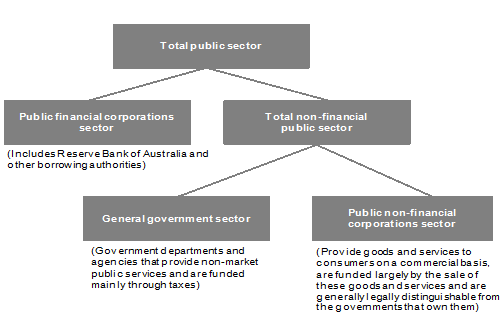
Table B10: Entities within the sectoral classifications
| General government sector entities |
|---|
Agriculture PortfolioAustralian Fisheries Management Authority, Australian Pesticides and Veterinary Medicines Authority, Cotton Research and Development Corporation, Department of Agriculture, Fisheries Research and Development Corporation, Grains Research and Development Corporation, Grape and Wine Research and Development Corporation, Rural Industries Research and Development Corporation, Wine Australia Corporation |
Attorney‑General's PortfolioAdministrative Appeals Tribunal, Attorney‑General's Department, Australia Business Arts Foundation Ltd, Australian Commission for Law Enforcement Integrity, Australia Council, Australian Crime Commission, Australian Federal Police, Australian Film, Television and Radio School, Australian Financial Security Authority, Australian Human Rights Commission, Australian Institute of Criminology, Australian Law Reform Commission, Australian National Maritime Museum, Australian Security Intelligence Organisation, Australian Transaction Reports and Analysis Centre, Bundanon Trust, CrimTrac Agency, Family Court and Federal Circuit Court, Federal Court of Australia, High Court of Australia, National Archives of Australia, National Film and Sound Archive of Australia, National Gallery of Australia, National Library of Australia, National Museum of Australia, National Native Title Tribunal, National Portrait Gallery of Australia, Office of the Australian Information Commissioner, Office of the Director of Public Prosecutions, Office of Parliamentary Counsel, Old Parliament House, Screen Australia |
Communications PortfolioAustralian Broadcasting Corporation, Australian Communications and Media Authority, Department of Communications, Special Broadcasting Service Corporation, Telecommunications Universal Service Management Agency |
Defence PortfolioAAF Company, Army and Air Force Canteen Service, Australian Military Forces Relief Trust Fund, Australian Strategic Policy Institute Limited, Australian War Memorial, Defence Housing Australia, Defence Materiel Organisation, Department of Defence, Department of Veterans' Affairs, RAAF Welfare Recreational Company, Royal Australian Air Force Veterans' Residences Trust Fund, Royal Australian Air Force Welfare Trust Fund, Royal Australian Navy Central Canteens Board, Royal Australian Navy Relief Trust Fund |
Education PortfolioAustralian Curriculum, Assessment and Reporting Authority, Australian Institute for Teaching and School Leadership Limited, Australian Research Council, Department of Education, Tertiary Education Quality and Standards Agency |
Employment PortfolioAsbestos Safety and Eradication Agency, Comcare, Department of Employment, Fair Work Commission, Office of the Fair Work Building Industry Inspectorate (Fair Work Building and Construction), Office of the Fair Work Ombudsman, Safe Work Australia, Seafarers Safety, Rehabilitation and Compensation Authority (Seacare Authority), Workplace Gender Equality Agency |
Environment PortfolioBureau of Meteorology, Clean Energy Regulator, Climate Change Authority, Department of Environment, Director of National Parks, Great Barrier Reef Marine Park Authority, Low Carbon Australia Limited, Murray‑Darling Basin Authority, National Water Commission, Sydney Harbour Federation Trust |
Finance PortfolioAustralian Electoral Commission, Commonwealth Superannuation Corporation, ComSuper, Department of Finance, Future Fund Management Agency |
Foreign Affairs and Trade PortfolioAustralian Centre for International Agricultural Research, Australian Secret Intelligence Service, Australian Trade Commission, Department of Foreign Affairs and Trade, Export Finance and Insurance Corporation National Interest Account, Tourism Australia |
Health PortfolioAustralian Commission on Safety and Quality in Health Care, Australian Institute of Health and Welfare, Australian National Preventative Health Agency, Australian Organ and Tissue Donation and Transplantation Authority, Australian Radiation Protection and Nuclear Safety Agency, Australian Sports Anti‑Doping Authority, Australian Sports Commission, Australian Sports Foundation Limited, Cancer Australia, Department of Health, Food Standards Australia New Zealand, General Practice Education and Training Limited, Health Workforce Australia, Independent Hospital Pricing Authority, National Blood Authority, National Health Funding Body, National Health and Medical Research Council, National Health Performance Authority, National Mental Health Commission, Private Health Insurance Administration Council, Private Health Insurance Ombudsman, Professional Services Review |
Immigration and Border Protection PortfolioAustralian Customs and Border Protection Service, Department of Immigration and Border Protection, Migration Review Tribunal and Refugee Review Tribunal |
Industry PortfolioAustralian Institute of Marine Science, Australian Nuclear Science and Technology Organisation, Australian Renewable Energy Agency, Australian Skills Quality Authority (National Vocational Education and Training Regulator), Commonwealth Scientific and Industrial Research Organisation, Department of Industry, Geoscience Australia, IIF Investments Pty Limited, IP Australia, National Offshore Petroleum Safety and Environmental Management Authority |
Infrastructure and Regional Development PortfolioAustralian Maritime Safety Authority, Australian Transport Safety Bureau, Civil Aviation Safety Authority, Department of Infrastructure and Regional Development, National Capital Authority, National Transport Commission |
Prime Minister and Cabinet PortfolioAboriginal Hostels Limited, Anindilyakwa Land Council, Australian Institute of Aboriginal and Torres Strait Islander Studies, Australian National Audit Office, Australian Public Service Commission, Central Land Council, Department of the Prime Minister and Cabinet, Indigenous Business Australia, Indigenous Land Corporation, National Australia Day Council Limited, Northern Land Council, Office of the Commonwealth Ombudsman, Office of the Inspector‑General of Intelligence and Security, Office of National Assessments, Office of the Official Secretary to the Governor‑General, Outback Stores Pty Ltd, Tiwi Land Council, Torres Strait Regional Authority, Wreck Bay Aboriginal Community Council |
Social Services PortfolioAged Care Standards and Accreditation Agency Ltd, Australian Institute of Family Studies, Department of Human Services, Department of Social Services, National Disability Insurance Agency |
Treasury PortfolioAustralian Bureau of Statistics, Australian Competition and Consumer Commission, Australian Office of Financial Management, Australian Prudential Regulation Authority, Australian Securities and Investments Commission, Australian Taxation Office, Clean Energy Finance Corporation, Commonwealth Grants Commission, Corporations and Markets Advisory Committee, Department of the Treasury, Inspector‑General of Taxation, National Competition Council, Office of the Auditing and Assurance Standards Board, Office of the Australian Accounting Standards Board, Productivity Commission, Royal Australian Mint |
Parliamentary DepartmentsDepartment of Parliamentary Services, Department of the House of Representatives, Department of the Senate, Parliamentary Budget Office |
| Public financial corporations |
Employment PortfolioCoal Mining Industry (Long Service Leave Funding) Corporation |
Finance and PortfolioMedibank Private Ltd |
Foreign Affairs and Trade PortfolioExport Finance and Insurance Corporation |
Treasury PortfolioAustralia Reinsurance Pool Corporation, Reserve Bank of Australia |
| Public non‑financial corporations |
Attorney‑General's PortfolioAustralian Government Solicitor |
Communications PortfolioAustralian Postal Corporation, NBN Co Ltd |
Finance PortfolioAlbury‑Wodonga Development Corporation, ASC Pty Ltd, Australian River Co. Ltd |
Infrastructure and Regional Development PortfolioAirservices Australia, Australian Rail Track Corporation Ltd, Moorebank Intermodal Company Ltd |
Prime Minister and Cabinet PortfolioVoyages Indigenous Tourism Australia Pty Ltd |
Social Services PortfolioAustralian Hearing Services |
Differences between ABS GFS and AAS framework
AASB 1049 has adopted the AAS conceptual framework and principles for the recognition of assets, liabilities, revenues and expenses and their presentation, measurement and disclosure. In addition, AASB 1049 has broadly adopted the ABS GFS conceptual framework for presenting government financial statements. In particular, AASB 1049 requires the GGS to prepare a separate set of financial statements, over‑riding AASB 127 Consolidated and Separate Financial Statements. AASB 1049 also follows ABS GFS by requiring changes in net worth to be split into either transactions or 'other economic flows' and for this to be presented in a single operating statement. AASB 1049 is therefore broadly consistent with international statistical standards and the International Monetary Fund's (IMF) Government Finance Statistics Manual 2001.6
Some of the major differences between AAS and the ABS GFS treatments of transactions are outlined in Table B11. Further information on the differences between the two systems is provided in the ABS publication Australian System of Government Finance Statistics: Concepts, Sources and Methods, 2005 (cat. no. 5514.0).
Table B11: Major differences between AAS and ABS GFS
| Issue | AAS treatment | ABS GFS treatment | Treatment adopted |
|---|---|---|---|
| Acquisition of defence weapons platforms (DWP) | Treated as capital expenditure. DWP appear as a non‑financial asset on the balance sheet. Depreciation expense on assets is recorded in the operating statement. AASB 1049 requires cost to be used where fair value of the assets cannot be reliably measured. | ABS has updated its treatment in its GFS reports to record DWP as a non‑financial asset on a market value basis. This represents an early adoption of changes to the System of National Accounts. | AAS |
| Circulating coins — seigniorage | The profit between the cost and sale of circulating coins (seigniorage) is treated as revenue. | Circulating coin is treated as a liability, and the cost of producing the coins is treated as an expense. | AAS |
| Provisions for bad and doubtful debts | Reported in the balance sheet as an offset to assets. Under AASB 1049, it is included in the operating statement as other economic flows. | Creating provisions for bad and doubtful debts is not considered an economic event and is therefore not considered to be an expense or reflected in the balance sheet. | AAS |
| Advances to the International Development Association and Asian Development Fund | Recorded at fair value in the balance sheet. | Recorded at nominal value in balance sheet. | ABS GFS |
| Concessional loans | Discounts concessional loans by a market rate of a similar instrument. | Does not discount concessional loans as no secondary market is considered to exist. | AAS |
| Investment in other public sector entities | Valued at fair value in the balance sheet as long as it can be reliably measured, otherwise net assets is permissible. | Unlisted entities valued based on their net assets in the balance sheet. | AAS |
| Provision for restoration, decommissioning and make‑good | Included in the fiscal balance capital adjustment. | Excluded from the calculation of net lending capital adjustment. | AAS |
| Renewable Energy Certificates (RECs) | The issuance and registration of such certificates are considered to be an administrative function and does not result in the recognition of an asset or liability and therefore no revenue or expense is recognised. | The issuance and registration of such certificates are considered to be government financial transactions resulting in the recognition of assets, liabilities, revenue and expenses. | AAS |
| Carbon tax | The issuance and surrender of free carbon units and ACCUs used in the settlement of emissions liabilities are not recognised. | This issuance and surrender of free carbon units and ACCUs used in the settlement of emissions' liabilities are treated as expenses and revenues respectively. | ABS GFS |
| Dividends paid by public corporations | Treated as an equity distribution. Equity distributions are treated as a distribution of profits, as opposed to an expense. | Dividends are treated as an expense. | ABS GFS |
| Commercial tax effect accounting assets and liabilities | Corporations in the PNFC and PFC sectors record tax expenses on a commercial basis. | Deferred tax assets and liabilities are reversed so that corporations record tax expenses on a consistent basis to the Australian Taxation Office. | ABS GFS |
| Fiscal aggregates differences | |||
| Finance leases | Does not deduct finance leases in the derivation of the cash surplus/deficit. | Deducts finance leases in the derivation of the cash surplus/deficit. | Both are disclosed |
| Net worth of PNFC and PFC sectors | Calculated as assets less liabilities. | Calculated as assets less liabilities less shares and other contributed capital. | AAS |
| Classification difference | |||
| Prepayments | Treated as a non‑financial asset. | Treated as a financial asset. | ABS GFS |
| Spectrum sales | Recognise non‑financial asset sales for fiscal balance when licences are transferred, which may be after the auction of licences, as this is regarded as the point control is transferred. Recognise cash at the time of receipt. | Recognise non‑financial asset sales for fiscal balance at time of auction as this is regarded as the point control is transferred. Recognise cash at the time of receipt | AAS |
1 Not all transactions impact on net worth. For example, transactions in financial assets and liabilities do not impact on net worth as they represent the swapping of assets and liabilities on the balance sheet.
2 The net operating balance includes consumption of non-financial assets because depreciation is an expense. Depreciation also forms part of net capital investment, which (in the calculation of fiscal balance) offsets the inclusion of depreciation in the net operating balance.
3 Financial assets are defined as cash, an equity instrument of another entity, a contractual right to receive cash or financial asset, and a contract that will or may be settled in the entity's own equity instruments.
4 The underlying cash balance treats the acquisition and disposal of non-financial assets in the same manner regardless of whether they occur by purchase/sale or finance lease —acquisitions reduce the underlying cash balance and disposals increase the underlying cash balance. However, finance leases do not generate cash flows at the time of acquisition or disposal equivalent to the value of the asset. As such, net acquisitions of assets under finance leases are not shown in the body of the cash flow statement but are reported as a supplementary item for the calculation of the underlying cash balance.
5 Cash flows from investments in financial assets for policy purposes were called net advances under the cash budgeting framework.
6 Additional information on the Australian accrual GFS framework is available in the ABS publication Australian System of Government Finance Statistics: Concepts, Sources and Methods, 2005 (cat. no. 5514.0).
Note: Where possible, Budget documents are available in HTML and for downloading in Portable Document Format(PDF). If you require further information on any of the tables or charts on this website, please contact The Treasury.