Living within our means
Ensuring that the Government lives within its means
Respecting future taxpayers
This Budget ensures fiscal sustainability and economic growth for the next generation
Meeting our everyday expenses
Australians know that while it can be wise to borrow for investment, it is generally not a good idea to borrow to meet everyday expenses.
This is the difference between ‘good debt’ and ‘bad debt’.
Since the Global Financial Crisis, Australian governments have been borrowing to meet everyday expenses like welfare and health.
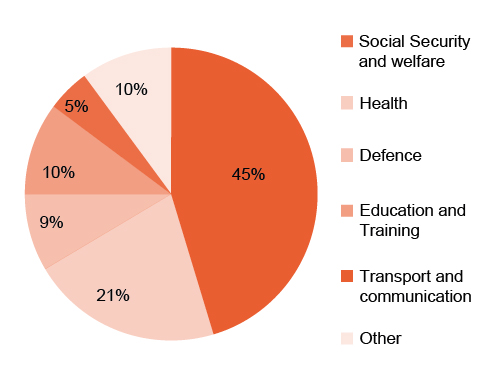
More than 75 per cent of the growth in our debt since then has been raised to pay for welfare (45 per cent), health (21 per cent) and education (10 per cent).
This means we have been borrowing for a decade to pay for everyday expenses. Putting these on the national credit card, is not sustainable.
Everyday expenditures like welfare and health should be funded from the taxes and other revenues we collect each year, not by debt.
This does not mean those expenditures are high or low quality, just that they should be paid for when they are received or consumed.
To not do so is unfair to future taxpayers. They are being asked to pay for benefits and services that were being consumed long before they probably even started paying taxes.
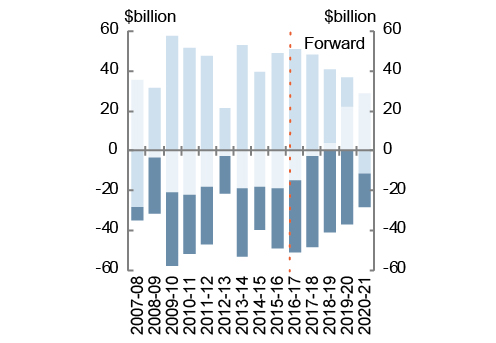
The net operating balance, given more emphasis in this year’s budget, only takes account of these recurrent expenditures and shows the Budget returning to surplus a year earlier in 2019-20.
However, when you take out infrastructure grants to the States and Territories, which support their net operating balance, and remove other non-cash accounting items, we get another result.
This shows that the Government will no longer be borrowing to pay for recurrent activities from 2018-19.
This is good news for future taxpayers, as the Government will soon be living within its means.
Medium-term fiscal projections
The Government is making progress in meeting its fiscal strategy. Despite the reversal of a number of savings measures, the Budget is projected to return to balance in 2020-21 and remain in surplus over the medium term.
The underlying cash balance is projected to reach 0.5 per cent of GDP in 2026-27, an improvement of 0.1 per cent of GDP relative to the 2016-17 MYEFO.
Government debt is also projected to fall as a share of the economy. Net debt is projected to peak at 19.8 per cent of GDP in 2018-19, before falling to 8.5 per cent in 2027-28. Gross debt is projected to fall from 30.7 per cent of GDP in 2018-19 to 24.2 per cent of GDP in 2027-28.
The Future Fund
The Government has decided to continue to build the assets of the Future Fund to benefit successive generations of Australians.
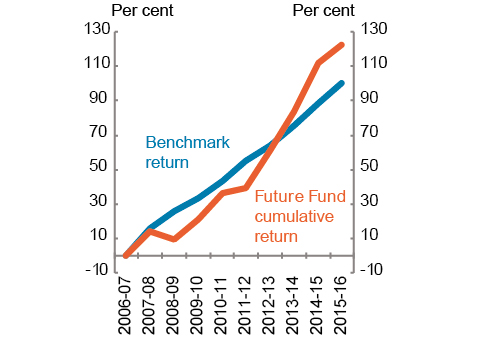
The Future Fund was established in 2006 to accumulate financial assets on behalf of the Australian Government to meet the Government’s unfunded superannuation liability.
Since the initial contributions of $60.5 billion to the Future Fund, the average return has been 7.7 per cent per annum. The Future Fund has since more than doubled its worth to $130 billion as at 31 March 2017.
The Government’s decision to delay drawdowns from the Future Fund will allow it to build its assets to fully cover the Government’s superannuation liabilities. This will help ensure that future generations of Australians are not burdened with the debt of predecessors.
Investing for the future
Well-selected infrastructure investment can improve productivity and increase economic growth and lead to better paying jobs.
The Government has committed to invest additional equity of $8.4 billion into Australian Rail Track Corporation to deliver the Melbourne to Brisbane Inland Rail project. It has also committed to establish WSA Co to develop Western Sydney Airport. The Government is making an equity investment of up to $5.3 billion in WSA Co.