
Budget overview
This Budget is the next stage in the Government's economic plan, building on commitments from the 2016-17 Budget and the 2016 election.
A responsible and fairer path to a balanced Budget
Taking action to lower the deficit and growth of debt
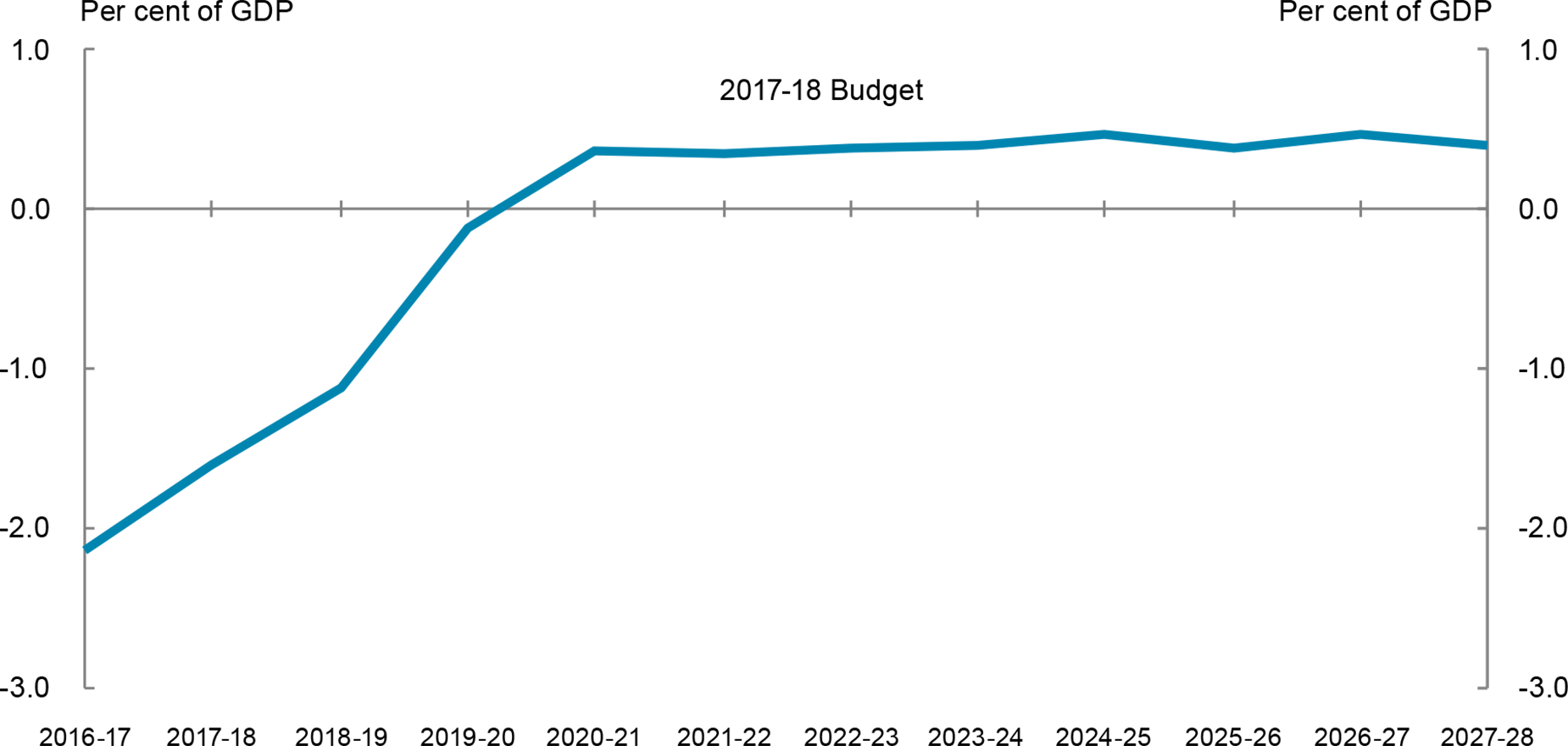
This Budget, once again, demonstrates the Government’s fiscal discipline. The bottom line is projected to return to balance in 2020-21 and remain in surplus over the medium term.
The underlying cash balance is expected to improve from a deficit of 1.6 per cent of GDP in 2017-18 to a projected surplus of 0.4 per cent of GDP in 2020-21.
This is an improvement to the bottom line of $11.4 billion over the four years from 2017-18 to 2020-21 relative to the 2016-17 MYEFO.
This Budget guarantees the essential services that Australians rely on, especially our most vulnerable, by guaranteeing important services like Medicare, fully funding the National Disability Insurance Scheme and delivering fairer and more transparent funding for students.
The projected return to surplus comes despite considerable obstruction.
The Parliament’s decision to reject previous savings measures has put great pressure on the bottom line, costing taxpayers more than $13 billion over the forward estimates period.
However, the Government has refused to walk away from its budget task.
The reversal of the savings measures has been offset by new budget repair measures with the underlying cash balance returning to balance in 2020-21.
All new spending has been offset by policy decisions.
Real growth in payments has been restricted to 1.9 per cent, in line with the 2016-17 MYEFO.
Government payments are also forecast to fall to 25 per cent of GDP in 2020-21, returning close to the 30 year historical average.
Continuing to keep a tight rein on expenditure will create space to lower the tax burden over time and underpins the strength of the Commonwealth’s balance sheet.
A strong balance sheet provides the Government with the flexibility to continue to respond to unanticipated events during economic shocks and continue investing in building Australia.
Net debt as a share of GDP is expected to peak in 2018-19 before declining over the remainder of the forward estimates.
The choices made in this Budget mean that net debt is projected to fall to 8.5 per cent of GDP over the next decade.
Also, the Government will not need to borrow to pay for its everyday expenses from 2018-19. This would be the first time since the Global Financial Crisis that this has been the case.

Making the right choices to secure better days ahead
 A plan for more and better paying jobs
- Lower and more competitive taxes for Australian businesses
- Extending the $20,000 instant asset write-off for businesses with annual turnover less than $10 million
- Cutting red tape for small businesses
- Investing in skilling Australians for Australian jobs
- Investing in nation building infrastructure
- Investing in growing our regions
 Guaranteeing essential services
- Establishing the Medicare Guarantee Fund
- Providing affordable access to medicines
- Ensuring the National Disability Insurance Scheme is fully funded
- Ensuring fairer funding for students
- Valuing higher education
- Defending Australia
- Keeping Australians safe
- Protecting our tax base to help sustainably fund essential services
 Downward pressure on cost of living
- Improving Australians’ access to secure and affordable housing across the housing spectrum
- Helping first home buyers save for a deposit
- Reducing barriers to downsizing
- Delivering more affordable, accessible and flexible child care
- Ensuring the reliability, affordability and sustainability of our energy supply
- A fairer and more accountable banking system
 Living within our means
- Keeping Australia on track for a return to budget balance by 2020-21
- Cracking down on multinationals
- Exposing the black economy
- Improving tax integrity
- Improving welfare integrity
- Reducing welfare dependency
- Extending income management